
The Sustainability of U.S. Clean Energy Jobs: Navigating Policy Risks and Market Resilience
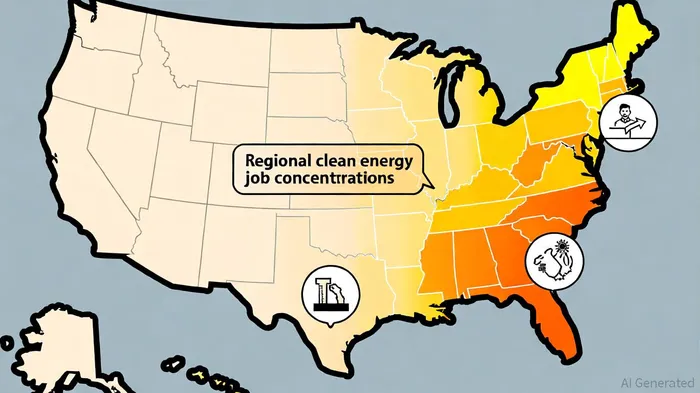
The U.S. clean energy sector has emerged as a formidable engine of job creation, yet its long-term sustainability hinges on a delicate balance between policy stability and market-driven resilience. According to a report by Electrek, U.S. clean energy jobs surged to 3.56 million in 2024, expanding at a rate three times faster than the overall economy in the same year [2]. This growth, however, masks underlying vulnerabilities tied to political uncertainty and shifting economic conditions. For investors, understanding the interplay between policy risks and market adaptability is critical to assessing the sector's future trajectory.
Policy Risks: The Shadow of Uncertainty
The slowdown in 2024—adding 50,000 fewer jobs than in 2023—was attributed to policy uncertainty and a cooling economy [2]. This raises concerns about the sector's dependence on federal incentives, particularly the Inflation Reduction Act (IRA), which catalyzed $80 billion in clean energy investment in 2024 alone [2]. A report by Reuters warns that potential shifts in administration priorities, such as those under a Trump-led policy agenda, could undermine this momentum by scaling back subsidies or regulatory support [3]. For instance, wind power production, concentrated in the Great Plains and Midwest, faces risks if federal tax credits for renewables are not extended [3]. Similarly, solar sector growth, driven by declining costs and state-level incentives, could stall without consistent policy frameworks [3].
The IRA's success in leveraging public investment—where every $1 of federal spending stimulated $5–$6 of private capital [4]—highlights the sector's reliance on policy continuity. Yet, this also exposes it to abrupt reversals. Investors must weigh the likelihood of sustained legislative support against the potential for abrupt policy shifts, particularly in an election year.
Market Resilience: Diversification and Private Investment
Despite these risks, the clean energy sector exhibits remarkable resilience. Energy efficiency remains the largest employer, with 2.4 million jobs, while renewable generation and clean vehicle sectors added 569,000 and 398,000 jobs, respectively [2]. This diversification across subsectors—solar, wind, batteries, and grid infrastructure—reduces overreliance on any single technology or policy. Moreover, private investment has surged, with 45 new or expanded manufacturing facilities for batteries, EVs, and solar energy coming online in 2024 [2].
Regional dynamics further bolster resilience. The South, home to over 1 million clean energy jobs, and states like Texas, California, and Idaho—where growth rates hit 7.7%—demonstrate the sector's geographic spread [2]. Notably, 23 states now have at least 50,000 clean energy jobs, and in all but eight states, these jobs outnumber fossil fuel employment [2]. This decentralization mitigates regional economic shocks and aligns with local policy incentives, such as Texas's $20 billion in clean energy investment [2].
Conclusion: A Dual-Track Strategy for Investors
The U.S. clean energy sector's sustainability depends on a dual-track approach: advocating for stable, long-term policies while capitalizing on market-driven innovation. While the IRA has proven its ability to amplify private investment, investors must remain vigilant about political risks. Diversifying portfolios across subsectors and geographies—particularly in regions with robust policy frameworks—can mitigate these risks.
For now, the data suggests that clean energy jobs will continue to outpace the broader economy, even amid headwinds. As the Department of Energy notes, understanding the distribution of these jobs is essential for effective policy planning and workforce development [3]. For investors, this means not only supporting the transition to a low-carbon economy but also ensuring that their strategies account for both the opportunities and vulnerabilities inherent in this dynamic sector.







Comentarios
Aún no hay comentarios