
Sunstone Hotel Investors' $1.35 Billion Credit Facility Restructuring: A Strategic Response to Sector Turbulence
The recent restructuring of SunstoneSHO-- Hotel Investors' $1.35 billion credit facility represents a pivotal moment in the company's efforts to navigate the volatile post-pandemic hospitality real estate investment trust (REIT) landscape. By extending debt maturities, consolidating obligations, and optimizing leverage-dependent pricing, the firm has sought to insulate itself from sector-specific risks while enhancing financial flexibility. This move must be understood in the context of a broader industry grappling with rising operational costs, shifting demand patterns, and the lingering effects of economic uncertainty.
Capital Structure Optimization: A Prudent Defense Against Liquidity Pressures
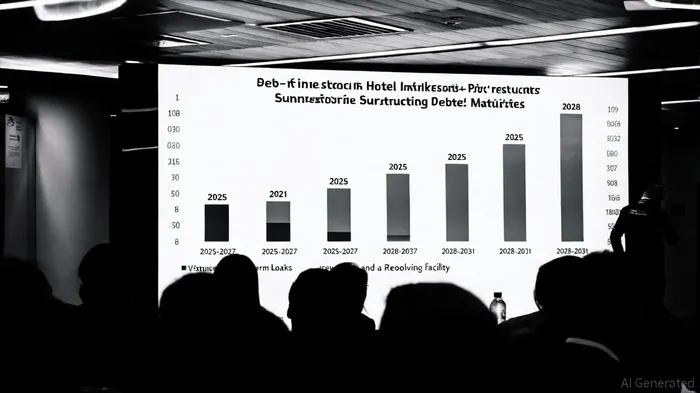
Sunstone's restructuring replaces its previous capital structure with a more balanced and extended framework. The new credit agreement includes a $500 million revolving credit facility maturing in September 2029 (extendable to 2030), a $275 million delayed-draw term loan maturing in January 2029, and two additional term loans due in 2030 and 2031. These terms push all debt maturities to 2028 or later, effectively eliminating near-term refinancing risks[1]. This extension is critical in an environment where liquidity constraints remain a persistent threat to REITs with shorter-term obligations[3].
The leverage-dependent pricing grid—ranging from 1.35% to 2.25% over SOFR—further underscores the company's focus on cost efficiency. By aligning interest rates with its debt-to-EBITDA ratio, Sunstone incentivizes disciplined leverage management. Additionally, the firm has hedged over 75% of its debt and preferred equity with fixed-rate swaps, shielding itself from potential SOFR volatility[1]. This contrasts sharply with its pre-restructuring position, where a net leverage ratio of 4.5x (as of May 2025) and $872 million in total debt exposed it to margin compression from rising interest rates[4].
Sector-Specific Risks and Strategic Adaptation
The hospitality REIT sector faces a unique set of challenges in 2025. Rising operational costs—particularly labor expenses, construction inflation, and insurance premiums—are eroding profit margins[2]. For instance, Sunstone's Q2 2025 earnings revealed a 59% decline in net income, partly due to a $8.8 million loss from the sale of the Hilton New Orleans St. Charles and elevated operating expenses[5]. Meanwhile, shifting consumer behavior, including the rise of hybrid work models and “bleisure” travel, has forced operators to rethink traditional revenue streams[5].
Sunstone's restructuring addresses these risks through dual strategies. First, by deferring $90 million in delayed-draw term loans until 2026, the company avoids over-leveraging during periods of economic uncertainty while retaining flexibility to repay high-cost debt (e.g., Series A Senior Notes) at maturity[1]. Second, the firm has aggressively repurchased shares—investing $100 million in Q2 2025 at an average price of $8.83 per share—to return capital to shareholders and reduce equity dilution[4]. These actions align with broader industry trends, as REITs increasingly prioritize capital recycling and shareholder value preservation[5].
A Test of Resilience in a Fragmented Market
Despite these measures, Sunstone's subscale portfolio remains a vulnerability. As highlighted by Tarsadia Capital, its concentrated holdings in urban and resort markets leave it susceptible to localized disruptions, such as weather events or hotel renovations[5]. The recent sale of the Hilton New Orleans St. Charles and planned $80–$100 million in 2025 capital investments for property upgrades (e.g., Andaz Miami Beach) reflect an attempt to mitigate this risk through asset rationalization and value-added renovations[4]. However, the success of this strategy hinges on the ability to redeploy capital into high-growth opportunities—a challenge in a sector where RevPAR (revenue per available room) growth has slowed[2].
Conclusion: A Cautious Optimism
Sunstone's credit facility restructuring is a calculated response to both immediate financial pressures and long-term sector dynamics. By extending maturities, reducing refinancing risks, and hedging interest rate exposure, the company has strengthened its balance sheet at a time when liquidity remains a critical concern. Yet, the broader challenges—rising costs, shifting demand, and portfolio concentration—mean that this restructuring alone cannot guarantee long-term stability. Investors must monitor how effectively Sunstone executes its capital recycling strategy and adapts to evolving market conditions. For now, the restructuring provides a foundation for resilience, but the true test lies in the execution of its strategic vision.





Comentarios
Aún no hay comentarios