
Sunrun's Sustained Cash Generation and Subscriber Economics: A Strategic Edge in Home Energy Markets?
Operational Momentum: A Tale of Cash and Subscribers
Sunrun's Q3 2025 performance underscores its ability to convert market demand into tangible financial outcomes. The company reported $108 million in Cash Generation, marking the sixth consecutive quarter of positive cash flow, according to Sunrun's Q3 2025 earnings release. This achievement is underpinned by a 35% year-over-year revenue increase to $724.6 million, driven by a 13% rise in total subscribers to 971,805 and a 70% storage attachment rate, according to Sunrun's Q3 2025 earnings release.
The subscriber economics are equally striking. Aggregate Subscriber Value (ASV) reached $1.6 billion, up 10% year-over-year, while Contracted Net Value Creation (CNVC) surged 35% to $279 million, according to Sunrun's Q3 2025 earnings release. These metrics reflect not only growth in customer base but also enhanced customer lifetime value-a critical differentiator in a sector where retention and recurring revenue are paramount.
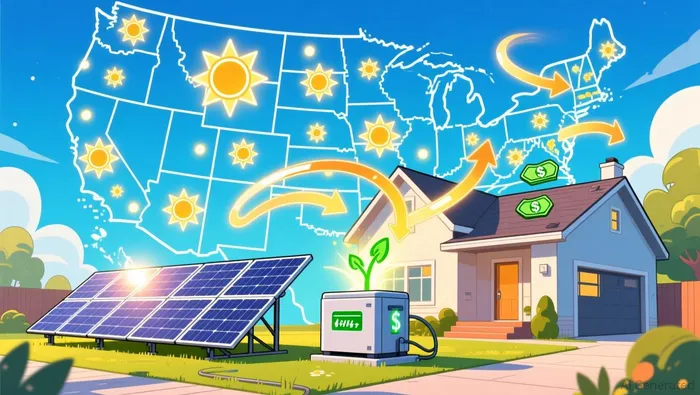
Sunrun's strategic pivot toward storage-first offerings has further strengthened unit economics. By bundling solar with battery storage, the company is capturing a larger share of the home energy value chain, thereby improving cash flow predictability. This approach aligns with broader industry trends, as consumers increasingly prioritize energy independence amid grid instability and rising electricity costs.
Capital Structure Resilience: A Double-Edged Sword
Despite these operational strengths, Sunrun's capital structure remains a source of concern. The company's debt-to-equity ratio stands at 316.3%, with total liabilities of $16.8 billion against equity of $4.4 billion, according to Sunrun's balance sheet. More alarmingly, its debt-to-EBITDA ratio is 62.0x, a level that would be unsustainable for most traditional businesses, according to Sunrun's debt-to-EBITDA metrics. This extreme leverage is compounded by a negative EBITDA interest coverage ratio of -0.2x, indicating that the company's earnings are insufficient to cover interest expenses, according to Sunrun's Q3 earnings release.
Yet, Sunrun's reliance on non-recourse debt-which totaled $2.8 billion year-to-date-provides a partial buffer. By securitizing subscriber contracts, the company has access to capital markets without directly exposing its balance sheet to systemic risks. This strategy has allowed Sunrun to reduce recourse borrowings by $66 million since year-end 2024, according to Sunrun's Q3 2025 earnings release, a step toward deleveraging. However, the sheer scale of its debt obligations raises questions about long-term sustainability, particularly if interest rates remain elevated or securitization markets tighten.
Strategic Initiatives: Mitigating Risks or Hiding Them?
Sunrun's management has responded to these challenges with a dual focus on capital efficiency and customer retention. The company's collaboration with Tesla on a new home energy plan, launched in July 2025, aims to enhance customer satisfaction and reduce churn, according to Sunrun's Q3 earnings release. While the Q3 report does not disclose an explicit retention rate, the 13% year-over-year subscriber growth-despite a 1% decline in new additions-suggests that retention efforts are yielding results, according to Sunrun's Q3 2025 earnings release.
Moreover, Sunrun's $1.4 billion in Q3 securitizations highlights its ability to monetize future cash flows, a critical capability in a capital-intensive industry, according to Sunrun's Q3 2025 earnings release. This approach, however, depends on the continued willingness of investors to fund long-dated residential energy contracts-a dynamic that could shift with macroeconomic conditions.
Conclusion: A Strategic Edge, but at What Cost?
Sunrun's sustained cash generation and subscriber economics position it as a formidable player in the home energy market. Its ability to scale storage-first solutions and leverage securitization markets has enabled growth in a sector where capital constraints often stifle innovation. Yet, the company's financial leverage-particularly its 62.0x debt-to-EBITDA ratio-remains a significant overhang.
For investors, the key question is whether Sunrun's operational momentum can justify its structural risks. The company's guidance for full-year 2025 Cash Generation of $250–450 million, with a midpoint of $350 million, suggests confidence in its ability to service debt, according to Sunrun's Q3 2025 earnings release. However, this optimism must be tempered by the reality of its negative interest coverage and the fragility of securitization markets.
In the end, Sunrun's strategic edge lies in its ability to navigate the dual imperatives of growth and financial discipline. If it can continue to improve unit economics while deleveraging its balance sheet, it may yet emerge as a leader in the decentralized energy revolution. But for now, the path remains fraught with uncertainty.





Comentarios
Aún no hay comentarios