
Student Loan Policy Shifts and the Redefinition of "Professional" Degrees: Implications for Education, Healthcare, and Financial Markets
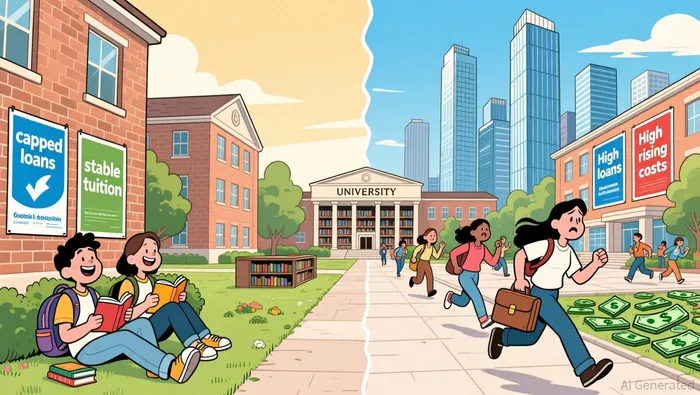
The reclassification of "professional" degrees under the One Big Beautiful Bill Act (OBBBA), enacted in 2025, has triggered a seismic shift in U.S. student loan policy, with profound implications for tuition inflation, debt dynamics, and investment opportunities in education and healthcare sectors. By imposing starkly different borrowing limits for graduate and professional programs-$20,500 annually and $100,000 total for non-professional degrees versus $50,000 and $200,000 for professional ones-the policy has created a bifurcated financial landscape. This divergence, while ostensibly aimed at curbing excessive debt, risks exacerbating inequities in access to education and reshaping institutional strategies in ways that investors must now scrutinize.
Tuition Inflation and Institutional Pricing Strategies
The OBBBA's loan caps are likely to dampen tuition inflation in non-professional graduate programs, particularly in fields like nursing, social work, and education, where average annual costs exceed $30,000. The Bennett Hypothesis, which posits that increased federal aid fuels tuition hikes, suggests that reduced access to federal loans could slow the rate of price increases in these programs. However, for professional degrees such as medicine and law, the higher loan limits may not act as a brake on tuition, as institutions may perceive these programs as less constrained by financial aid limitations. This asymmetry could lead to a reallocation of institutional resources toward professional programs, potentially at the expense of non-professional ones, as universities seek to maximize revenue in a tighter funding environment.
Debt Trends and Workforce Development
The policy's exclusion of advanced nursing and other healthcare-related degrees from the "professional" category has sparked urgent concerns. According to a report by the American Nurses Association, 95% of nursing students currently borrow below the $20,500 annual cap, but the average cost of these programs exceeds that threshold. This discrepancy may force students into high-interest private loans, which typically carry variable rates and less favorable repayment terms. Such a shift could deter enrollment in critical fields, exacerbating existing workforce shortages in healthcare and education. For instance, rural hospitals already struggle with physician and nurse shortages; the OBBBA's restrictions may further strain these systems by reducing the pipeline of graduates willing to pursue lower-paying specialties like primary care.
Investment Opportunities in Private Loans and Institutional Adaptation
The OBBBA's elimination of the Graduate PLUS loan program-a flexible funding source for non-professional graduate students-has created a vacuum that private lenders are poised to fill. According to data from the Institute for College Access and Success, private loan borrowing among graduate students could surge by 30–40% in the coming years, driven by the need to bridge the gap between federal loan limits and program costs. This trend presents both opportunities and risks for investors: while private lenders may see short-term growth, the higher default rates associated with these loans could undermine long-term profitability.
Institutions, meanwhile, are likely to adopt innovative strategies to mitigate the financial burden on students. Some may introduce tuition discounts or loan forgiveness programs tailored to high-demand fields, while others could pivot toward shorter, credential-based programs eligible for Workforce Pell Grants. According to insights from Jackson Lewis, these adaptations could create investment opportunities in education technology platforms that facilitate alternative financing models or in institutions that successfully reposition themselves to align with the new policy framework.
Sector-Specific Risk Assessments
The healthcare sector faces a dual risk: reduced workforce diversity and increased reliance on private debt. A study by the Association of American Medical Colleges warns that the OBBBA's loan caps could disproportionately affect students from low-income backgrounds, who are more likely to require Graduate PLUS loans to cover living expenses. This could lead to a less diverse physician workforce, with knock-on effects for healthcare equity. Similarly, nursing schools may see declining enrollment if students perceive the financial barriers as insurmountable, further straining an already fragile labor market.
For investors, the key challenge lies in balancing the potential for growth in private lending with the systemic risks of a debt-laden graduate population. The OBBBA's phase-in period-allowing existing students to borrow under old rules for up to three years-provides a temporary buffer but does not eliminate the long-term structural shifts. According to a JFF analysis, institutions that fail to adapt their financial aid strategies or diversify revenue streams may see declining enrollments and reputational damage, particularly in non-professional programs.
Conclusion
The OBBBA's redefinition of "professional" degrees has created a complex interplay of opportunities and risks for education and healthcare sectors. While the policy aims to curb student debt, its unintended consequences-such as the exclusion of critical healthcare fields from higher loan limits-threaten to undermine workforce development and exacerbate inequities. For investors, the private loan market and institutional adaptation strategies represent key areas of focus, but these must be approached with caution. The coming years will test whether policymakers can reconcile fiscal prudence with the need to sustain access to education in fields vital to the nation's economic and social well-being.







Comentarios
Aún no hay comentarios