
Strategic Sector Rotation in a Weakening Global Economy: Navigating the 2025 Slowdown
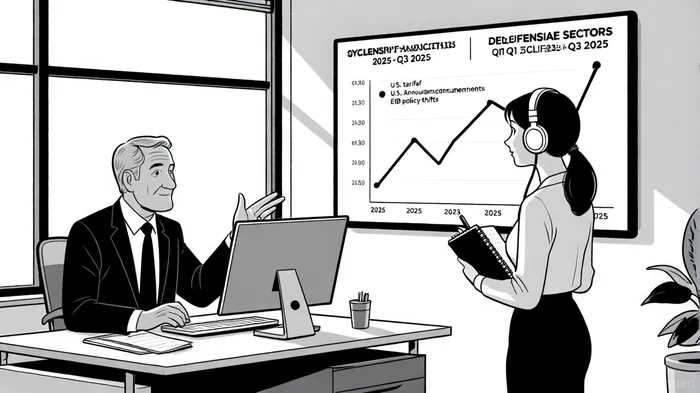
The global economy in 2025 is marked by a discernible slowdown in private-sector activity, driven by a confluence of geopolitical tensions, trade policy disruptions, and fragile consumer demand. In the United States, GDP growth contracted by 0.1% in Q1 2025 before rebounding to 3.3% in Q2, yet annual projections now hover at 1.6%—a stark decline from earlier forecasts[1]. The Eurozone, meanwhile, grapples with industrial stagnation, as manufacturing PMI indices remain below critical thresholds, while trade tensions with the U.S. threaten to undermine export-driven growth[2]. China's property sector crisis and weak private-sector confidence further compound global economic fragility[1]. In this environment, strategic sector rotation has emerged as a critical tool for investors seeking to preserve capital and capitalize on asymmetries in sectoral performance.
The Case for Defensive Sectors
As economic uncertainty intensifies, defensive sectors have demonstrated resilience. Healthcare, utilities, and consumer staples have outperformed broader markets, reflecting their non-cyclical nature and consistent demand. For instance, the Health Care Select Sector SPDR ETF (XLV), which includes firms like Eli LillyLLY-- and Johnson & Johnson, has delivered a year-to-date return of 7.72% as of March 2025, outpacing the S&P 500's -1.57% return[3]. This performance underscores the sector's appeal during periods of volatility, as healthcare spending remains relatively inelastic to economic cycles. Similarly, the Consumer Staples Select Sector SPDR Fund (XLP), focused on essential goods producers like Procter & Gamble, has returned 4.44% year-to-date, benefiting from sustained demand for household necessities[3].
Utilities, another traditional safe haven, have also gained traction. The Utilities Select Sector SPDR Fund (XLU) has returned 3.10% year-to-date, supported by declining interest rates and high dividend yields[3]. These sectors collectively offer a buffer against macroeconomic shocks, aligning with historical patterns where defensive allocations outperform during contractions[4].
Cyclical Sectors Under Pressure
Conversely, cyclical sectors such as industrials and small-cap equities face headwinds. The iShares Russell 2000 ETF (IWM), which tracks small-cap U.S. stocks, has historically exhibited high volatility, with a 30-year compound annual return of 8.49% but a standard deviation of 20.14%[5]. In 2025, however, its performance has been constrained by trade policy uncertainty and weak consumer spending. Small businesses, often reliant on narrow margins, are particularly vulnerable to supply chain disruptions and rising input costs[6]. Similarly, the Vanguard Real Estate ETF (VNQ) has underperformed, with a 12-month total return of -0.54% as of 2025, reflecting the sector's sensitivity to interest rates and reduced commercial demand[7].
The industrial sector's struggles are evident in the Federal Reserve's G.17 report, which noted a 0.1% decline in U.S. industrial production in July 2025, despite manufacturing output remaining 1.4% above year-ago levels[1]. Sectors like primary metals and motor vehicles have contracted, while trade tensions with the U.S. have introduced further downside risks for Eurozone exporters[2].
Strategic Rotation: Balancing Defense and Opportunity
Investors navigating this landscape must adopt a nuanced approach. Defensive sectors offer stability, but overexposure risks missing out on eventual cyclical rebounds. A balanced portfolio—combining 43% equities, 40% bonds, and 17% alternatives—has historically delivered superior risk-adjusted returns during slowdowns[4]. For instance, while defensive ETFs like XLV and XLP provide downside protection, interest-sensitive sectors such as financials and REITs may benefit from anticipated rate cuts. The Vanguard Real Estate ETF (VNQ), for example, has shown long-term resilience, with a 10-year total return of 88.67%[7], suggesting that strategic entry points could emerge as monetary policy eases.
Policy and Geopolitical Risks
The trajectory of sector rotation will also hinge on policy developments. The European Central Bank's pause in rate cuts, despite stable inflation, reflects caution about trade tensions and fiscal uncertainty[2]. Meanwhile, U.S. tariffs on European steel and aluminum have already dampened exports, particularly for Germany and Italy[2]. Investors must monitor these dynamics, as policy shifts could accelerate or delay sectoral reallocations.
Conclusion
The 2025 economic slowdown, while uneven across regions and sectors, presents a clear imperative for strategic sector rotation. Defensive allocations in healthcare, consumer staples, and utilities offer a bulwark against volatility, while selective exposure to interest-sensitive sectors may position investors for eventual recovery. As central banks navigate the delicate balance between inflation control and growth support, the ability to dynamically adjust portfolios will remain paramount. In this uncertain climate, the disciplined application of sector rotation—grounded in macroeconomic signals and historical precedent—offers a path to both preservation and opportunity.







Comentarios
Aún no hay comentarios