
Strategic Investment Opportunities in 5G Infrastructure and Telecommunications Firms Amid FCC's Spectrum Auctions and Broadband Expansion
The Federal Communications Commission's (FCC) upcoming spectrum auctions and broadband expansion initiatives represent a pivotal moment for the U.S. telecommunications sector. These developments, driven by the One Big Beautiful Bill Act and updated regulatory frameworks, are poised to reshape the competitive landscape for 5G infrastructure and broadband deployment. For investors, the opportunities are manifold, spanning major telecom players, satellite operators, and small businesses benefiting from targeted policy incentives.
The AWS-3 Auction: A Catalyst for 5G and National Security
The FCC's AWS-3 auction, mandated to conclude by June 23, 2026, is a cornerstone of its strategy to modernize wireless infrastructure. This auction will unlock the 1695-1710 MHz, 1755-1780 MHz, and 2155-2180 MHz bands, which were previously underutilized due to defaults by initial winners in 2014, as reported by RBR. The proceeds will directly fund the "Rip and Replace" initiative, aimed at removing untrustworthy network equipment from U.S. telecoms-a critical national security measure, according to a Tech Blog analysis.
AT&T, with its limited mid-band spectrum holdings, is expected to be a dominant bidder, reflecting its strategic need to close the gap with competitors like VerizonVZ-- and T-MobileTMUS--, as noted by the FCC Law Blog. For investors, this signals a high probability of aggressive spending by major carriers, which could drive up auction revenues and, in turn, justify capital expenditures on 5G rollouts. The 15% bidding credit for small businesses and rural providers further diversifies the pool of potential participants, creating a niche for smaller firms to enter the market and expand broadband access in underserved areas, as described by the National Law Review.
Upper C-Band and the Satellite-Telecom Synergy
Parallel to the AWS-3 auction, the FCC is exploring reallocation strategies for the upper C-band (3.98-4.2 GHz), a spectrum band critical for 5G and 6G advancements. SpaceX has emerged as a vocal advocate for a modernized sharing framework that accommodates both terrestrial and satellite operators, signaling a potential shift toward hybrid infrastructure models, according to the DWT Broadband Advisor. This development could benefit companies like SpaceX, which are positioning themselves to leverage satellite-based broadband services, while traditional telecoms such as AT&T, Verizon, and T-Mobile may seek to secure contiguous spectrum blocks to enhance network performance, as Broadband Breakfast discusses.
Investors should monitor the FCC's Notice of Inquiry on upper C-band strategies, as the outcome could determine whether satellite operators gain a larger role in the 5G ecosystem. A collaborative approach between terrestrial and satellite providers might unlock new revenue streams, particularly in rural and remote areas where traditional infrastructure is costly to deploy.
Pole Attachment Reforms: Accelerating Broadband Deployment
The FCC's recent pole attachment rules, adopted in July 2025, are another critical enabler of broadband expansion. These rules streamline the process for attaching infrastructure to utility poles, with codified timelines for large orders (exceeding 3,000 poles) and enhanced self-help rights for broadband providers. By reducing bureaucratic delays, the reforms are expected to lower deployment costs and accelerate the rollout of high-speed internet, particularly in rural regions.
Infrastructure providers specializing in pole attachment services, such as those offering make-ready solutions or equipment for utility pole modifications, stand to benefit. Additionally, companies that provide software platforms for managing pole attachment workflows may see increased demand as telecoms scale their operations.
Small Businesses and the Spectrum Pipeline
The One Big Beautiful Bill Act has restored the FCC's spectrum auction authority through 2034, ensuring a steady pipeline of 800 MHz of spectrum for commercial use over the next decade, according to RCR Wireless. This includes 500 MHz of government spectrum being transitioned for commercial purposes, a move projected to generate $85 billion in revenue while expanding access to cheaper, faster internet, as highlighted in a Sen. Cruz statement. For small businesses, the 15% bidding credit and the Spectrum Pipeline Act's emphasis on equitable access create a unique opportunity to compete with larger firms.
Investors seeking high-growth potential might focus on small telecoms and rural broadband providers that can leverage these credits to acquire spectrum licenses and expand their services. These firms could become key players in bridging the digital divide, a priority for policymakers and regulators.
Legislative and Regulatory Risks
While the regulatory environment is largely supportive, investors must remain cautious about potential headwinds. The FCC's spectrum allocation decisions must balance competing interests, including national security, consumer access, and technological innovation. For instance, the debate over contiguous spectrum blocks for 6G could delay timelines or create regulatory uncertainty, as previously discussed. Additionally, the NDAA amendment mentioned in the research highlights the risk of legislative interference with the spectrum pipeline, as detailed in a communications alert.
Conclusion: A Strategic Window for Investors
The FCC's spectrum auctions and broadband initiatives present a compelling case for strategic investment in 5G infrastructure and telecommunications. Major carriers like AT&T and Verizon are likely to dominate the AWS-3 auction, while satellite operators such as SpaceX could redefine the industry's boundaries. Meanwhile, small businesses and infrastructure providers stand to gain from policy-driven incentives and streamlined deployment rules.
For investors, the key is to align with firms that can capitalize on both the regulatory tailwinds and the technological imperatives of the 5G era. Diversifying across large-cap telecoms, emerging satellite operators, and small broadband providers offers a balanced approach to navigating this dynamic landscape. 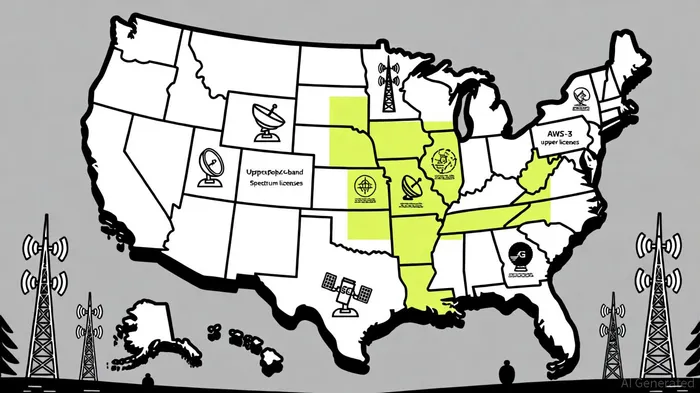







Comentarios
Aún no hay comentarios