
The Strategic Implications of AppLovin and Robinhood’s Inclusion in the S&P 500
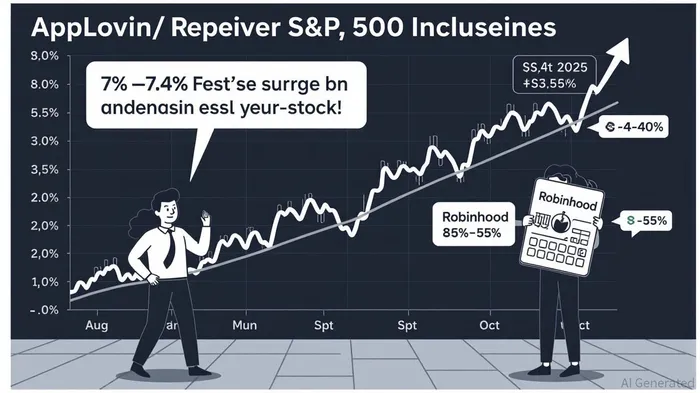
The inclusion of AppLovinAPP-- and RobinhoodHOOD-- in the S&P 500 index in September 2025 marks a pivotal moment for both companies and the broader market. This event, part of the index’s quarterly rebalancing, has triggered immediate institutional demand and valuation re-rating, reflecting the mechanical forces of passive investing and the symbolic weight of index membership. Yet, as history shows, such re-ratings often come with long-term risks, particularly for high-growth firms lacking sustainable profitability.
The Mechanics of Institutional Demand and Valuation Re-Rating
When a stock is added to the S&P 500, index-tracking funds and ETFs are compelled to purchase the security to maintain alignment with the benchmark. This “forced buying” typically drives short-term price appreciation. For example, Interactive BrokersIBKR-- (IBKR) surged 34% in revenue growth and traded at a 75% margin after its inclusion, with its valuation expanding due to passive inflows [1]. Similarly, AppLovin and Robinhood saw their shares jump by 7.1% and 7.4%, respectively, in after-hours trading following the announcement [2].
However, historical patterns suggest caution. A report by AInvest notes that newly added S&P 500 stocks underperform the index by about 1.7% post-inclusion, as elevated valuations revert to mean levels [1]. TeslaTSLA-- and PalantirPLTR--, for instance, faced prolonged underperformance after their inclusions, underscoring the need for companies to justify premium multiples through scalable profitability [1].
AppLovin: High Multiples and Marginal Resilience
AppLovin’s inclusion reflects its dominance in the ad-tech sector, with a trailing P/E ratio of 67.01 and a P/S ratio of 29.89 as of Q3 2025 [2]. These multiples, far above the S&P 500 average, are justified by its 71% year-over-year advertising revenue growth and projected 80% operating margins post-divestiture of its low-margin gaming operations [3]. Institutional ownership of AppLovin has also risen, with analysts noting its status as a “high-conviction AI winner” [4].
Yet, the company’s valuation remains precarious. A Seeking Alpha analysis highlights that AppLovin’s GAAP P/E of 102—well above the sector median of 32—leaves little room for error, particularly given its reliance on volatile ad-tech markets [5]. The challenge for AppLovin lies in sustaining its margins while scaling, a task complicated by macroeconomic headwinds and regulatory scrutiny of digital advertising.
Robinhood: Fintech’s Index Debut and Institutional Embrace
Robinhood’s inclusion in the S&P 500 validates its transformation from a pandemic-era disruptor to a mainstream financial services player. Its stock surged 7.3% post-announcement, with institutional ownership now at 59%, including major stakes held by Vanguard, BlackRockBLK--, and FMR LLC [6]. This institutional embrace reflects confidence in Robinhood’s post-pandemic recovery and its pivot toward recurring revenue streams, such as crypto custody and margin lending.
However, Robinhood’s valuation remains opaque. While its market capitalization reached $91.5 billion in September 2025 [2], specific P/E or P/S ratios are not disclosed in the sources. This lack of transparency raises questions about whether its valuation is anchored to fundamentals or speculative optimism. The broader fintech sector, including DatadogDDOG-- (P/S of 19.3), trades at elevated multiples, but Robinhood’s reliance on thin margins and regulatory risks could expose it to mean reversion [7].
Strategic Implications and Long-Term Risks
The inclusion of AppLovin and Robinhood in the S&P 500 underscores the index’s evolving composition, which now favors high-growth tech and fintech firms. However, this shift amplifies systemic risks. The S&P 500’s forward P/E of 19.7—above its 25-year average of 16.4—is largely driven by the Magnificent Seven, which account for 31% of the index’s market cap [8]. AppLovin and Robinhood, while smaller, contribute to this trend of overvaluation, particularly in sectors with uncertain earnings trajectories.
Goldman Sachs’ revised 10-year return forecast of 3% for U.S. equities highlights the consequences of high starting valuations [9]. For AppLovin and Robinhood, the path forward requires not only maintaining growth but also demonstrating resilience in a tightening regulatory and macroeconomic environment.
Conclusion
The S&P 500 inclusion of AppLovin and Robinhood has catalyzed institutional demand and valuation re-rating, but the long-term success of these firms hinges on their ability to justify their multiples through profitability and innovation. As the index increasingly reflects the dominance of high-growth sectors, investors must remain vigilant against the risks of overvaluation and mean reversion. For now, the market’s enthusiasm is justified—but not without limits.
Source:
[1] S&P 500 Inclusion and Its Impact on High-Growth Tech [https://www.ainvest.com/news/500-inclusion-impact-high-growth-tech-stocks-2509/]
[2] AppLovin, Robinhood, and EmcorEME-- to Join S&P 500 Index [https://www.barrons.com/articles/applovin-robinhood-and-emcor-to-join-s-p-500-the-stocks-are-rallying-563371e6]
[3] AppLovin: Can 80% Margins Survive Outside Gaming? [https://finance.yahoo.com/news/applovin-80-margins-survive-outside-094035178.html]
[4] AppLovin Stock: Wall Street’s Most Misunderstood AI Winner [https://seekingalpha.com/article/4801078-applovin-stock-wall-streets-most-misunderstood-ai-winner]
[5] AppLovin: Some Strong Fundamentals, But A Premium Valuation Provides No Room For Error [https://seekingalpha.com/article/4801182-applovin-some-strong-fundamentals-but-a-premium-valuation-provides-no-room-for-error]
[6] HOOD - Robinhood MarketsHOOD--, Inc. Stock [https://fintel.io/so/us/hood]
[7] Datadog’s S&P 500 Inclusion: Strong Fundamentals Meet Premium Valuations [https://www.trefis.com/stock/ddog/articles/568585/datadogs-sp-500-inclusion-strong-fundamentals-meet-premium-valuations/2025-07-03]
[8] Are U.S. Stocks Too Expensive? [https://www.troweprice.com/financial-intermediary/us/en/insights/articles/2024/q3/are-us-stocks-too-expensive.html]
[9] Updating Our Long-Term Return Forecast for US Equities [https://www.gspublishing.com/content/research/en/reports/2024/10/18/29e68989-0d2c-4960-bd4b-010a101f711e.html]





Comentarios
Aún no hay comentarios