
H&M's Strategic Cost Controls and Sustainability: A Pathway to Long-Term Growth in a Competitive Retail Landscape
In the second quarter of 2025, H&M Group delivered a modest but notable profit beat, reporting an operating profit of SEK 5.91 billion—surpassing analysts' expectations of SEK 5.88 billion[1]. This performance, however, masks underlying challenges. While local currency sales rose by 1% year-over-year, the operating profit margin contracted to 10.4% from 11.9% in the prior year, reflecting persistent pressures from foreign exchange volatility and elevated freight costs[2]. The company's gross margin, at 55.4%, showed sequential improvement, underscoring progress in supply chain optimization[3]. Yet, these gains remain fragile against a backdrop of global economic uncertainty and rising tariffs.
Cost Controls and Supply Chain Resilience
H&M's strategic response to these headwinds has centered on cost controls and supply chain agility. The company has accelerated a shift toward regionalized sourcing, prioritizing Central America for U.S. markets and Turkey, Morocco, and Egypt for Europe[4]. This nearshoring strategy aims to mitigate risks from geopolitical tensions and U.S. import tariffs while shortening lead times. By decentralizing production, H&M seeks to enhance responsiveness to seasonal trends—a critical advantage in fast fashion.
Technological investments further bolster these efforts. The adoption of RFID technology and artificial intelligence (AI) for demand forecasting has improved inventory accuracy and reduced overproduction[5]. For instance, H&M's 2025 sustainability report notes a 29.5% share of recycled materials in its products, nearing its 30% target for the year[6]. Such innovations not only cut costs but also align with the company's broader sustainability ambitions.
Sustainability as a Competitive Edge
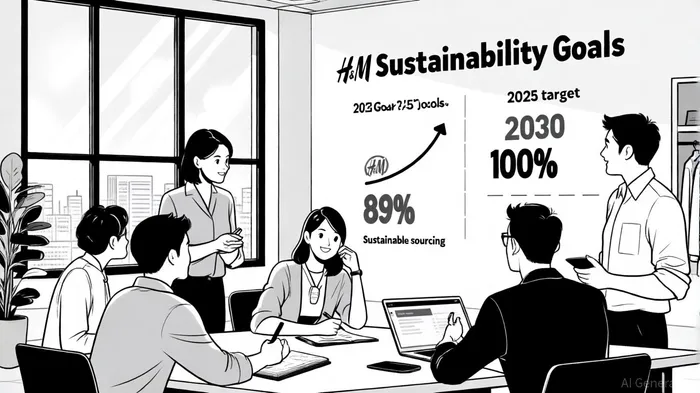
H&M's sustainability initiatives have gained traction, distinguishing it in a sector often criticized for environmental harm. The company now sources 89% of its materials sustainably—a significant leap from previous years—and aims for 100% by 2030[7]. Its circular business models, including resale platforms and textile take-back programs, have expanded to 26 markets[8]. These efforts have earned H&M a B+ rating in the 2025 Fossil-Free Fashion Scorecard, outperforming peers like Zara and Shein[9].
Critically, H&M's sustainability strategy is not merely aspirational. A $179 million decarbonization fund underscores its commitment to measurable progress[10]. For example, the company reduced Scope 1 and 2 emissions by 41% compared to 2019 levels, partly by phasing out coal-dependent factories[11]. Such transparency and investment position H&M to meet evolving consumer preferences and regulatory demands.
Competitive Positioning and Long-Term Risks
Despite these strengths, H&M faces stiff competition from Zara and Uniqlo. Zara's vertically integrated supply chain enables 15-day production cycles, allowing it to outpace H&M's 4–6 month lead times[12]. Uniqlo, meanwhile, leverages high-quality, functional designs to command premium pricing while maintaining cost efficiency[13]. H&M's reliance on a decentralized, global supplier network—while cost-effective—introduces vulnerabilities to inflationary pressures and supply chain disruptions[14].
Financial performance further highlights these challenges. From 2020 to 2024, H&M's revenue growth lagged behind Zara's parent company, Inditex, and Uniqlo's Fast Retailing[15]. While H&M's 2025 operating profit beat expectations, its profitability remains volatile, constrained by sourcing costs and price competition[16].
The Road Ahead
H&M's long-term growth hinges on its ability to balance affordability with sustainability. The company's 2025 guidance—anticipating improved currency and freight conditions in the second half—offers cautious optimism[17]. However, success will require continued innovation in cost controls, such as expanding RFID adoption and deepening supplier partnerships[18].
Moreover, H&M must navigate the tension between fast fashion's inherent environmental costs and its sustainability pledges. While its circular initiatives are promising, scaling them without compromising margins will be a test of its strategic resolve.
Conclusion
H&M's strategic pivot toward cost controls, regionalized supply chains, and sustainability has yielded tangible progress. Yet, its long-term growth potential remains contingent on navigating competitive pressures and macroeconomic headwinds. For investors, the company's ability to harmonize profitability with environmental responsibility will be a key determinant of its resilience in an increasingly demanding retail landscape. Notably, historical backtests of H&M's earnings beats since 2022 reveal mixed signals: while short-term positive sentiment often follows, the average 30-day return post-beat has been negative (-2.7%), suggesting that investors may need to look beyond quarterly surprises to assess long-term value[19].







Comentarios
Aún no hay comentarios