
SoftBank's Strategic AI Chipplay: The Ampere Acquisition and Its Implications for AI Infrastructure
Strategic Positioning: A Vertical Integration Play
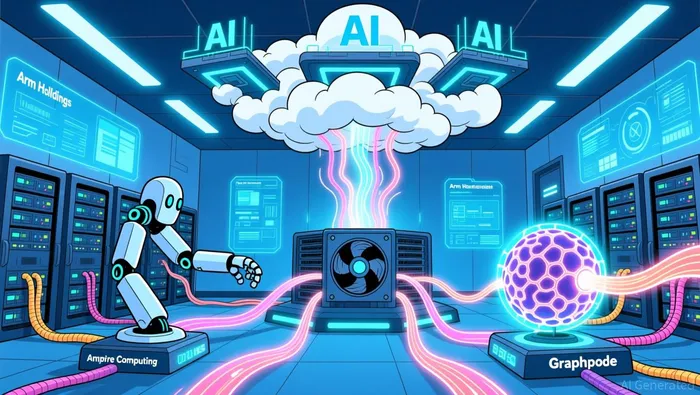
SoftBank's acquisition of Ampere is not an isolated transaction but part of a broader $30 billion AI investment strategy according to Forbes. By acquiring a chipmaker that licenses Arm's architecture-already a cornerstone of its portfolio-SoftBank is vertically integrating its control over AI infrastructure. Ampere, a designer of server processors for data centers, complements Arm's energy-efficient chip designs and Graphcore's AI-specific architectures. This synergy allows SoftBank to dominate multiple layers of the AI stack, from foundational architecture to application-specific hardware.
The Federal Trade Commission's approval of the deal according to Bloomberg removes regulatory hurdles, enabling SoftBank to accelerate its integration of Ampere into its AI ecosystem. This move aligns with founder Masayoshi Son's vision of leveraging Arm's global influence to drive innovation in cloud computing and AI. By controlling both the architecture (Arm) and the implementation (Ampere), SoftBank can optimize performance and cost-efficiency for data centers-a critical battleground for AI scalability.
Implications for AI Infrastructure: Consolidation and Competition
Ampere's role in server processors underscores SoftBank's focus on the backbone of AI infrastructure. While specific technical details about Ampere's 2025 AI chip roadmap remain undisclosed according to Bloomberg, its existing expertise in high-performance, low-power server chips positions it to meet the surging demand for AI workloads. This demand is driven by generative AI and large language models, which require vast computational resources.
SoftBank's strategy contrasts with rivals like NVIDIA, which has dominated the AI chip market through its GPU-centric approach. However, by leveraging Arm's RISC architecture-known for its efficiency-SoftBank may challenge NVIDIA's hegemony in data centers. The integration of Ampere's processors with Arm's architecture could yield cost-competitive solutions, particularly for cloud providers seeking to reduce energy consumption.
Long-Term Value Capture: Beyond the Acquisition
SoftBank's ambitions extend beyond Ampere. Its $22.5 billion investment in OpenAI according to Forbes and potential minority stake in Neysa Networks-a cloud infrastructure firm according to Inkl-highlight its intent to capture value across the AI value chain. By controlling both hardware (Ampere, Arm) and software (OpenAI), SoftBank aims to create a self-reinforcing ecosystem where each component enhances the others.
Yet, long-term success hinges on execution. The AI chip market is highly competitive, with Intel, AMD, and NVIDIA investing heavily in next-generation technologies. SoftBank must ensure that Ampere's innovations align with industry trends, such as specialized AI accelerators and quantum computing. Regulatory scrutiny, too, remains a risk, though the FTC's approval according to Bloomberg suggests a temporary reprieve.
Conclusion
SoftBank's acquisition of Ampere is a bold bet on the future of AI infrastructure. By consolidating ArmARM--, Graphcore, and now Ampere, the company is positioning itself to influence the architecture, design, and deployment of AI technologies. While technical specifics about Ampere's AI chips remain opaque, the strategic logic of vertical integration is compelling. If executed effectively, this move could secure SoftBank a central role in the AI era-provided it navigates the challenges of innovation, competition, and regulation.





Comentarios
Aún no hay comentarios