
Small-Cap Equity Income Opportunities in a Rising Rate Environment
In an era of persistent monetary tightening, investors seeking income from equities face a paradox: rising interest rates traditionally depress equity valuations, yet certain segments of the market demonstrate unexpected resilience. The Vanguard Small-Cap Value ETF (VBR) offers a compelling case study in this dynamic. By examining its dividend performance and risk-adjusted returns during the 2020–2025 period of sustained rate hikes, we uncover why small-cap value equities might still hold promise for income-focused investors.
Dividend Resilience Amid Rising Rates
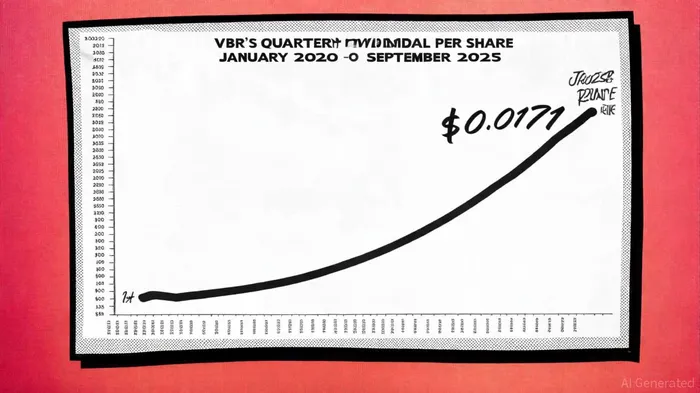
Small-cap value stocks have long been criticized for their perceived fragility in high-rate environments. Yet VBR's track record challenges this assumption. According to data from MarketBeat, the ETF has maintained a consistent quarterly dividend schedule, with the most recent payout of $0.9108 per share on July 2, 2025, and an upcoming increase to $0.9279 per share on October 1, 2025 [2]. Over the past five years, VBR's annualized dividend has grown from $1.96 in 2020 to $4.11 in 2025, reflecting a compound annual growth rate (CAGR) of 17.5% [4].
This resilience is particularly striking during the 2022–2023 rate-hike cycle, when the Federal Reserve raised the federal funds rate by 525 basis points. Despite such turbulence, VBR's underlying holdings—small-cap value companies—have not experienced widespread disruptions in their payout policies. For instance, the ETF's dividend surged to $1.182 per share in September 2021, then dipped to $0.636 in March 2022 before rebounding to $0.876 by December 2022 [4]. These fluctuations suggest that while individual companies may struggle, the broader index's diversification and focus on value stocks—often with strong balance sheets—mitigate systemic risk.
Risk-Adjusted Returns: A Trade-Off Worth Considering?
VBR's performance during the 2020–2025 period underscores the tension between returns and volatility. The ETF delivered a total return of 107.70%, with an average annual return (CAGR) of 14.64% [2]. However, this came at the cost of significant volatility: a standard deviation of 19.53% and a maximum drawdown of -55.89% during the 2005–2025 period [2]. The Sharpe ratio, a measure of risk-adjusted returns, stood at 0.18 for the 12-month period ending August 2025, lagging behind the 0.26 ratio of the broader small-cap ETF VB [1].
Yet these metrics must be contextualized. Small-cap value stocks inherently carry higher volatility than large-cap counterparts, but their potential for outperformance during economic recoveries remains a key attraction. For example, VBRVBR-- rebounded with a 12.40% return in 2024 and a 7.64% year-to-date return in 2025 [2]. Such resilience suggests that while VBR's risk profile is elevated, its returns may justify the trade-off for investors with a medium-term horizon.
Conclusion: Balancing Income and Risk
The Vanguard Small-Cap Value ETF exemplifies the duality of small-cap equity income investing in a rising rate environment. Its dividend resilience, driven by the underlying companies' value-oriented fundamentals, offers a rare combination of income growth and stability. However, the ETF's risk profile—evidenced by its low Sharpe ratio and high volatility—demands careful consideration. For investors willing to tolerate short-term drawdowns in pursuit of long-term outperformance, VBR represents a strategic allocation. Yet it is not a panacea; diversification and active monitoring remain essential.
In the end, the lesson from VBR is clear: in a world of shifting monetary policy, income opportunities often lie where conventional wisdom least expects them.





Comentarios
Aún no hay comentarios