
Ryman Hospitality’s Bold Move into the Sunbelt: A Strategic Gamble with Long-Term Upside
Ryman Hospitality Properties (NYSE: RHP) has made a significant bet on the future of upscale hospitality with its $865 million acquisition of the JW Marriott Phoenix Desert Ridge Resort & Spa—a transaction funded in part by an upsized equity offering. While the deal involves dilution and debt, the strategic calculus here is clear: Ryman is leveraging its financial flexibility to secure a premium asset in one of North America’s fastest-growing meetings markets. For investors seeking exposure to high-margin, destination-driven hotels, this could be a defining move.
Why the Equity Upsizing Makes Strategic Sense
Ryman’s decision to increase its public offering from 2.3 million to 2.6 million shares (plus underwriter options) isn’t just about raising capital—it’s about strategic balance. By combining equity, existing cash reserves, and targeted debt, Ryman avoids over-leverage while securing a resort that boasts a 12.7x EBITDA multiple based on 2024 performance. This approach mitigates risks associated with borrowing at elevated interest rates while ensuring the company retains financial flexibility.
The dilution here is justified by the asset’s long-term profile. The Desert Ridge Resort—a 950-room, 243,000-square-foot meeting space behemoth—is a cash-rich property undergoing $100 million in renovations. With Phoenix’s status as the nation’s fifth-largest city and a top-10 meetings market, the resort’s “all under one roof” design caters to corporate and convention groups seeking scale and amenities (think golf courses, water parks, and a spa). This aligns perfectly with Ryman’s focus on group-driven revenue streams, which have historically offered higher margins than transient bookings.
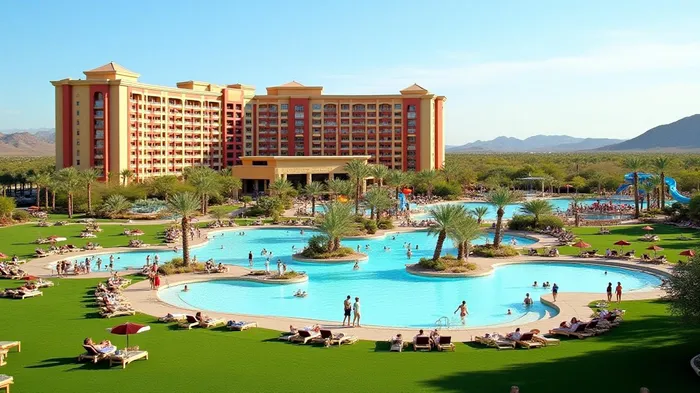
Geographic Diversification into a Sunbelt Powerhouse
Ryman’s portfolio has long been anchored in markets like Nashville and Orlando. Expanding into Phoenix—a sunbelt market with no new competitive supply—is a masterstroke. Phoenix-Sky Harbor Airport, the 14th-busiest in the U.S., serves as a gateway to the resort, which is strategically positioned to capitalize on both corporate travel and leisure demand.
The acquisition also fills a geographic gap in Ryman’s portfolio. With 11,414 rooms and 3 million square feet of meeting space already under its umbrella, adding Desert Ridge gives Ryman a foothold in a region primed for growth. Phoenix’s population is expected to grow by over 10% by 2030, driven by tech-sector relocations and tourism. This makes the resort a long-term bet on demographic tailwinds, not just cyclical trends.
Brand Synergy with Marriott and Operational Prudence
Operating the resort under the JW Marriott flag ensures alignment with Ryman’s existing partnerships and Marriott’s operational prowess. The JW brand’s premium positioning complements Ryman’s portfolio of Gaylord and Renaissance properties, creating cross-selling opportunities for group clients.
Moreover, Ryman’s track record of value creation—such as the JW Marriott San Antonio Hill Country acquisition—suggests it can extract synergies here. The resort’s renovations, though temporarily disrupting 2025 EBITDA, are a strategic reinvestment to drive occupancy and rates in 2026 and beyond.
Mitigating Over-Leverage Risks
Critics may point to Ryman’s increased debt load post-acquisition, but the capital structure remains prudent. The equity offering alone covers ~29% of the $865 million price tag, while existing cash and revolving credit facilities will handle the remainder. This avoids reliance on costly long-term debt, and the resort’s $68.256 million 2024 EBITDA provides a solid cash flow base to service any borrowing.
A visual showing Ryman’s historically low leverage ratio (e.g., ~4.0x) and the projected modest increase post-acquisition (to ~4.5x), which remains within investment-grade thresholds.
The Case for Immediate Investment
The stock’s current valuation—trading at 16.5x 2024 FFO—appears discounted relative to its growth prospects. The Desert Ridge acquisition is projected to be accretive by 2026, and Ryman’s diversified portfolio (including its 70% stake in the Grand Ole Opry) provides a steady cash flow floor.
For income investors, RHP’s 4.2% dividend yield offers stability, while growth-oriented investors gain exposure to a secular trend: the rebound in corporate and group travel. With Phoenix’s demand outpacing supply and the resort’s operational excellence, this is a high-conviction buy for portfolios seeking exposure to premium hospitality.
Final Analysis: A Prudent Risk, a Compelling Reward
Ryman’s equity raise and acquisition are anything but reckless. By deploying capital into a high-margin, strategically positioned asset while maintaining financial discipline, Ryman is positioning itself to capitalize on secular trends in meetings-driven hospitality. The dilution is temporary; the upside is structural.
Investors who prioritize long-term capital appreciation and diversification into resilient real estate should act now. The sun is rising on the Desert Ridge—and Ryman is poised to shine.
A comparison showing RHP’s relative underperformance in 2024, highlighting a potential buying opportunity ahead of accretive growth in 2026.





Comentarios
Aún no hay comentarios