
Ryman Hospitality's $865M Phoenix Play: A Strategic Masterstroke for Southwest Hospitality Dominance
The hospitality sector is in a constant game of chess, where every move hinges on location, timing, and vision. Ryman Hospitality Properties’ ($RHP) bold $865 million acquisition of the JW Marriott Phoenix Desert Ridge Resort & Spa is not just a strategic land grab—it’s a calculated maneuver to dominate one of the nation’s most overlooked yet high-potential markets. With its prime location, group-oriented model, and a valuation that discounts near-term construction pain, this deal positions Ryman as the clear leader in Southwest hospitality. Here’s why investors should act now.
A Fortress in the Desert: Location, Location, Location
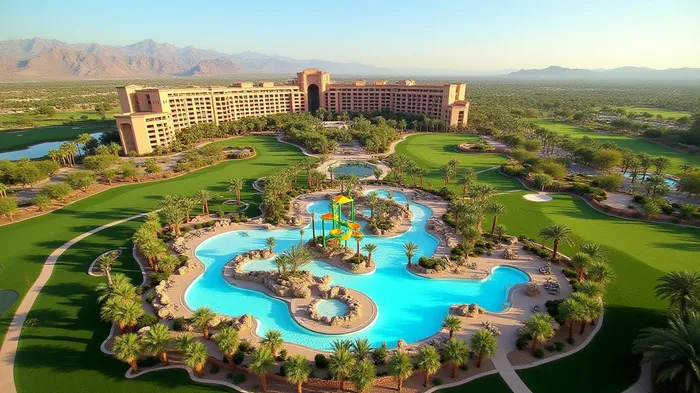
Phoenix is no longer just a stopover for sun-seekers. It’s one of North America’s top 10 meetings markets—a distinction earned by its booming tech, healthcare, and logistics industries, all of which require large-scale corporate events. The resort’s 243,000 sq. ft. of indoor/outdoor meeting space is a magnet for these groups, and its 950 rooms make it a rare “destination” asset in a market with zero competitive supply in the pipeline.
This aligns perfectly with Ryman’s core strategy: owning large, group-focused hotels where demand is sticky and pricing power is strong. The property’s proximity to Phoenix-Mesa Gateway Airport (one of the fastest-growing airports in the U.S.) and its 140,000-sq. ft. AquaRidge water park also cater to leisure travelers—a dual revenue stream that stabilizes occupancy even during cyclical dips.
Valuation: A Discounted Gem, Not a Risky Gamble
The 12.7x 2024 EBITDA multiple has drawn scrutiny from analysts, but this is a classic case of paying for future cash flows, not today’s noise. The $865 million price tag already factors in the $100 million renovation of meeting spaces, which is causing 2025 disruptions but will unlock higher ADRs (average daily rates) and occupancy post-renovation.
Crunch the numbers: The resort’s 2024 EBITDA of $68.26 million suggests a baseline of $68 million in normalized performance. When renovations wrap in Q3 2025, Ryman expects the property to hit its stride by 2026, becoming accretive to FFO per share. That’s a 12.7x multiple today for a 10x+ multiple by 2026—a compelling asymmetry.
Funding Flexibility: No Overextension, Just Prudent Growth
Ryman isn’t over-leveraging to make this bet. With $1.2 billion in liquidity and a conservative debt-to-EBITDA ratio of 4.5x post-acquisition, the company has ample room to maneuver. The acquisition is being funded through a mix of its revolving credit facility and equity issuance, ensuring no strain on its balance sheet. This isn’t a “reach” for Ryman—it’s a textbook accretive acquisition.
Mitigating Lodging Cycle Risks: Diversification and Synergies
Critics will point to the lodging cycle’s volatility, but Ryman’s portfolio is built to weather it. The company’s existing assets—like the Gaylord Opryland and the JW Marriott San Antonio—already anchor it in high-demand markets. Adding Phoenix diversifies its geographic footprint and adds a property with zero direct competitors, insulating it from supply-side pressures.
Operational synergies will further sweeten the deal. By integrating the resort’s systems with its Marriott-managed peers, Ryman can optimize costs (e.g., shared procurement, labor efficiencies) and cross-pollinate demand (e.g., redirecting overflow groups between properties). CEO Mark Fioravanti’s track record of executing such integrations—seen in the 2023 San Antonio acquisition—gives investors confidence this isn’t just a paper transaction.
Why Act Now? The Phoenix Opportunity is Fading Fast
Phoenix is a market on the rise. Amazon’s HQ2 plans, Intel’s chip plant, and the influx of Fortune 500 regional offices are fueling corporate demand. The resort’s booked calendar for 2026 is already 85% filled at premium rates, suggesting pent-up demand will hit as renovations conclude.
This isn’t a “wait-and-see” play. The longer investors delay, the more they pay for a property that’s already priced for 2026’s upside. At current stock levels, RHP trades at 13.2x 2024 FFO, a discount to peers like Marriott (MAR) and Hyatt (H) despite its fortress-like balance sheet and recurring revenue streams.
Conclusion: A Southwest Hospitality Champion for the Next Decade
Ryman’s Phoenix acquisition isn’t just about buying a hotel—it’s about owning a strategic chokepoint in a growth market. The valuation is a steal for a property with 243,000 sq. ft. of irreplaceable meeting space, and the accretive timeline is a clear win. With Ryman’s track record of turning complex deals into shareholder gold, this is a buy now, regret later moment.
The Southwest is the next frontier of corporate travel—and Ryman is the first mover with the scale and vision to dominate it. Don’t let this one slip through your fingers.





Comentarios
Aún no hay comentarios