
The Rise of Low-Carbon Ammonia as a Green Energy Catalyst: A Strategic Investment Opportunity
The global energy transition is reshaping industrial landscapes, and few commodities exemplify this transformation as vividly as low-carbon ammonia. Once confined to the realm of fertilizers, ammonia is now emerging as a cornerstone of decarbonization strategies, bridging the gap between renewable energy, industrial agriculture, and maritime transport. For investors, this evolution presents a compelling opportunity: a market poised to grow at extraordinary rates, driven by policy, technology, and the urgent need to reduce carbon emissions.
A Market on the Cusp of Exponential Growth
According to S&P Global Commodity Insights, the low-carbon ammonia market is projected to triple in size by 2050, with nearly all growth stemming from decarbonization efforts. By 2033, the market is expected to expand from USD 1.5 billion in 2024 to USD 4.5 billion, growing at a compound annual rate of 15.7%, according to Verified Market Reports. Even more striking is the forecast from Future Market Insights, which anticipates a surge to USD 25 billion by 2032, with green ammonia-produced via renewable hydrogen-dominating the value chain. These figures underscore a sector transitioning from niche innovation to mainstream infrastructure.
The drivers are clear. Decarbonization policies, such as the U.S. Inflation Reduction Act and the EU's Carbon Border Adjustment Mechanism, are redefining the economics of low-carbon ammonia. These frameworks incentivize producers to adopt cleaner technologies, such as alkaline water electrolysis and proton exchange membrane systems, while penalizing carbon-intensive alternatives, as Wood Mackenzie observes. Meanwhile, the Asia-Pacific region-home to China, India, and Indonesia-is becoming a growth engine, driven by demand for sustainable energy and industrial decarbonization, according to Dataintelo.
From Fertilizer to Energy Carrier: The Versatility of Ammonia
Ammonia's renaissance lies in its dual role as a chemical feedstock and a hydrogen carrier. Traditionally, over 80% of ammonia production has been tied to fertilizers, but this is shifting. According to Mordor Intelligence, green ammonia is now being explored for power generation, maritime bunkering, and even as a medium for hydrogen storage. Japan and South Korea, for instance, are leading the charge in ammonia-fueled ships, aligning with the International Maritime Organization's 2050 decarbonization targets, according to Accio.
This diversification is not merely speculative. Hybrid production plants, which blend natural gas with electrolytic hydrogen, are already scaling up, offering a transitional pathway to full decarbonization (as noted by Mordor Intelligence). Moreover, ammonia's energy density and ease of transport make it an attractive solution for countries lacking direct access to renewable energy grids. For investors, this versatility translates into a multi-sectoral asset class, spanning agriculture, energy, and transportation.
Challenges and the Path Forward
Despite its promise, the low-carbon ammonia market faces hurdles. A critical bottleneck is the gap between project announcements and final investment decisions (FIDs). As Wood Mackenzie notes, developers require long-term offtake agreements to secure financing, yet such commitments remain scarce. Energy price volatility and geopolitical tensions further complicate cost structures, particularly in Europe and the Middle East, according to Global Growth Insights.
However, these challenges are not insurmountable. The rapid decline in renewable energy costs, coupled with advancements in electrolysis efficiency, is narrowing the price gap between conventional and low-carbon ammonia. Additionally, policy tailwinds-such as carbon pricing and green hydrogen subsidies-are creating a regulatory environment conducive to investment.
Strategic Implications for Investors
For those seeking exposure to the energy transition, low-carbon ammonia offers a unique confluence of growth, policy support, and technological innovation. Key players like Yara International, Siemens Energy, and CF IndustriesCF-- are already scaling production, while emerging startups are pioneering novel applications. The market's long-term trajectory is further reinforced by its alignment with global decarbonization goals, including net-zero targets and the Paris Agreement.
A visual representation of the market's growth trajectory would reveal a steep upward curve, particularly after 2030, as policy and technological barriers fall (as highlighted by Future Market Insights). Investors should also consider regional diversification, with Asia-Pacific and the Middle East offering both demand and production potential.
Conclusion
Low-carbon ammonia is no longer a peripheral curiosity but a central pillar of the global energy transition. Its ability to decarbonize hard-to-abate sectors, from shipping to agriculture, positions it as a strategic asset for forward-looking investors. While risks remain, the scale of the opportunity-backed by robust growth projections and policy momentum-makes it a compelling case for inclusion in diversified portfolios. As the world races to meet climate targets, ammonia's ascent is not just inevitable-it is already underway.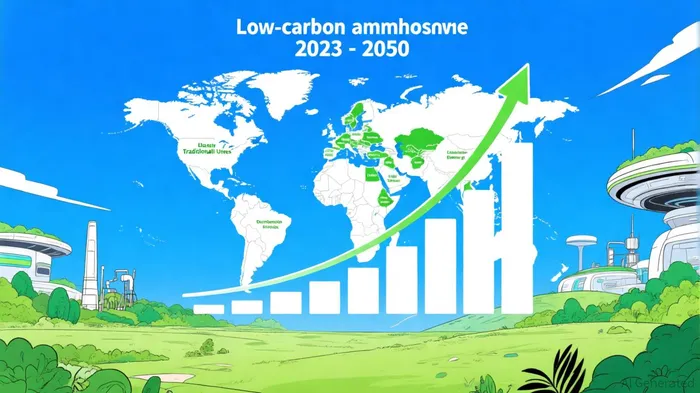





Comentarios
Aún no hay comentarios