
Retail Optimism and Institutional Pessimism: A Tale of Contrarian Timing in 2025
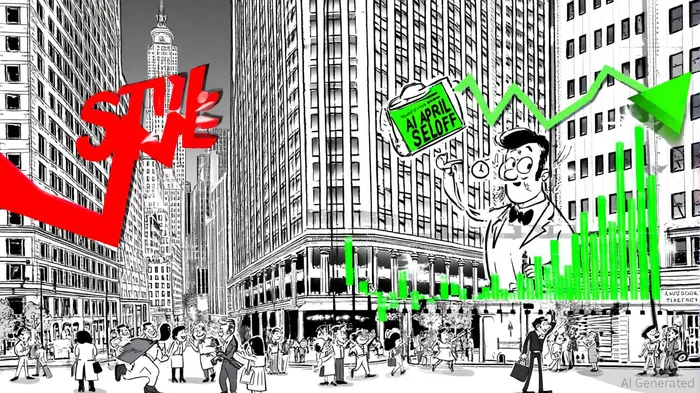
The divergence between retail and institutional investor behavior in 2025 has become one of the most striking phenomena in modern financial markets. In early April, both groups collectively sold $27 billion in U.S. stocks, driven by uncertainty over newly announced tariffs, according to S&P Global Market Intelligence. Yet, as the selloff deepened, a sharp divergence emerged: while institutional investors—particularly hedge funds—adopted a bearish stance, shorting U.S.-listed ETFs to record levels, per an Investing.com analysis, retail traders poured $40 billion into equity markets, defying macroeconomic headwinds. This asymmetry raises critical questions about contrarian market timing and the reallocation of capital in an era of fragmented investor sentiment.
The Mechanics of Divergence
The April–May 2025 period revealed a stark split in risk appetite. Institutional investors, wary of rising interest rates and geopolitical tensions, rotated capital from active long-only accounts to diversified ETFs, prioritizing broad exposure over individual stock risk, according to S&P Global Market Intelligence. Meanwhile, retail investors, emboldened by social media-driven momentum and the allure of AI stocks, extended their buying streak despite economic uncertainties, according to a CNBC report. By May, retail flows had absorbed much of the equity sell-off, with hedge funds and index funds absorbing $17.12 billion in equities, per S&P Global Market Intelligence. This dynamic created a self-reinforcing cycle: institutional shorting depressed prices, while retail buying provided a floor, amplifying volatility.
Contrarian Outcomes: AI Stocks and the Post-Selloff Rebound
The subsequent Q3 2025 market rebound, fueled by a retreat in tariffs and a Federal Reserve rate cut, vindicated some retail bets. A basket of 38 AI stocks, as identified by Morningstar, surged 15.7% in the third quarter, outpacing the broader market's 7.7% return. This performance underscores the potential rewards of contrarian timing when retail investors target sectors with strong fundamentals—such as AI infrastructure—amid institutional pessimism. However, the narrative is not uniformly positive. The Consumer Discretionary sector, a favorite among retail traders, faced headwinds due to rising operational costs and a U.S. government shutdown, illustrating the risks of overconcentration in momentum-driven assets, as reported by S&P Global Market Intelligence.
Capital Reallocation and the Rise of Private Markets
The selloff also accelerated a broader shift in capital allocation. As public equity markets fluctuated, investors—both retail and institutional—increasingly turned to private markets for perceived stability, a trend highlighted in PwC's midyear outlook. Private equity and venture capital saw inflows as investors sought insulation from daily market volatility. Yet, this trend is not without caveats. Illiquidity and valuation risks remain significant, and private assets may eventually face repricing pressures as macroeconomic conditions evolve, PwC notes.
Lessons for Investors
The 2025 divergence highlights the limitations of traditional market wisdom. Institutional pessimism, often seen as a contrarian signal, did not always align with long-term value. Retail investors, frequently dismissed as irrational, demonstrated resilience and sector-specific insight. However, their success hinged on disciplined selection—AI stocks with robust earnings outperformed speculative tech names, according to Morningstar. For investors, the key takeaway is clear: divergence itself is not a strategy, but a signal. The real opportunity lies in discerning which bets reflect genuine value and which are driven by fleeting momentum.







Comentarios
Aún no hay comentarios