
Resilience in Turbulence: 4 Industrial Services Stocks Poised to Outperform in 2026
The global economy in 2026 is marked by a stark duality: while traditional manufacturing sectors grapple with contraction, rising costs, and trade policy uncertainty, e-commerce-driven demand continues to surge, creating a two-speed economy according to financial analysis. This divergence presents both challenges and opportunities for industrial services stocks. Those that align with structural trends-such as automation, supply-chain resilience, and digital transformation-are uniquely positioned to outperform. Below, we analyze four such stocks, each leveraging strategic positioning to navigate the turbulence.
1. Honeywell International (HON): Automation and Supply-Chain Resilience
Honeywell, a leader in industrial automation and control systems, has emerged as a critical player in addressing the dual pressures of manufacturing inefficiencies and supply-chain fragility. As manufacturers seek to offset rising labor and material costs, Honeywell's offerings in Industrial IoT and digital twin technology are gaining traction. The company has also expanded its U.S. facilities and diversified supplier bases to mitigate trade policy risks, a move that aligns with broader reshoring trends. Analysts highlight its ability to deliver operational efficiency amid macroeconomic headwinds, making it a cornerstone of a resilient industrial portfolio.
2. Rockwell Automation (ROK): Enabling Smart Manufacturing
Rockwell Automation is capitalizing on the shift toward smart manufacturing, a trend underscored by the Deloitte 2026 Manufacturing Industry Outlook as a key driver of competitiveness. Its programmable logic controllers (PLCs) and industrial software solutions are in high demand as manufacturers adopt automation to reduce costs and improve agility. Despite the broader manufacturing slowdown-evidenced by the S&P Global U.S. Manufacturing PMI easing to 52 in September 2025- Rockwell's focus on digital transformation has insulated it from sector-wide declines. 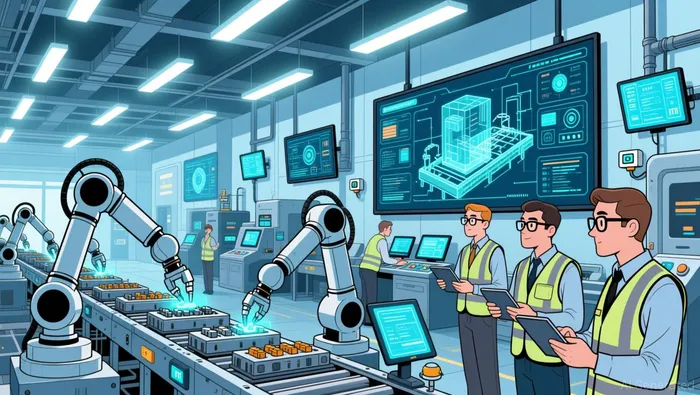 This strategic pivot positions it to benefit from long-term structural tailwinds in industrial productivity.
3. Fastenal (FAST): E-Commerce and Digital Transformation
Fastenal exemplifies how industrial services firms are adapting to the e-commerce boom. The company reported a 13.5% increase in eBusiness sales in Q2 2025, with digital sales accounting for 61% of total revenue. By enhancing its digital footprint and automating operations, Fastenal has improved margins and customer retention, even as traditional manufacturing activity wanes. Its success reflects broader industry trends outlined in the 2025 fulfillment industry report, which emphasizes automation and real-time data analytics as critical to meeting evolving consumer expectations according to industry analysis.
4. Stantec (STN): Infrastructure and Long-Term Structural Demand
Stantec, a provider of infrastructure and facilities services, is benefiting from long-term structural trends such as water security and aging infrastructure. While manufacturing employment and investment have declined in 2025, Stantec's focus on asset longevity and operational efficiency has driven steady demand. Its expertise in public and private infrastructure projects positions it to capitalize on government spending initiatives and private-sector investments in resilience, making it a defensive play in an otherwise volatile sector.
Conclusion: Navigating the Two-Speed Economy
The industrial services sector's performance in 2026 will hinge on its ability to adapt to divergent economic forces. Companies like HoneywellHON--, Rockwell AutomationROK--, Fastenal, and Stantec are not merely weathering the storm-they are actively reshaping their industries through innovation and strategic foresight. As Deloitte notes, technologies such as agentic AI and smart manufacturing will further redefine competitiveness. For investors, these stocks represent a compelling blend of resilience and growth potential in an era of uncertainty.







Comentarios
Aún no hay comentarios