
Regulatory Scrutiny and Risk in the Subprime Auto Lending Sector
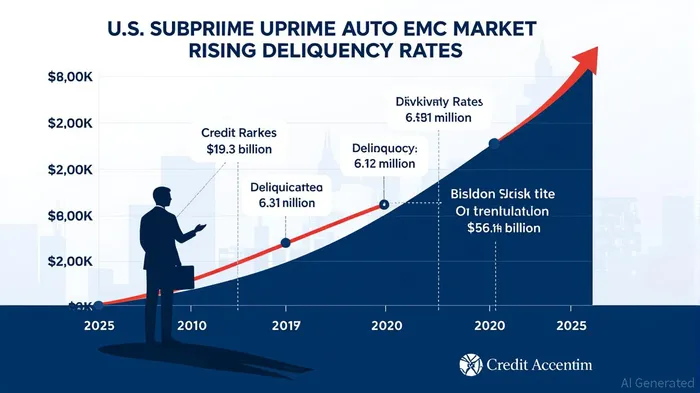
The subprime auto lending sector, long a cornerstone of financial inclusion for credit-challenged borrowers, now faces a precarious juncture. While the market has expanded to a value of $19.3 billion in 2025, growing at a compound annual rate of 4.6% since 2020, this growth has been accompanied by rising delinquency rates and intensifying regulatory scrutiny. Investors must grapple with a dual challenge: the sector's potential to serve underserved markets and the systemic risks posed by its fragility under economic stress.
Regulatory Shifts and the Case of Credit Acceptance
The withdrawal of the Consumer Financial Protection Bureau (CFPB) from a joint lawsuit against Credit AcceptanceCACC-- in January 2023 underscores the evolving regulatory landscape. Initially, the CFPB and New York State Attorney General had targeted the lender for alleged predatory practices, including excessive fees and opaque terms. However, the CFPB's decision to limit the case to New York consumers significantly reduced its scope and potential penalties. This outcome, hailed by Credit Acceptance as a “positive development,” reflects a broader trend of federal regulators adopting a more cautious approach to enforcement in subprime lending.
Such shifts, while beneficial for firms like Credit Acceptance, highlight the sector's vulnerability to sudden policy changes. The CFPB's retreat may embolden other lenders to resist regulatory pressure, but it also raises questions about the adequacy of consumer protections. For investors, this duality—reduced immediate legal exposure versus long-term reputational and compliance risks—demands careful consideration.
Rising Delinquencies and Economic Volatility
The sector's financial health is further strained by deteriorating credit performance. By June 2025, the 60-day delinquency rate for subprime auto loans had climbed to 6.31%, up from 5.62% in June 2024. This rise is particularly pronounced among non-captive lenders, which cater to borrowers with the lowest credit scores and highest risk profiles. The confluence of rising interest rates and economic uncertainty has exacerbated defaults, leading to the collapse of several smaller lenders.
For investors, these trends signal a growing asymmetry of risk. While the sector's growth is driven by demand for credit among marginalized borrowers, the concentration of high-risk loans creates a fragile asset base. A further spike in delinquencies—triggered by a recession or tightening monetary policy—could lead to widespread losses, particularly for firms lacking robust risk-management frameworks.
Fintech and the New Frontier of Risk
The integration of digital platforms and artificial intelligence into subprime lending has introduced both opportunities and challenges. On one hand, these tools have improved operational efficiency and expanded access to credit. On the other, they have complicated regulatory oversight, especially when fintech firms partner with FDIC-insured banks. The rapid pace of innovation has outstripped the ability of regulators to enforce consistent standards, creating pockets of systemic risk.
Moreover, the digitalization of lending has amplified the transmission of monetary policy. As interest rates rise, the cost of capital for subprime lenders increases, squeezing profit margins. This dynamic is particularly acute for non-bank lenders reliant on securitization markets, which have tightened in response to higher default expectations.
Investor Implications and Strategic Considerations
The absence of specific details about the Department of Justice's (DOJ) investigation into Tricolor Auto Finance—despite its potential to serve as a bellwether for the sector—underscores the opacity of regulatory risks. However, the broader trends outlined above provide a clear framework for assessing exposure. Investors should prioritize firms with:
1. Robust credit underwriting: Lenders that employ conservative risk-assessment models and maintain adequate loss reserves.
2. Diversified funding sources: Companies less reliant on volatile securitization markets or high-cost debt.
3. Compliance agility: Firms capable of adapting to shifting regulatory priorities, such as those with dedicated legal and policy teams.
Conversely, investors should approach firms with opaque business models or heavy exposure to non-captive lending with caution. The recent failures of smaller lenders demonstrate that even modest economic shocks can trigger cascading defaults in a sector already stretched by high leverage.
Conclusion
The subprime auto lending sector remains a double-edged sword for investors. Its growth reflects a genuine need for credit access among underserved populations, but its structural vulnerabilities—exacerbated by regulatory ambiguity and economic volatility—pose significant risks. As the DOJ's probe into Tricolor Auto Finance unfolds, the broader industry must brace for intensified scrutiny. For now, the lessons from Credit Acceptance and the sector's deteriorating credit metrics offer a cautionary tale: in subprime lending, the line between innovation and instability is perilously thin.
Source:
[1] Research Exchange: June 2025 [https://bpi.com/research-exchange-june-2025/]
[2] Breaking Down Auto Loan Performance [https://libertystreeteconomics.newyorkfed.org/2025/02/breaking-down-auto-loan-performance/]
[3] Subprime Auto Loans in the US [https://www.ibisworld.com/united-states/industry/subprime-auto-loans/5743/]
[4] CFPB Drops Federal Lawsuit Against Credit Acceptance [https://www.stocktitan.net/news/CACC/credit-acceptance-welcomes-cfpb-s-withdrawal-from-1z86k6wp7tw9.html]





Comentarios
Aún no hay comentarios