
Regulatory Risk in High-Growth Tech Firms: Governance and CEO Accountability in the Age of AI and Digital Assets
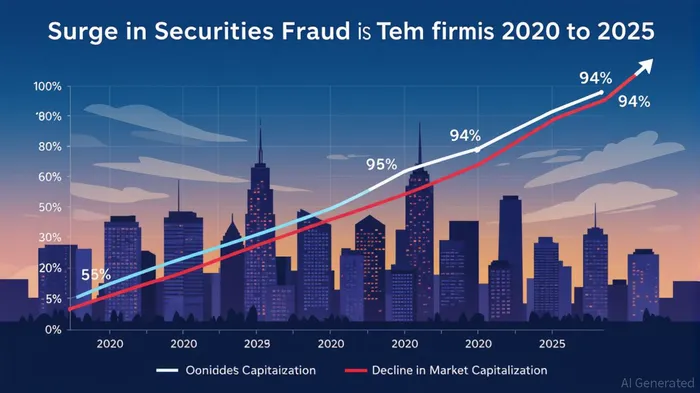
The recent charges against the co-CEO of Oustin Technology by the U.S. Department of Justice (DOJ) underscore a critical juncture in the regulatory scrutiny of high-growth technology firms. The case, which involves a $100 million securities fraud scheme orchestrated through a social media-driven stock price manipulation, has caused the company's market value to plummet by 94%[1]. This dramatic collapse is not an isolated incident but part of a broader pattern of governance failures and CEO overreach in the tech sector, where rapid innovation often outpaces institutional safeguards.
The Oustin Technology Case: A Microcosm of Governance Failures
Oustin Technology's co-CEO allegedly exploited the company's governance structure to execute a fraudulent scheme that misled investors about the firm's financial health and strategic direction. According to a report by Marketscreener, the manipulation involved coordinated social media campaigns to inflate the stock price, followed by the co-CEO's exit with significant gains as the market value collapsed[1]. This case highlights a recurring issue in high-growth tech firms: the concentration of power in executive leadership. When a single individual or a small group holds disproportionate control over decision-making, oversight mechanisms often falter, enabling self-serving behavior at the expense of transparency and accountability[1].
The fallout from Oustin's case mirrors similar governance crises in other tech firms. For instance, Luminar TechnologiesLAZR-- faced a 16.8% stock price drop in May 2025 after its founder and CEO, Austin Russell, resigned amid an internal ethics inquiry. Russell's 83% voting power in the company created a governance risk that regulators and investors are now scrutinizing more closely[2]. These cases reveal a systemic vulnerability: when leadership structures lack checks and balances, the potential for fraud—and its subsequent market repercussions—increases exponentially.
Regulatory Shifts: DOJ and SEC Prioritize Investor Protection
The DOJ and SEC have responded to these challenges with a recalibration of enforcement priorities. Under the leadership of SEC Chairman Paul Atkins, the agency has adopted a “back-to-basics” approach, emphasizing retail investor protection and holding individual wrongdoers accountable[3]. This strategy is evident in the recent case against Albert Saniger, founder of Nate, Inc., who was charged for misrepresenting the AI capabilities of his application to investors[3]. Similarly, the DOJ's dismissal of FCPA charges against former CognizantCTSH-- executives reflects a nuanced enforcement framework that differentiates between willful misconduct and good-faith innovation[4].
These regulatory shifts signal a broader intent to balance innovation with accountability. As stated by Acting Assistant Attorney General Matthew R. Galeotti, the DOJ aims to “protect good-faith innovators while prosecuting bad actors in the digital asset space”[4]. This dual focus is critical in an era where AI, blockchain, and other emerging technologies are reshaping industries but also creating new avenues for fraud.
Implications for Investors: Governance as a Risk Metric
For investors, the Oustin and LuminarLAZR-- cases serve as cautionary tales. High-growth tech firms often attract capital with bold visions and disruptive technologies, but these very attributes can mask governance weaknesses. Laura H. Posner, a prominent figure in securities litigation, has emphasized the importance of derivative actions and governance reforms in recovering losses for defrauded investors[5]. Her work underscores a growing trend: investors are increasingly demanding robust oversight mechanisms, such as independent boards, whistleblower protections, and transparent succession planning[5].
The financial consequences of governance failures are stark. Oustin's 94% market value drop and Luminar's $2 billion loss illustrate how quickly investor confidence can erode when trust is breached. Moreover, the SEC's recent dismissal of the SolarWinds case over cybersecurity disclosure standards[6] suggests that regulatory expectations are evolving. Investors must now assess not only a firm's technological potential but also its governance maturity.
Conclusion: Rebuilding Trust in the Tech Sector
The regulatory landscape for high-growth tech firms is undergoing a profound transformation. As the DOJ and SEC intensify their focus on securities fraud and corporate governance, the onus is on firms to institutionalize accountability. For Oustin Technology and others like it, the path to recovery lies in demonstrating transparency, diversifying leadership structures, and aligning executive incentives with long-term value creation.
Investors, in turn, must treat governance as a core risk metric. In an industry where innovation is both a blessing and a curse, the ability to distinguish between visionary leadership and self-serving opportunism will determine not just regulatory outcomes but also market resilience.







Comentarios
Aún no hay comentarios