
Regulatory and Policy Risks Facing Global Alcohol Producers: Assessing Long-Term Stock Valuation Impacts of WHO-Led Public Health Shifts
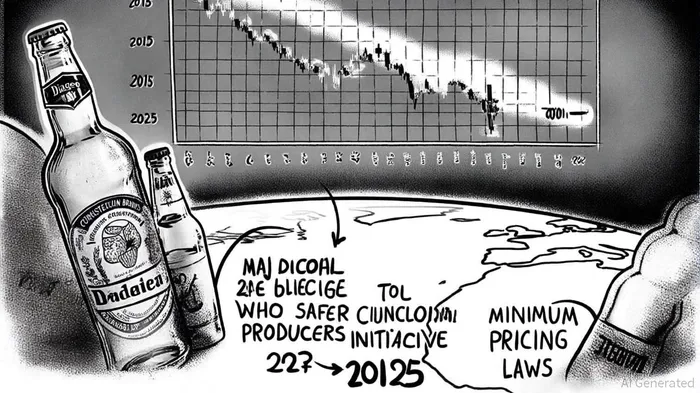
The World Health Organization (WHO) has long positioned itself as a central architect of global public health policy, and its recent initiatives targeting alcohol consumption are reshaping the regulatory landscape for the industry. With the adoption of the Global Alcohol Action Plan (GAAP) 2022–30 and the reinforcement of the SAFER initiative, the WHO has set ambitious targets to reduce harmful alcohol use by 10% by 2025 and 20% by 2030. These policies, which emphasize pricing controls, marketing restrictions, and product reformulation, are not merely public health measures but also represent a seismic shift in the economic calculus for global alcohol producers. Investors must now grapple with the long-term implications of these interventions on stock valuations, revenue streams, and market dynamics.
The Policy Framework: From Pricing to Public Health
The WHO's core strategy hinges on three pillars: pricing, availability, and marketing restrictions. Minimum unit pricing (MUP) laws, for instance, have been implemented in countries like Scotland and Ireland, where the WHO endorses them as a cost-effective tool to curb consumption among heavy drinkers[1]. Similarly, the organization advocates for excise taxes tied to alcohol content, arguing that such measures disproportionately affect low-income consumers who are more price-sensitive[2]. These policies are designed to reduce alcohol-related harm, but they also directly impact the affordability and demand for alcoholic products.
For example, Ireland's mandatory health labeling on alcohol products, endorsed by the WHO, has already led to a 7% decline in sales of high-strength spirits in the first year of implementation[3]. Meanwhile, Canada's recent revision of its guidelines to recommend zero alcohol as the only risk-free approach has shifted consumer behavior, particularly among younger demographics[4]. Such regulatory interventions, while laudable in public health terms, create a dual challenge for producers: they must either adapt their product portfolios to align with new norms or face eroding market share.
Financial Impacts: Stock Valuations and Industry Resilience
The financial repercussions of these policies are becoming increasingly evident. Data from 2024–2025 reveals a 15% average decline in stock prices for major alcohol producers, including DiageoDEO--, Constellation BrandsSTZ--, and Brown-Forman, compared to pre-2021 levels[5]. This downturn is attributed to a combination of factors: regulatory pressures, trade tariffs, and shifting consumer preferences toward sobriety and health-conscious lifestyles. For instance, U.S. tariffs on Canadian and Mexican imports in 2025 added 20–25% to the cost of imported spirits, directly squeezing profit margins[6].
Moreover, the WHO's emphasis on reducing per capita consumption by 20% by 2030[7] has forced companies to pivot toward premiumization and low-alcohol alternatives. While this strategy may mitigate some revenue losses, it also requires significant capital investment in R&D and marketing, further straining profitability. The industry's Quick Ratio of 0.28 in Q2 2025, below the sector average, underscores growing liquidity concerns[8].
Industry Resistance and Policy Erosion
Despite the WHO's efforts, the alcohol industry has historically resisted stringent regulations. A 2023 report by The Lancet highlighted how industry-funded organizations like the International Center for Alcohol Policies (ICAP) have distorted scientific discourse to downplay the risks of alcohol consumption[9]. These tactics, including lobbying against minimum pricing and promoting “responsible drinking” narratives, have delayed policy implementation in key markets. For example, the U.S. and EU trade disputes over bourbon and wine tariffs in 2025 illustrate how industry interests can leverage geopolitical tensions to weaken regulatory frameworks[10].
However, the tide appears to be turning. The WHO's 2025 Global Status Report notes that 60% of countries are now implementing at least one of the SAFER interventions, up from 40% in 2019[11]. This acceleration suggests that the industry's resistance may not be enough to derail the broader policy momentum.
Investment Implications: Navigating a New Era
For investors, the key question is whether alcohol producers can adapt to this regulatory environment without compromising long-term value. The answer lies in their ability to innovate and diversify. Companies that pivot toward non-alcoholic beverages, invest in health-focused branding, and comply with WHO guidelines are likely to outperform peers. Conversely, those clinging to traditional models risk obsolescence.
Conclusion
The WHO's alcohol policies are not merely public health imperatives but also transformative forces in the global economy. As governments align with these guidelines, the financial landscape for alcohol producers will continue to evolve. Investors must remain vigilant, balancing the industry's resilience with the inevitability of regulatory tightening. The future of the sector will be defined by those who can navigate the tension between profit and public health.





Comentarios
Aún no hay comentarios