
Regional Banking Consolidation and Investor Value: The Mid Penn Bancorp Acquisition of 1st Colonial Bancorp as a Case Study
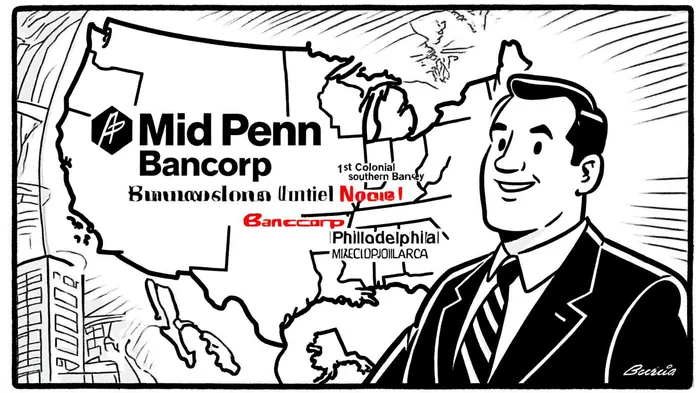
The acquisition of 1st Colonial Bancorp by Mid Penn BancorpMPB--, valued at approximately $101 million, represents a strategic move in the broader context of regional banking consolidation. This transaction, structured as a 60% stock and 40% cash deal, underscores the growing trend of midsize banks seeking scale to navigate regulatory pressures, technological demands, and competitive market dynamics. For investors, the deal raises critical questions about the balance between cost synergies, integration risks, and long-term value creation.
Strategic Rationale and Market Context
Mid Penn Bancorp's acquisition of 1st Colonial Bancorp is driven by the need to expand its footprint in the greater Philadelphia metropolitan area, particularly southern New Jersey. The combined entity will hold pro forma assets exceeding $7.2 billion, positioning it to better serve a broader customer base and enhance product offerings[1]. This aligns with a broader industry shift: regional banks are increasingly leveraging mergers to leap over regulatory asset thresholds rather than incrementally scaling operations[3]. For instance, the 2018 Economic Growth, Regulatory Relief and Consumer Protection Act raised compliance burdens for banks below $100 billion in assets, incentivizing consolidation[1].
The current regulatory environment, marked by a more flexible stance from the new administration, has further accelerated this trend. The recent approval of Capital One's acquisition of Discover signals a willingness to tolerate larger deals, potentially paving the way for up to 40 bank M&A transactions annually involving institutions with over $100 billion in assets[3]. Analysts predict this could lead to the formation of seven megabanks with more than $1 trillion in assets within a decade[2].
Investor Value: Opportunities and Challenges
For investors, the Mid Penn-1st Colonial deal exemplifies the dual-edged nature of regional banking consolidation. On the one hand, mergers can unlock economies of scale, reduce operational costs, and enhance profitability. Historical data suggests that successful bank mergers yield an 8% increase in shareholder value within the first year and a 15% return over five years[2]. For example, the 2022 merger of Alpha Bank and Omega Financial boosted cross-product sales by 10%, directly contributing to revenue growth[2].
However, the current market environment presents challenges. Post-election stock rallies have driven up valuations for regional banks, making it harder to identify acquisition targets at prices that justify the expected synergies[2]. Mid Penn's per-share offer of $20.03, based on its stock price as of September 23, 2025, reflects this premium. While the deal promises cost synergies—such as branch rationalization and staff realignment—it also carries integration risks. Cultural misalignment, technological system consolidation, and talent retention are persistent hurdles that could erode value if mishandled[4].
Integration Risks and Regulatory Hurdles
The success of the Mid Penn-1st Colonial merger hinges on effective integration. Past mergers, such as Mega Bank's union with Superior Bank, achieved $500 million in annual savings through operational efficiencies[2]. Yet, these gains required meticulous planning. For Mid PennMPB--, the challenge lies in harmonizing 1st Colonial's operations with its own while maintaining customer trust and regulatory compliance.
Regulatory scrutiny remains a wildcard. While the new administration's pro-consolidation stance reduces some barriers, antitrust concerns persist. A 2023 Brookings Institution report noted that 30% of proposed banking mergers face regulatory challenges related to market concentration[2]. Mid Penn's acquisition, though modest in scale, will still require approvals that could delay the closing until late Q1 or early Q2 2026[1].
Conclusion: A Calculated Bet in a Shifting Landscape
Mid Penn Bancorp's acquisition of 1st Colonial Bancorp is emblematic of a sector in transition. For investors, the deal offers a glimpse into the strategic imperatives driving regional banks: scale, resilience, and technological agility. While the potential for cost synergies and geographic expansion is compelling, the risks of integration missteps and regulatory delays cannot be ignored.
In the long term, the success of this merger—and others like it—will depend on the ability of management to execute integration plans with precision. If Mid Penn can navigate these challenges, the combined entity may emerge as a stronger competitor in a consolidating market. For now, the transaction serves as a case study in the delicate balance between ambition and execution in the evolving banking landscape.





Comentarios
Aún no hay comentarios