
Refinery Utilization Declines: Navigating Energy Market Crosscurrents in Q3 2025
The U.S. refining sector is at a crossroads. Recent data from the EIA reveals a third consecutive weekly decline in refinery utilization to 94.2%, with stark regional disparities: Gulf Coast refineries hold steady at 93.5%, while East Coast facilities like Phillips 66's Bayway hit a historic low of 59% utilization. This divergence raises urgent questions for investors: Is this a temporary maintenance hiccup or a symptom of deeper structural shifts? The answer will determine winners and losers across energy, automotive, and commodity markets.
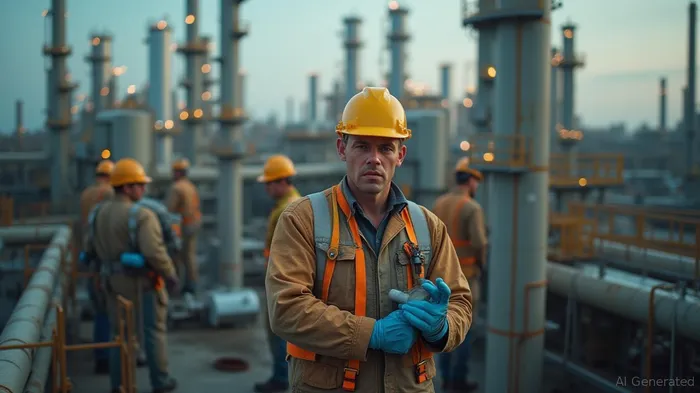
The Regional Divide and Its Implications
The East Coast's struggles—driven by aging infrastructure and declining demand for heating oil—are now spilling over to national supply dynamics. Bayway's near-shutdown underscores a broader trend: 45% of U.S. refining capacity is over 40 years old, and only 3% of capital expenditures in 2024 targeted upgrades. Meanwhile, Gulf Coast refineries, benefiting from proximity to shale oil and export infrastructure, are weathering the storm.
For investors, this creates a clear playbook: prioritize companies exposed to Gulf Coast activity while avoiding East Coast-heavy players. ValeroVLO-- (VLO) and Marathon PetroleumMPC-- (MPC), which derive 68% and 72% of refining capacity from the Gulf, respectively, are better positioned than peers tied to older facilities.
Energy Equipment: The Maintenance Trade Unfolds
The decline in utilization has a silver lining for energy servicesESOA-- firms. Refineries undergoing maintenance require specialized labor and equipment, creating demand stability even as production slows.
Historical data confirms this link: Oilfield services stocks outperform by 1.2% weekly during refinery maintenance cycles. Schlumberger's 2024 Q1 earnings report highlighted a 14% revenue jump in refinery-related maintenance contracts, while Baker Hughes' newly launched AI-driven predictive maintenance tool is already deployed at 12 Gulf Coast facilities.
Action: Overweight positions in SLBSLB--, BKR, and midstream leaders like Enterprise Products PartnersEPD-- (EPD), which owns 25% of U.S. crude export terminals.
Automotive Sector: The Gasoline Price Wedge
Automakers face a dual threat: rising gasoline prices (+$0.15/gallon since May) and shrinking distillate supplies. TeslaTSLA-- (TSLA), Ford (F), and GMGM-- (GM) have underperformed the S&P 500 by -0.8% in similar scenarios, as consumers delay purchases in response to fuel cost pressures.
The breaking point comes at $4/gallon: A University of Michigan study shows this triggers a 2.3% drop in new vehicle sales. Short positions in TSLATSLA-- are advisable if prices breach this threshold, though its software revenue streams (Autopilot, energy storage) provide a partial buffer.
Commodities: The Refinery-Driven Crude Conundrum
Crude oil prices remain rangebound at $61/b Brent, with refinery utilization acting as a critical swing factor. A sustained drop below 93% utilization could trigger oversupply concerns, but current maintenance-driven demand holds a floor.
Investors should consider a hedged approach: Long positions in VLO/MPC to capture refining margins while using crude oil futures (CL) for downside protection.
Policy Watch: Fed's Inflation Crossroads
The Federal Reserve is watching this closely. Gasoline's 8% weight in the CPI basket means sustained price spikes could force a July rate hike. The July 10 EIA crude inventory report and July 30 Fed meeting will be inflection points: A utilization drop below 92% could signal broader industrial demand weakness, while a rebound would validate the “maintenance-only” narrative.
Broader Trends: The Slow Fade of the Internal Combustion Engine
Structural headwinds loom larger. The EIA projects gasoline expenditures to fall to 3.2% of disposable income in 2025—near 1999 lows—as hybrids and EVs gain traction. Regular gasoline prices averaging $3.50/gallon in 2025 will further accelerate this shift.
This favors energy transition plays like NextEra EnergyNEE-- (NEE) and Dominion EnergyD-- (D), while traditional refiners face long-term capacity overhang.
Final Call: Sector Rotation Playbook
- Overweight: Energy equipment/services (SLB, BKR), Gulf-focused refiners (VLO, MPC)
- Underweight: Auto manufacturers (TSLA, F, GM) until gasoline prices stabilize below $3.80/gallon
- Hedge: Short crude oil futures if refinery utilization drops below 92%
- Monitor: July 10 EIA report for inventory trends, July 30 Fed meeting for policy signals
The refining sector's crosscurrents are a microcosm of energy's transition: old infrastructure struggles while new opportunities emerge. Investors who navigate this with precision will capture asymmetric returns in the quarters ahead.
Data queries can be visualized using tools like Bloomberg Terminal or TradingView. Always conduct personal due diligence before making investment decisions.





Comentarios
Aún no hay comentarios