
Realty Income's Liquidity and Dividend Sustainability in a Shifting REIT Landscape
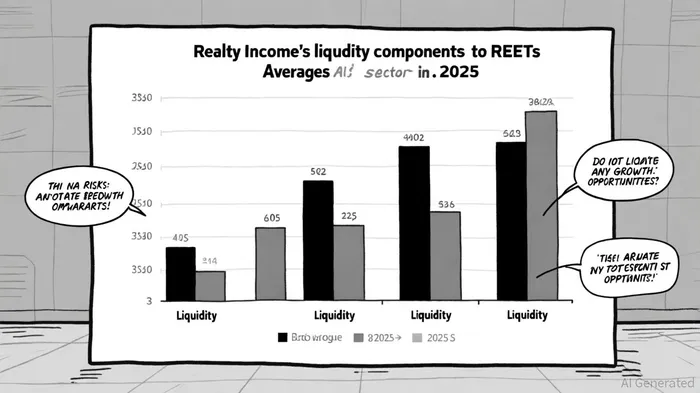
Realty Income (O), the “Monthly Dividend Company,” has long been a cornerstone for income-focused investors, boasting 32 consecutive years of dividend growth. As of September 2025, the company reported $3.6 billion in liquidity, comprising $579 million in cash and equivalents, $1.1 billion in unsettled ATM forward equity, and $1.9 billion in revolving credit facilities[1]. This robust liquidity position, coupled with a strategic focus on European expansion, underscores its ambition to achieve a $5 billion investment volume in 2025[2]. Yet, the sustainability of its 5.62% yield remains a critical question, particularly given a dividend payout ratio of 310.6%—far exceeding the REIT sector average of 80.5%[3].
Liquidity and Strategic Allocation
Realty Income's liquidity provides a buffer against immediate refinancing pressures, including its $4.625 billion notes due in November 2025[1]. The company's A3/A- credit ratings further bolster confidence in its ability to access capital markets[4]. However, the composition of its liquidity raises concerns. While $1.9 billion in credit facilities offers flexibility, reliance on short-term debt exposes it to interest rate volatility. With the Federal Reserve signaling potential rate cuts in 2025, Realty IncomeO-- may benefit from lower borrowing costs, but its 3.18% ROIC—below its WACC—suggests inefficiencies in capital deployment[1].
Dividend Sustainability: A Delicate Balance
The company's dividend payout ratio of 310.6% is unsustainable by traditional metrics. Unlike most REITs, which target payout ratios below 100%, Realty Income funds dividends through a mix of operating cash flow and external financing. For instance, in Q1 2025, it raised $625 million via equity to offset negative operating free cash flow of $456 million[5]. This strategy hinges on continued access to capital, which could be strained if market conditions deteriorate. The Altman Z-Score of 1.05—a threshold for potential insolvency—further amplifies risks[1].
Sector Context: Resilience Amid Divergence
The broader REIT sector offers a mixed backdrop. Publicly traded U.S. equity REITs averaged an 80.5% AFFO payout ratio in Q1 2025, with self-storage REITs at 94.3% and industrial REITs at 86.3%[6]. Realty Income's 310.6% ratio is an outlier, reflecting its aggressive dividend policy. While industrial and residential REITs benefit from e-commerce and urbanization trends, Realty Income's focus on retail and net-lease properties exposes it to sector-specific headwinds, such as tenant bankruptcies and declining foot traffic[7].
Interest rate dynamics will also shape outcomes. J.P. Morgan Research notes that REITs with lower leverage (Realty Income's debt-to-equity ratio: 0.74) are better positioned to navigate rate cuts[8]. However, net-lease REITs like Realty Income typically thrive in low-rate environments, as their long-term, fixed-rate leases become more attractive. With rates stabilizing in 2025, the company's European expansion—targeting higher-yielding markets—could offset domestic challenges[2].
Growth Potential and Risks
Realty Income's 2025 guidance for $5 billion in investments highlights its growth ambitions. European expansion, while promising, introduces geopolitical and currency risks. For example, a 10% depreciation of the euro against the dollar could erode earnings from its European portfolio. Additionally, the company's focus on recycling assets—selling underperforming properties to fund higher-yielding acquisitions—remains a double-edged sword. While this strategy has historically driven growth, it requires disciplined execution to avoid margin compression[4].
Conclusion: A High-Yield Gamble
Realty Income's liquidity and credit ratings provide a strong foundation, but its dividend sustainability hinges on continued access to capital and favorable interest rate conditions. In a sector where payout ratios above 90% are already seen as risky, Realty Income's 310.6% ratio demands vigilance. For investors, the key question is whether the company can maintain its dividend streak without compromising long-term value. While its European expansion and disciplined balance sheet offer hope, the risks of overleveraging and declining operating margins cannot be ignored[1].





Comentarios
Aún no hay comentarios