
Raymond James' $1.5 Billion Senior Notes Offering: Strategic Capital Structure Optimization in a Rising Rate Environment
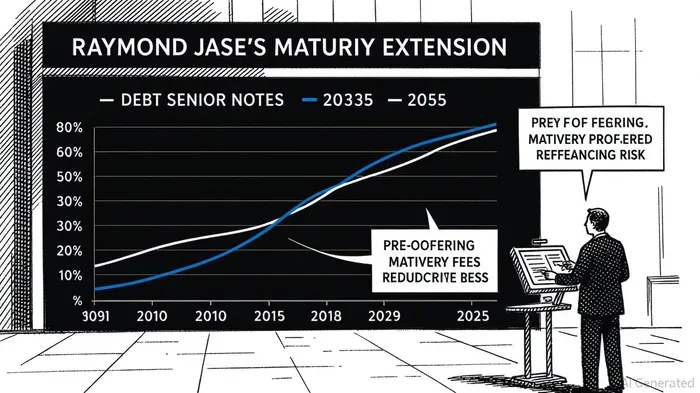
In a calculated move to fortify its balance sheet amid persistent macroeconomic uncertainties, Raymond James FinancialRJF-- Inc. has priced a $1.5 billion senior notes offering, split into two tranches: $650 million of 4.900% notes due 2035 and $850 million of 5.650% notes due 2055[1]. This issuance, set to close on September 11, 2025, reflects a deliberate strategy to optimize capital structure, reduce refinancing risks, and navigate the challenges of a rising interest rate environment[2].
Strategic Rationale: Locking in Rates Amid Uncertainty
The decision to issue long-term fixed-rate debt underscores Raymond James' proactive approach to managing interest rate exposure. With the Federal Reserve's tightening cycle still reverberating through capital markets, corporations face elevated borrowing costs for short-term refinancing. By securing funding at fixed rates of 4.900% and 5.650%, Raymond James effectively insulates itself from near-term rate hikes, ensuring predictable debt servicing costs over the next decade and beyond[3].
This strategy aligns with broader fixed-income principles: in a rising rate environment, extending debt maturities and locking in current rates mitigate the risk of refinancing at higher costs. The 2055 tranche, in particular, demonstrates a long-term orientation, anchoring the firm's capital structure against cyclical volatility[4]. Such a move is especially prudent for a financial services firm with $1.64 trillion in client assets, where stability and investor confidence are paramount[5].
Capital Structure Resilience: Low Leverage and Strong Credit Metrics
Raymond James' ability to execute this offering at favorable terms is underpinned by its robust credit profile. The firm maintains long-term issuer ratings of A- from S&P and Fitch, and A3 from Moody'sMCO--, reflecting its conservative financial management and capital strength[5]. As of Q3 2025, its long-term debt-to-equity ratio stands at 0.24, with $2.889 billion in long-term debt and $12.261 billion in equity[6]. This low leverage, combined with no short-term debt maturities in recent quarters[7], positions the firm to absorb interest rate shocks without compromising liquidity.
The offering further enhances financial resilience by extending the average maturity of its debt. With no immediate refinancing needs, Raymond James can focus on long-term value creation rather than short-term cost management. This is critical in an industry where regulatory demands and market fluctuations necessitate a buffer of liquidity and capital[8].
Broader Implications for Financial Sector Strategy
Raymond James' approach mirrors trends across the investment banking sector, where firms are increasingly prioritizing debt capital markets underwriting to help clients navigate trade tensions and regulatory shifts[9]. For Raymond James itself, the offering reinforces its role as both a capital allocator and a strategic advisor, leveraging its expertise to align its own balance sheet with macroeconomic realities.
However, the firm's strategy is not without risks. The 2055 tranche, with its 5.650% coupon, exposes the firm to potential discounting pressures if rates rise further. Yet, given its stable earnings history—150 consecutive quarters of profitability[5]—and conservative leverage, such risks appear manageable.
Conclusion: A Model for Prudent Capital Management
Raymond James' $1.5 billion senior notes offering exemplifies strategic capital structure optimization. By extending maturities, securing fixed rates, and maintaining a low-debt profile, the firm strengthens its financial resilience in an era of uncertainty. For investors, this move signals confidence in long-term stability and operational discipline—qualities that will become increasingly valuable as interest rates remain elevated.





Comentarios
Aún no hay comentarios