
The Political Uncertainty of a Government Shutdown and Its Impact on Financial Markets
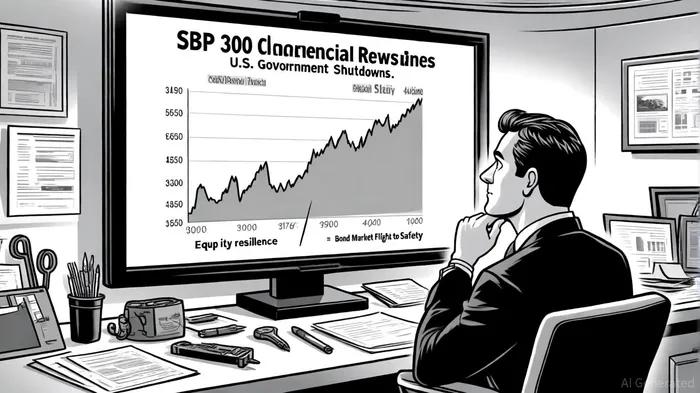
The U.S. government shutdown that began on October 1, 2025, has once again exposed the fragility of political institutions in managing fiscal responsibilities. While the immediate economic impact remains modest-historical precedent suggests a GDP contraction of approximately 0.05 percentage points per week of shutdown, according to a Morgan Stanley analysis-the broader implications for financial markets and strategic asset allocation are far more complex. This shutdown, driven by partisan deadlock over healthcare subsidies and executive authority, has created a "data desert" that obscures the Federal Reserve's ability to navigate its monetary policy path, as noted in a J.P. Morgan note. For investors, the challenge lies in balancing short-term volatility with long-term resilience, while navigating the unique pressures of a political landscape increasingly defined by brinkmanship.
Market Reactions: Resilience Amid Uncertainty
Financial markets have responded with a mix of caution and adaptability. On the first day of the shutdown, the S&P 500 defied expectations by rising 0.34%, a testament to the index's historical resilience during such events, according to a YCharts analysis. Defense stocks, however, exhibited divergent behavior: while manufacturers like Lockheed Martin remained stable, government services contractors such as CACI InternationalCACI-- surged by 2.28%, reflecting investor expectations of post-shutdown catch-up spending noted in the YCharts analysis. Fixed-income markets, meanwhile, have amplified their role as safe havens. The 10-Year Treasury yield fell by 3 basis points in the shutdown's early days, as capital flowed into perceived safety, a pattern highlighted in that YCharts analysis. This dynamic underscores a critical lesson for asset allocators: in times of political uncertainty, liquidity and credit quality become paramount.
The volatility index (VIX) has risen modestly, but remains below levels indicative of systemic panic, per the YCharts analysis. Yet the true risk lies in the shutdown's potential to prolong uncertainty. A prolonged impasse could delay critical economic data-such as employment and inflation reports-disrupting the Federal Reserve's ability to calibrate its rate-cutting cycle, as the J.P. Morgan note explains. As economist Mark Zandi notes in a Business Insider article, such a scenario could force the Fed into policy decisions based on incomplete or outdated information, increasing the likelihood of missteps.
Strategic Asset Allocation: Navigating the New Normal
For investors, the shutdown highlights the need for a dual-pronged approach. First, defensive assets-particularly U.S. Treasuries and high-quality corporate bonds-remain essential hedges against short-term volatility. Despite historically low yields, Treasuries continue to attract capital during periods of uncertainty, with the 10-Year yield's decline during past shutdowns reinforcing their role as a refuge, as observed in the Morgan Stanley analysis. Second, sectoral tilts toward government-dependent industries, such as defense and healthcare, offer asymmetric payoffs. Healthcare ETFs like XLV, for instance, surged by 3.09% during the 2025 shutdown, reflecting a flight to quality amid broader market jitters noted in the YCharts analysis.
However, the shutdown also presents opportunities for contrarian strategies. Historically, the S&P 500 has delivered positive returns 55% of the time during shutdowns, according to the YCharts analysis, suggesting that prolonged political dysfunction may not necessarily translate into sustained equity underperformance. Investors with a longer time horizon might consider selectively adding to undervalued sectors insulated from government spending cuts, such as technology or consumer staples.
The Fed's Dilemma and Macroeconomic Risks
The shutdown's most profound indirect impact lies in its disruption of the Federal Reserve's decision-making framework. With key economic data delayed, the Fed faces a heightened risk of policy errors. For example, if inflation data is unavailable during a critical meeting window, the central bank may be forced to rely on lagging indicators or extrapolate from partial data-a recipe for misjudging inflationary pressures, as the J.P. Morgan note warns. This uncertainty has already contributed to a weakening U.S. dollar against the euro and Japanese yen, as capital seeks more stable jurisdictions, a trend the YCharts analysis highlights.
Moreover, the administration's threat of permanent workforce reductions via Reduction in Force (RIF) notices adds a layer of economic instability. While the direct GDP impact of such measures remains unclear, the psychological toll on markets could amplify volatility, particularly if shutdowns become recurrent features of the political landscape, a risk flagged by J.P. Morgan.
Conclusion: Preparing for a New Era of Political Risk
The 2025 government shutdown serves as a stark reminder of how political dysfunction can morph into financial risk. For asset allocators, the priority must be to build portfolios resilient to both short-term shocks and long-term institutional erosion. This means overweighting liquid, high-credit-quality assets, maintaining flexibility in equity exposure, and closely monitoring developments in fiscal policy.
As the shutdown unfolds, the broader lesson is equally important: in an era where political uncertainty is no longer an exception but a norm, strategic asset allocation must evolve to treat such risks as endemic. The markets' ability to adapt-much like the S&P 500's 4.4% average gain during past shutdowns noted in the Morgan Stanley analysis-will ultimately depend on the agility of investors to reprice risk in real time.





Comentarios
Aún no hay comentarios