
Political Turmoil in France: Market Volatility and Investment Opportunities Post-Lecornu
The resignation of French Prime Minister Sébastien Lecornu on October 6, 2025, within hours of forming his government, has intensified a political crisis that has plagued France for much of the year. This abrupt transition-marking Macron's fifth prime minister in two years-has sent shockwaves through financial markets and raised urgent questions about the country's economic governance. The episode underscores the fragility of a political system increasingly polarized between Macron's centrist coalition, the far-right National Rally, and a fragmented opposition. For investors, the implications are twofold: heightened market volatility and the emergence of sector-specific opportunities amid uncertainty.
Market Reactions: A Test of Resilience
The immediate fallout from Lecornu's resignation was stark. According to a CNBC report, the CAC 40 index plummeted 1.9% in the wake of the news, reflecting investor anxiety over the government's ability to pass the 2026 budget and implement structural reforms. Bond markets also reacted, with France's 10-year yield climbing to a 10-day high, signaling rising risk perceptions, the CNBC report added. This volatility mirrors broader European trends, as the DAX and FTSE MIB indices also declined, illustrating contagion effects noted in a Le Monde opinion piece.
The banking sector bore the brunt of the selloff, with BNP Paribas and Société Générale dropping over 6% in a single session. This vulnerability stems from the sector's reliance on sovereign debt and domestic lending, which become riskier in an environment of fiscal uncertainty - according to a France24 live update. Similarly, energy stocks faced headwinds as France's fiscal instability raised doubts about policy continuity in the sector, particularly for EDF, the state-owned utility critical to maintaining the country's nuclear fleet, according to a Telkes analysis.
Defense and Energy: Strategic Priorities Amid Chaos
Despite the turmoil, France's defense and energy sectors remain focal points for both policy and investment. Lecornu's brief tenure highlighted his commitment to shielding European defense industries from non-EU competition, particularly U.S. systems like the Patriot missile. His resignation has left a void in leadership for the National Strategic Review (RNS 2025), which outlines 11 strategic objectives, including modernizing air and missile defense, advancing space capabilities, and ensuring technological sovereignty, according to France24.
The RNS 2025 also emphasizes a €64 billion defense budget by 2027, with €6.5 billion in additional funding announced to accelerate rearmament efforts. However, the delayed 2025 budget and political gridlock threaten to stall critical projects, such as the next-generation aircraft carrier and cyber-AI recruitment drives, as noted by Le Monde. For investors, this duality of ambition and dysfunction presents opportunities in defense contractors capable of navigating bureaucratic hurdles, as well as in European joint ventures like the ELSA long-range strike program, which France24 has discussed.
In the energy sector, the government's focus on nuclear expansion and renewable acceleration remains a cornerstone of its economic strategy. The Renewables and Nuclear Acceleration Acts aim to streamline permitting and boost infrastructure, but EDF's financial struggles-exacerbated by aging reactors and rising debt-pose risks to France's role as Europe's top electricity exporter, as reported by Telkes. Investors with a long-term horizon may find value in firms positioned to benefit from green technology incentives, though short-term volatility is likely as political transitions delay policy implementation.
Navigating the Uncertainty: Expert Insights and Strategies
Political instability has already slowed France's economy, with growth forecasts slashed to below 1% for 2025 and public debt reaching 113.9% of GDP, Investing.com reported. Laurent Ferrara of SKEMA Business School notes that the lack of a stable government has eroded foreign investment and household confidence, compounding challenges from rising debt and a potential credit rating downgrade, according to France24. Yet, within this uncertainty, some sectors show resilience. The manufacturing sector, for instance, has posted its first growth in two and a half years, suggesting opportunities for investors willing to target industrial modernization, the Investing.com piece also noted.
For defense and energy, the key lies in aligning with policy priorities that transcend political cycles. The RNS 2025's emphasis on European technological autonomy and industrial resilience offers a framework for long-term investment, even as short-term execution falters. In energy, bets on nuclear innovation and renewable infrastructure may prove less volatile than broader equity markets, provided they align with the government's strategic goals.
Conclusion: A Balancing Act
France's political instability presents a paradox for investors: a market rife with volatility yet underpinned by strategic sectors poised for growth. The defense and energy industries, though buffeted by short-term uncertainty, remain central to Macron's vision of a sovereign, reindustrialized Europe. For those with the patience to navigate the turbulence, opportunities exist in firms and projects aligned with these priorities. However, the path forward demands vigilance, as the next government-whether led by Macron's allies or the far right-will inevitably reshape the landscape.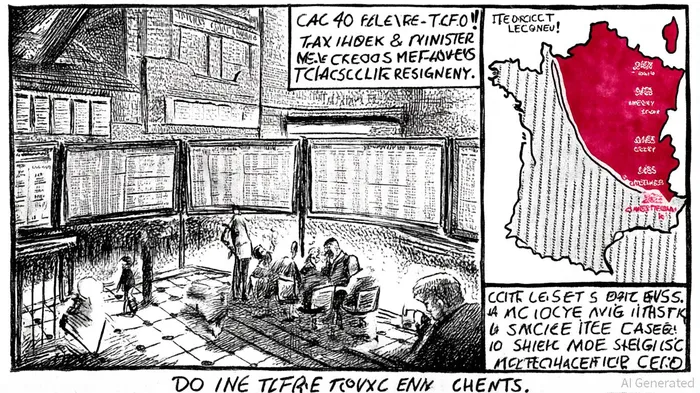







Comentarios
Aún no hay comentarios