
Pemex's Escalating Payment Crisis and Its Implications for Energy Service Providers
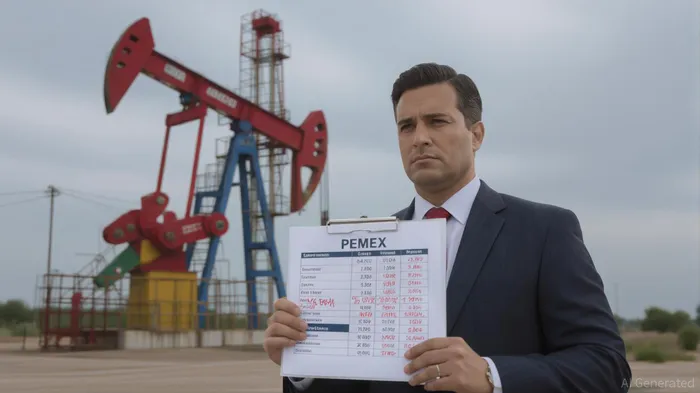
The Mexican state-owned oil company Pemex has become a ticking time bomb for global energy infrastructure firms. As of August 2025, its supplier debt has ballooned to $23 billion, with total financial obligations nearing $101 billion. This crisis is no longer confined to Mexico's borders; it has triggered a ripple effect across the global energy supply chain, threatening the solvency of major service providers like Baker HughesBKR--, HalliburtonHAL--, and SchlumbergerSLB--. For investors, the question is no longer whether Pemex's debt crisis will resolve itself, but how to navigate the fallout—and whether strategic divestment or hedging is warranted.
A Systemic Risk in the Making
Pemex's payment delays have created a liquidity crisis for energy serviceESOA-- providers. The Mexican Association of Oil Services Companies (AMESPAC) reports that its members—representing firms like Halliburton and Schlumberger—are owed $3.49 billion in unpaid invoices for work already completed in 2024 and the first half of 2025. These delays are not just a cash flow issue; they are a production issue. Service providers are now scaling back operations, with some, like Grupo Mexico, halting oil platforms entirely. The result? Mexico's crude output has fallen to a 15-year low, and the risk of a full-scale production collapse looms.
The systemic risk extends beyond Mexico. Energy service firms are capital-intensive, and prolonged cash flow disruptions threaten their ability to service debt, invest in technology, and maintain operational capacity. For example, Halliburton has reported unresolved payments from Pemex, while Grupo Carso, controlled by Carlos Slim, is owed $700 million in overdue invoices. These firms are now forced to prioritize liquidity over growth, a shift that could stifle innovation and efficiency gains in the global energy sector.
Investor Strategies: Hedging, Divestment, and the Search for Resilience
For investors, the Pemex crisis has become a case study in risk management. The widening credit default swap (CDS) spreads for Pemex—now exceeding 600 basis points—signal a growing perception of default risk. This has prompted a reevaluation of exposure to Mexico-exposed equities.
1. Hedging Against Pemex's Debt Contagion
Investors with holdings in energy service providers like Baker Hughes or Schlumberger are increasingly turning to hedging tools. Shorting Pemex bonds or purchasing CDS contracts are two options to mitigate downside risk. Additionally, diversifying into firms with lower Pemex exposure—such as IEnova (INE), a Sempra Energy subsidiary focused on gas infrastructure—offers a buffer. IEnova's focus on cross-border pipelines and energy transition projects insulates it from Pemex's debt woes while aligning with long-term energy trends.
2. Strategic Divestment: When to Cut Ties
For firms with significant Pemex exposure, divestment is becoming a pragmatic choice. The Energy Workforce & Technology Council (EWTC), representing 250 energy service companies, has warned that $1.2 billion in unpaid invoices from 2024 and 2025 alone could force operational shutdowns. Investors should scrutinize companies that lack diversified revenue streams or robust balance sheets. For example, private producers like Hokchi Energy are already pivoting to alternative markets to avoid Pemex's payment bottlenecks.
3. Capitalizing on Market Consolidation
The crisis may also create opportunities for value investors. If the Pemex debt crisis triggers a wave of distressed asset sales, firms with strong liquidity—such as Grupo Mexico's mining and logistics divisions—could acquire undervalued infrastructure at a discount. These sectors, less tied to Pemex's fortunes, offer a hedge against energy-sector volatility.
The Political and Regulatory Wild Card
Mexico's energy reforms, which prioritize Pemex and the state-run Federal Electricity Commission (CFE), add another layer of uncertainty. While these policies aim to stabilize the national energy sector, they risk alienating private investors and triggering trade disputes under the USMCA. Investors must also contend with Pemex's opaque debt restructuring plans and the politicization of its operations under the new National Energy Commission. Regulatory independence remains a critical concern.
Conclusion: Navigating the Storm
The Pemex crisis is a stark reminder of the interconnectedness of global energy markets. For investors, the path forward requires a balance of caution and opportunism. Hedging tools, selective divestment, and a focus on resilient infrastructure firms are essential strategies. Yet, the broader lesson is clear: in an era of energy transition and geopolitical volatility, overreliance on state-owned enterprises with unsustainable debt profiles is a recipe for disaster.
As the Mexican government scrambles to stabilize Pemex, investors must ask themselves: Is this a temporary disruption, or a harbinger of deeper systemic fragility? The answer will shape not only the future of Mexico's energy sector but the global energy landscape for years to come.





Comentarios
Aún no hay comentarios