
Oil Market Volatility Amid Trump's Russia Sanction Deadline and Global Trade Tensions
The 50-day grace period granted by U.S. President Donald Trump to Russia before potential sanctions take effect has recalibrated the oil market's near-term outlook. With immediate fears of supply disruption eased, traders are now laser-focused on oversupply risks, OPEC's production discipline, and weakening demand signals. This analysis argues for a short-term bearish stance on crude futures, supported by technical indicators and fundamental headwinds.
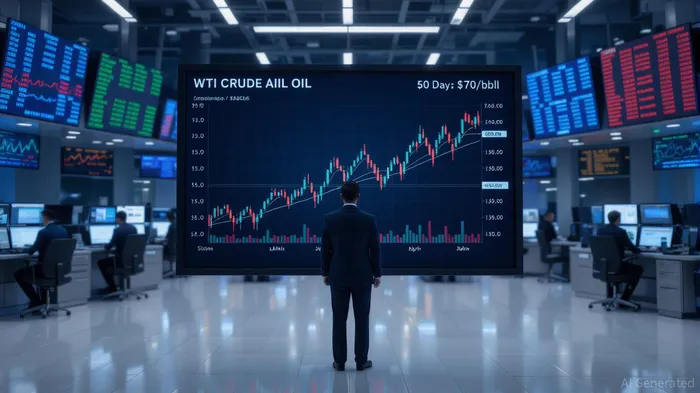
The Grace Period: A Bridge to Oversupply
Trump's decision to delay sanctions until early September 2025 has deflated immediate fears of a Russian oil supply shock. The 50-day window allows Moscow to continue selling crude to China, India, and others, bypassing U.S. sanctions via a “shadow fleet” of ships and opaque trade deals.
The market's relief is evident in crude's recent dip below $72/bbl—a 5% decline since the grace period was announced. However, the reprieve has also emboldened producers. Russian exports to Asia remain robust, while OPEC+ has quietly ramped up production to defend market share.
OPEC's Compliance: A Fragile Shield Against Oversupply
OPEC+'s production compliance has slipped to 70% in Q2 2025, according to internal reports, as members like Saudi Arabia and Iraq prioritize revenue over quotas. Meanwhile, non-OPEC Russia is flooding Asian markets, with exports to China alone hitting 5 million barrels/day in July—a record high.
This overproduction risks swamping a market already grappling with slowing demand. Analysts at Goldman SachsGS-- now project a 1 million barrel/day surplus by October 2025, even without sanctions.
China's Refining Data: A Demand Drag
China's refining throughput—the world's largest—has stalled at 13.5 million barrels/day, down 2% year-on-year, as domestic consumption lags.
Beijing's refineries, once a lifeline for Russian oil exporters, now face lower margins and weaker demand for fuels like gasoline and diesel. This has forced state-owned giants like Sinopec to cut crude purchases, further pressuring global prices.
U.S. Tariffs: A Double-Edged Sword for Growth
While the 50-day grace period delays sanctions, the looming threat of 500% tariffs on Russian oil buyers (under the Sanctioning Russia Act) remains a demand wildcard. A 30% tariff on Chinese imports, for instance, could trim U.S.-China trade by $200 billion annually, denting global GDP growth by 0.5%.
A weaker economy means less demand for crude—ahead of winter heating season—while U.S. shale producers, buoyed by high rig counts, add to oversupply.
Investment Strategy: Short Crude, Set Stops at Resistance
The confluence of overproduction, tepid demand, and geopolitical uncertainty creates a bearish near-term scenario for crude futures.
Recommendation:
- Position: Short WTIWTI-- crude futures (CL) or use put options on energy ETFs like USOUSO--.
- Target: $65/bbl by early September.
- Stop-Loss: Exit if prices breach $75/bbl (200-day moving average).
Technical Edge:
- WTI's recent breakdown below $72/bbl invalidates the July uptrend.
- Resistance at $75/bbl (psychological and technical) offers a clear exit point.
Conclusion: Ride the Bearish Wave, but Stay Alert
The oil market's near-term narrative is one of oversupply, not shortage. While geopolitical risks remain, the 50-day grace period has shifted focus to fundamentals—where the math points downward. Traders should capitalize on this bearish momentum, but remain nimble: a sudden ceasefire deal or OPEC+ cuts could reverse the trend abruptly.

Until then, short crude and set stops at $75/bbl. The bear's in town—and it's hungry.





Comentarios
Aún no hay comentarios