
Oil Market Oversupply and the Path to a $55–$60 Brent Price Floor in 2026
The global oil market in 2025 is grappling with a paradox: a structural oversupply that threatens to depress prices despite persistent geopolitical risks. According to the International Energy Agency (IEA), world oil supply has surged to 109 million barrels per day (b/d), driven by OPEC+ producers accelerating the unwinding of voluntary production cuts and non-OPEC nations-particularly the United States, Canada, Brazil, and Norway-expanding output according to a recent analysis. This imbalance has pushed Brent crude toward a projected price floor of $55–$60 per barrel in 2026, a level that reflects both the weight of oversupply and the lingering shadow of geopolitical uncertainty.
Structural Oversupply: The Dominant Force
The core of the current crisis lies in the mismatch between supply and demand. The IEA forecasts that global oil supply will grow by 3.1 million b/d in 2025 and an additional 2.5 million b/d in 2026, while demand growth remains subdued as reported by Reuters. By 2026, this dynamic is expected to create a surplus of 4.09 million b/d, a figure that dwarfs the market's ability to absorb excess output according to the same report.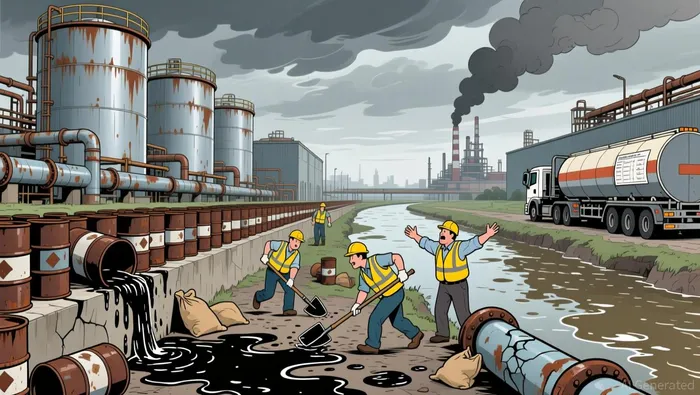 The U.S. Energy Information Administration (EIA) notes that domestic crude production may decline in 2026 due to weaker price signals, but this is unlikely to offset the broader glut according to a commentary.
This oversupply is not merely a short-term phenomenon. Reduced upstream investment, particularly in the U.S. shale sector, where breakeven costs hover between $61 and $70 per barrel according to industry analysis, suggests that the market may struggle to adjust to long-term demand shifts. Meanwhile, the IEA has revised its peak oil demand forecast to 113 million b/d by 2050, underscoring the structural risks of underinvestment in supply-side capacity as noted in the same analysis.
Geopolitical Risks: Complacency and Asymmetric Threats
While the market fixates on oversupply, geopolitical risks remain a critical wildcard. Analysts warn of a "complacent" outlook, with limited spare production capacity leaving the market vulnerable to shocks such as an attack on the Strait of Hormuz or renewed targeting of Russian infrastructure according to SP Global research. These risks are amplified by the asymmetric nature of geopolitical conflicts, which disproportionately increase price volatility during periods of heightened tension as highlighted in a recent article.
For instance, the potential removal of sanctions on Russian oil following a ceasefire in Ukraine could flood the market with discounted barrels, further depressing prices according to energy intelligence. Conversely, sustained sanctions or instability in the Middle East could tighten supply unexpectedly, creating upside risks for prices as forecasted by Investing.com. However, such scenarios are increasingly overshadowed by the bearish fundamentals of a surplus-driven market. J.P. Morgan Research and other institutions project that Brent crude will average $58 per barrel in 2026, with WTI trading in the low to mid-$50s according to their latest research.
Investment Implications: Navigating the Glut and Uncertainty
The structural oversupply and geopolitical volatility necessitate a recalibration of investment strategies. For oil producers, particularly smaller and mid-sized firms, the current price environment poses significant challenges. U.S. shale producers, for example, face breakeven costs that exceed the projected price floor, forcing a reevaluation of capital allocation and operational efficiency as noted in industry reports. OPEC+ members, meanwhile, are under pressure to balance market share and price stability, as evidenced by their decision to pause additional production increases in early 2026 according to financial news.
Investors must also contend with the implications of a flat oil futures curve, which reflects market expectations of prolonged oversupply according to financial analysis. This dynamic reduces the incentive for physical storage, as contango-a condition where future prices exceed spot prices-deepens as detailed in a market report. For energy transition-focused portfolios, the paradox of a near-term surplus coexisting with long-term supply deficits presents a unique challenge. While demand for oil is expected to peak by 2050, the lack of investment in upstream projects could trigger a supply crunch as early as the late 2020s according to the same commentary.
Conclusion: A Delicate Equilibrium
The path to a $55–$60 Brent price floor in 2026 is shaped by two opposing forces: the gravitational pull of oversupply and the unpredictable push of geopolitical shocks. While the market appears to have priced in the former, the latter remains a latent threat that could disrupt this equilibrium. For investors, the key lies in hedging against both scenarios-capitalizing on the near-term bearish outlook while preparing for the structural imbalances that may emerge in the coming decade. As the oil industry navigates this complex landscape, the interplay between supply, demand, and geopolitical risk will remain the defining narrative of the next chapter in energy markets.







Comentarios
Aún no hay comentarios