
Office REITs and the Path to Recovery: What Kilroy's BofA Presentation Reveals
The commercial real estate sector, long shadowed by the lingering effects of the post-pandemic shift to remote work, is showing signs of stabilization. Among the most compelling narratives is the resurgence of office Real Estate Investment Trusts (REITs), particularly those with strategic positioning in high-demand markets and a commitment to sustainability. Kilroy Realty CorporationKRC-- (KRC), a West Coast-focused office REIT, has emerged as a case study in resilience. Its participation in the Bank of AmericaBAC-- (BofA) 2025 Global Real Estate Conference underscores a broader industry reckoning with the future of office space. By examining KRC's strategies alongside BofA's sector analysis, we can discern why office REITs may yet prove to be a compelling long-term investment.
Strategic Positioning: Kilroy's Resilience in a Transformed Market
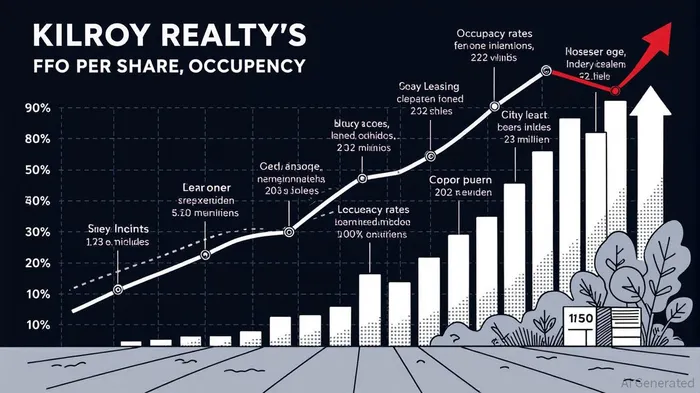
Kilroy's portfolio, spanning 16.4 million square feet of office and life science properties, is anchored in premier West Coast markets such as San Francisco, Los Angeles, and San Diego. As of June 30, 2025, its stabilized office portfolio reported 80.8% occupancy and 83.5% leased, reflecting steady demand despite broader sector challenges[1]. This performance is underpinned by a strategic pivot toward high-growth sectors, including artificial intelligence (AI) and life sciences, which have driven over 400,000 square feet of leasing activity in Q2 2025 alone[2].
The company's emphasis on sustainability further differentiates it. KilroyKRC-- has maintained carbon-neutral operations since 2020 and has been recognized with accolades such as the GRESB five-star rating and the ENERGY STAR Partner of the Year award[1]. These credentials align with a sector-wide shift toward environmentally responsible buildings, as tenants increasingly prioritize wellness and sustainability in their workspace choices[3]. Kilroy's CEO, Angela Aman, has explicitly linked this trend to San Francisco's recovery, noting that AI-driven economic activity is fueling demand for premium office space[2].
Sector Trends: BofA's Outlook and the Path to Recovery
BofA's 2025 analysis of the office REIT sector paints a cautiously optimistic picture. The bank projects that vacancy rates will peak by early 2026, with leasing activity gradually improving as companies adapt to hybrid work models and the return-to-office trend gains momentum[4]. Crucially, the report highlights a structural bifurcation in the market: high-quality, well-located properties are gaining favor, while lower-quality assets face obsolescence[5]. This dynamic positions REITs like Kilroy—those with disciplined capital allocation and a focus on premier assets—to outperform peers.
The firm also notes that office REITs are benefiting from declining new supply, which should support occupancy growth over time[4]. Kilroy's selective asset sales, including properties in Silicon Valley and Los Angeles, exemplify this strategy. By generating liquidity for reinvestment and debt reduction, the company is optimizing its balance sheet while maintaining a strong presence in key markets[2]. BofA's Jana Galan, a REIT analyst, emphasizes that capital allocation and NOI growth will be critical metrics for sector resilience, a focus that Kilroy has clearly embraced[5].
Challenges and Opportunities
Despite these positives, challenges persist. Kilroy's total assets as of June 30, 2025, stood at $10.86 billion, a decline from the previous year's $11.54 billion[2]. This reflects broader economic pressures, including elevated interest rates, which remain a drag on valuation growth. BofA's 2025 outlook acknowledges that while REITs are projected to deliver 9.5% total returns, earnings growth will remain modest, with FFO/AFFO growth estimated at 4.8%[3]. For office REITs, the path to recovery hinges on their ability to navigate these headwinds while capitalizing on structural shifts.
Kilroy's approach—combining sustainability, strategic reinvestment, and a focus on high-growth sectors—positions it to do just that. Its Q2 2025 FFO of $1.13 per share, which exceeded expectations[2], demonstrates the potential for earnings resilience even in a challenging environment. Moreover, the company's development pipeline, including stabilized office properties and residential assets, offers a long-term growth catalyst[5].
Conclusion: A Case for Long-Term Confidence
The office REIT sector is at an inflection pointIPCX--. While the transition to hybrid work models has disrupted traditional demand patterns, it has also accelerated the evolution of office space into a more flexible, technology-driven, and sustainable asset class. Kilroy's performance at BofA's conference and its operational strategies highlight how strategic positioning can turn these challenges into opportunities. For investors, the key takeaway is clear: office REITs with strong fundamentals, a focus on quality, and alignment with macroeconomic trends—such as the AI revolution—are well-placed to deliver value over the long term.





Comentarios
Aún no hay comentarios