
OceanFirst's Strategic Merger with Flushing Financial: A High-Conviction Play in Regional Banking Consolidation
The regional banking sector is undergoing a transformative phase, driven by regulatory pressures, technological disruption, and the need for scale. . represents a bold strategic move to consolidate market share in the New York–New Jersey corridor, a region critical to the U.S. financial ecosystem. This analysis evaluates the deal's long-term value creation, capital structure optimization, and strategic positioning, arguing that the merger is a high-conviction play for investors seeking exposure to regional banking consolidation.
Strategic Rationale: Synergies and Market Expansion
The merger combines OceanFirst's New Jersey-centric operations with Flushing's entrenched presence in Long Island and New York City, according to the announcement. According to a report by American Banker, OceanFirstOCFC-- CEO Christopher Maher emphasized that the deal accelerates the company's growth in the New York franchise, bypassing the need for years of organic expansion. Flushing's conservative credit culture and its portfolio of -critical in a market where real estate remains a cornerstone asset-complement OceanFirst's business model. However, , underscoring a disciplined approach to integration.
The $225 million investment from Warburg Pincus further strengthens the strategic rationale. This private equity firm's 12% stake and board representation provide not only capital but also operational expertise, enhancing the merged entity's ability to execute its growth strategy. The board structure, with 17 directors split between OceanFirst (10), FlushingFFIC-- (6), and Warburg Pincus (1), balances governance continuity with fresh perspectives.
Capital Structure Optimization: Balancing Risk and Reward
The all-stock structure of the merger, , ensures alignment of interests while preserving OceanFirst's equity base. , , and 12% to Warburg Pincus according to the official announcement. This structure mitigates dilution risks compared to debt-heavy deals, a critical consideration in a sector where leverage ratios are under scrutiny.
Financial metrics highlight the deal's capital efficiency. , according to financial analysis. , according to financial projections. , , according to financial forecasts. 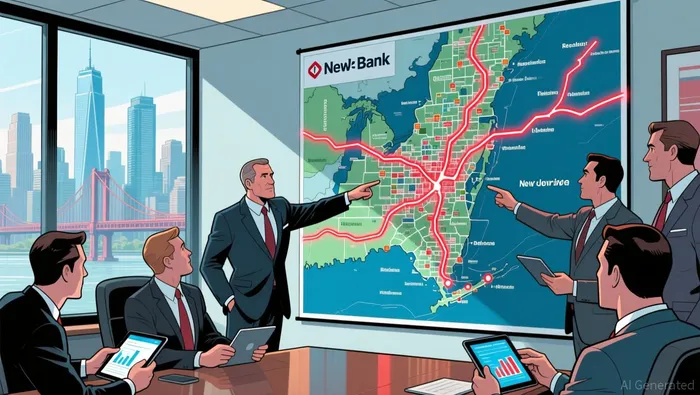
Strategic Positioning in the New York–New Jersey Corridor
The New York–New Jersey banking corridor is a high-growth market, with demand for specialized services in commercial real estate, small business lending, and wealth management. The merged entity's expanded footprint-covering 71 branches across Long Island, Queens, Brooklyn, Manhattan, and Philadelphia- positions it to capture market share from larger national banks. As noted by MarketBeat, the combined company's focus on multifamily loans aligns with the region's real estate dynamics, where rent-regulated properties remain a stable asset class.
Competitive advantages include a diversified loan portfolio ($17 billion in total loans) and a deposit base ($18 billion) that reduces reliance on wholesale funding. The merger also addresses regulatory pressures by enhancing capital adequacy. Warburg Pincus's investment elevates the combined company's Tier 1 capital, enabling it to withstand economic downturns while maintaining lending capacity.
Long-Term Value Creation: Metrics and Market Confidence
The deal's long-term value hinges on its ability to deliver consistent returns and operational efficiency. , as projected by , underscores the merger's financial viability. The strategic investment from Warburg Pincus not only provides capital but also signals confidence in the combined entity's growth trajectory.
Moreover, . , supported by a disciplined approach to risk management.
Conclusion
OceanFirst's merger with Flushing FinancialFFIC-- is a masterclass in regional banking consolidation. By leveraging strategic synergies, optimizing capital structure, and securing a dominant position in the New York–New Jersey corridor, the deal creates a compelling value proposition for investors. While challenges such as tangible book value dilution and integration risks exist, the projected financial metrics and Warburg Pincus's backing provide a strong foundation for long-term success. For investors seeking exposure to a high-conviction, well-structured regional banking play, this merger represents a rare opportunity in a sector poised for transformation.







Comentarios
Aún no hay comentarios