
Nvidia's Stock Sell-Off: Is This a Warning Signal or a Buying Opportunity?
Thiel's Exit: A Signal of Caution or a Misread of the Hype Cycle?
Billionaire Peter Thiel's decision to liquidate his entire $100 million stake in NvidiaNVDA-- during Q3 2025 has been interpreted by many as a cautionary signal. Thiel, known for his contrarian bets and early warnings about tech overvaluation, has long argued that the AI hype cycle risks outpacing real economic value. His Thiel Macro fund, which previously held 40% of its portfolio in Nvidia, now focuses almost entirely on Microsoft and Apple, reflecting a strategic pivot toward "sustainable" tech models according to reports. This exit aligns with broader institutional trends: SoftBank and Michael Burry also reduced positions in Nvidia during the same period according to financial reports.
Thiel's move is emblematic of a growing sentiment among institutional investors to lock in gains after Nvidia's stock surged 150% year-to-date. Yet, such exits must be contextualized. As one analyst noted, "Institutional selling is often a function of portfolio rebalancing rather than a rejection of the underlying business. The question is whether the sell-off reflects rational risk management or a misreading of the AI revolution's trajectory." According to analysis.
Nvidia's Financials: A Story of Resilience and Uncertainty
Nvidia's Q4 2025 results, released in early November, underscore its dominance in the AI and data-center markets. Revenue hit $39.3 billion, a 12% sequential increase and 78% year-over-year growth, with the data-center segment alone contributing $35.6 billion according to official results. Wall Street analysts project Q3 2026 revenue of $54.8 billion, a 56% year-on-year jump, driven by demand for Blackwell GB200 GPUs and AI infrastructure according to market analysis.
However, these figures mask growing concerns. The company's valuation-currently 42 times this fiscal year's expected earnings and 28 times next year's-has outpaced even the most optimistic revenue forecasts. As Bloomberg's David Rosenberg observed, "Nvidia's multiples are now embedded with the assumption that AI will deliver transformative value at scale. If that doesn't materialize, the stock could face a reckoning." According to financial commentary.
Institutional Behavior and Market Psychology: Parallels to the Dotcom Bubble?
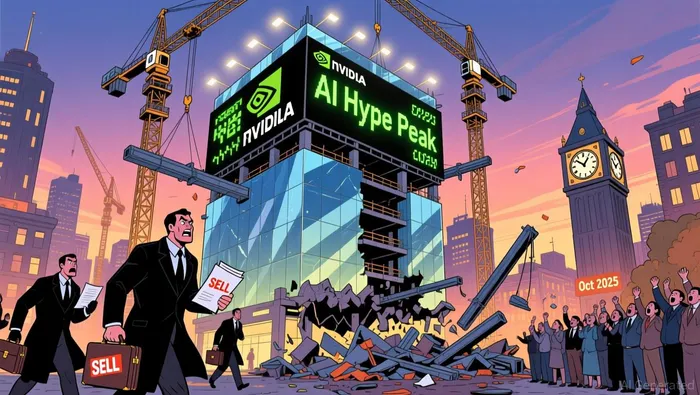
The sell-off has drawn comparisons to the Dotcom bubble of 2000, when institutional investors similarly exited overvalued tech stocks. Thiel himself has drawn this parallel, warning that "the current AI frenzy mirrors the irrational exuberance of the late 1990s" according to reports. Yet, the context differs. Unlike the Dotcom era, where many companies lacked revenue, Nvidia generates robust cash flows and has a clear path to monetizing AI through hardware and software ecosystems.
Still, institutional behavior suggests a shift in risk appetite. Thiel's fund reduced U.S. equity exposure from $212 million to $74.4 million during Q3 2025 according to financial reports, while others, such as Fidelity and BlackRock, have quietly added to their Nvidia positions. This duality-selling by some and buying by others-reflects divergent views on whether the stock is overcorrecting or overvalued.
Strategic Implications: Risk, Momentum, and Valuation
For investors, the key lies in balancing momentum with fundamentals. Nvidia's AI-driven growth story remains compelling, but its valuation now incorporates a high degree of forward-looking optimism. The sell-off by Thiel and peers may present a buying opportunity for those who believe in the long-term potential of AI, but it also serves as a reminder of the risks of extrapolating current trends indefinitely.
A strategic approach would involve:
1. Assessing Valuation Metrics: While Nvidia's price-to-earnings ratio is elevated, its revenue growth and market share in AI hardware justify a premium. However, investors must monitor whether earnings can keep pace with multiples.
2. Monitoring Institutional Sentiment: Divergent institutional behavior-selling by some, buying by others-suggests a market in flux. A sustained rebound in institutional demand could signal renewed confidence.
3. Evaluating AI's Economic Impact: The true test of Nvidia's value will come when AI-driven productivity gains translate into measurable economic outcomes, not just speculative hype.
Conclusion
Nvidia's stock sell-off is neither a definitive warning signal nor a guaranteed buying opportunity. It reflects the tension between market psychology-driven by fear of overvaluation-and the company's tangible growth in AI and data centers. For investors, the challenge is to distinguish between rational risk management and irrational exuberance. As history shows, markets often overcorrect before resuming their trajectories. The question is whether Nvidia's current sell-off is a correction or a prelude to a deeper reckoning.







Comentarios
Aún no hay comentarios