
NVIDIA's Dual-Architectural Strategy and Its Impact on 2026 AI Market Dominance
In the rapidly evolving landscape of artificial intelligence, NVIDIANVDA-- has emerged as a colossus, leveraging a dual-architectural strategy to cement its leadership. By strategically balancing the H200 and Blackwell architectures, the company is not only addressing immediate market demands but also future-proofing its supply chain and revenue streams. This approach, underpinned by meticulous supply chain management and a diversified business model, positions NVIDIA to dominate the AI hardware market in 2026 and beyond.
Strategic Supply Chain Flexibility: Bridging Gaps with H200 and Blackwell
NVIDIA's dual-track strategy hinges on the complementary roles of the H200 and Blackwell architectures. The H200, priced at approximately $27,000 per unit, serves as a critical bridge for mid-tier AI training and inference tasks, particularly in markets like China, where demand has surged following the relaxation of U.S. export restrictions. Chinese tech giants such as Alibaba and ByteDance have already placed orders for over 2 million H200 units in 2026, far outpacing NVIDIA's current inventory of 700,000. To meet this demand, NVIDIA is negotiating with TSMCTSM-- to ramp up 4nm production specifically for the H200, a move that extends the chip's lifecycle while ensuring supply stability according to market analysis.
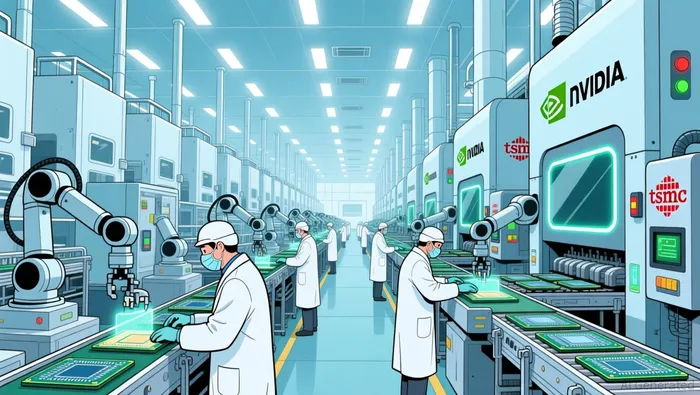
Meanwhile, the Blackwell architecture-represented by the GB200 and its successor, the GB300-remains in high demand, with backlogs stretching four to six quarters. Blackwell's complexity necessitates a sophisticated supply chain involving over 50 suppliers, including TSMC for fabrication and packaging, SK Hynix and Micron for HBM3e memory, and Amphenol and Foxconn for system integration as detailed in industry reports. This ecosystem, however, faces bottlenecks, particularly in advanced packaging technologies like CoWoS and HBM3e, which are expected to drive up costs and influence pricing strategies in 2026 according to supply chain experts. NVIDIA's ability to manage these dual supply chains-prioritizing H200 production for China while maintaining Blackwell's exclusivity-demonstrates its strategic flexibility.
Revenue Diversification: Beyond Data Centers
While NVIDIA's Data Center segment remains its crown jewel, the company is diversifying its revenue streams to mitigate risks. Q3 FY 2026 earnings highlighted record Data Center revenue of $51.2 billion, driven by Blackwell shipments and CUDA software adoption. However, NVIDIA is also expanding into adjacent markets. For instance, its automotive division reported a 103% year-over-year revenue increase in Q4 2025, reaching $570 million, fueled by autonomous vehicle demand. This diversification not only broadens NVIDIA's addressable market but also insulates it from sector-specific volatility.
The H200's role in this strategy is equally significant. By catering to China's AI infrastructure needs, NVIDIA is capturing a market that competitors like Huawei struggle to penetrate. Huawei's next-generation AI chips, despite recent advancements, remain less powerful and constrained by production capacity. This gap allows NVIDIA to maintain its premium pricing and ecosystem dominance, particularly through CUDA, which remains the de facto standard for AI developers according to industry analysts.
Implications for TSMC, HBM Suppliers, and Competitors
NVIDIA's dual-architectural strategy has profound implications for its supply chain partners. TSMC, for example, benefits from sustained 4nm utilization for the H200 while securing CoWoS-L packaging capacity for Blackwell, ensuring its position as NVIDIA's primary foundry. Similarly, HBM suppliers like SK Hynix and Micron face a historic supply crunch, with HBM3e prices expected to rise in early 2026 due to demand from both H200 and Blackwell lines. These dynamics reinforce NVIDIA's ability to command premium pricing and secure critical components, further entrenching its market position.
For competitors, NVIDIA's dominance presents a formidable barrier. AMD and Intel, despite incremental improvements in their AI offerings, lack the ecosystem and supply chain agility to match NVIDIA's scale. In China, Huawei's challenges in closing the performance gap underscore the difficulty of competing with a company that has mastered both hardware innovation and strategic production planning.
Conclusion: A Model for Sustained Dominance
NVIDIA's dual-architectural strategy exemplifies how strategic supply chain flexibility and revenue diversification can drive long-term market leadership. By tailoring the H200 to meet China's regulatory and demand constraints while maintaining Blackwell's exclusivity, NVIDIA is not only addressing immediate growth opportunities but also future-proofing its business. For investors, this approach signals a company that understands the delicate balance between innovation, supply chain resilience, and ecosystem control-a formula that is likely to sustain its dominance in the AI era.





Comentarios
Aún no hay comentarios