
Nvidia's AI-Driven Robotaxi Ecosystem and Its Strategic Implications for Uber's Future Growth
The autonomous vehicle revolution is no longer a distant promise but an unfolding reality, with NvidiaNVDA-- emerging as a pivotal infrastructure provider. For UberUBER--, a company that has long positioned itself as a platform for mobility rather than a technology developer, the partnership with Nvidia represents a strategic leap toward global robotaxi dominance. By leveraging Nvidia's AI-driven autonomous vehicle ecosystem, Uber is poised to overcome historical challenges in scalability, safety, and cost efficiency, accelerating its ambitions in a fiercely competitive market.
Nvidia's Infrastructure: A Catalyst for Scalability
Nvidia's DRIVE AGX Hyperion 10 platform is a cornerstone of its strategy to democratize Level 4 autonomy. This modular, sensor-agnostic architecture allows automakers and developers to build safe, scalable AI-defined fleets without reinventing the wheel. For Uber, this means significantly reduced R&D costs and faster deployment timelines. The platform's integration with the DRIVE AV software stack and the DRIVE AGX Thor automotive computer-capable of processing 1,000 TOPS of computing power-enables automakers like Stellantis, Lucid, and Mercedes-Benz to adopt standardized hardware and software solutions according to Nvidia and Uber.
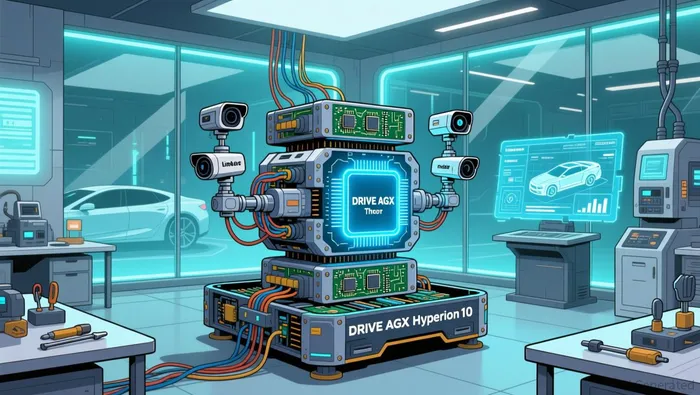 A key enabler of scalability is the joint AI data factory built on Nvidia's Cosmos platform, which processes trillions of real-world and synthetic driving miles. This infrastructure not only enhances the safety and performance of autonomous systems but also allows Uber to train its AI models at an unprecedented scale. By 2027, Uber aims to deploy 100,000 robotaxis globally, with 5,000 Level 4 vehicles already planned in collaboration with Stellantis as part of their 2027 plan. Such ambitions would be impossible without the computational and data-processing capabilities provided by Nvidia.
Overcoming Historical Challenges
Uber's previous forays into autonomous vehicles were marked by fragmented partnerships and technical hurdles. Collaborations with Waymo, Cruise, and May Mobility, while valuable, often involved disparate technologies and limited interoperability. The partnership with Nvidia, however, offers a unified solution. The DRIVE AGX Hyperion 10 platform's open architecture and the Alpamayo family of reasoning models-designed to break down complex driving scenarios into safer decision-making steps- address Uber's historical struggles with system integration and edge-case handling.
Moreover, Nvidia's Halos Certified Program, the first industry system to evaluate and certify physical AI safety, ensures that Uber's autonomous fleet meets rigorous safety standards across its lifecycle. This is critical in a market where public trust and regulatory approval are paramount. By aligning with a partner that prioritizes safety certification, Uber mitigates risks associated with autonomous deployment, a lesson learned from past incidents involving its earlier autonomous test fleets.
Strategic Positioning in a Competitive Landscape
The robotaxi race is intensifying, with Waymo and Tesla representing divergent approaches. Waymo's sensor-heavy, geo-fenced model has achieved 250,000 weekly paid rides, but its reliance on high-definition maps limits scalability. Tesla's camera-only system, while cost-effective, struggles with pedestrian detection and complex urban environments, as evidenced by its limited Austin deployment. Uber's partnership with Nvidia strikes a balance: leveraging AI-driven reasoning models (Alpamayo) and synthetic data training (Cosmos) to achieve scalability without sacrificing safety.
This strategic alignment also positions Uber to outpace competitors in cost efficiency. The DRIVE AGX Thor computer, for instance, reduces hardware costs by consolidating multiple functions into a single chip, enabling automakers to produce Level 4 vehicles at scale. For Uber, this translates to lower capital expenditures and faster ROI on its robotaxi network.
Implications for Uber's Growth
By 2028, Nvidia plans to introduce point-to-point self-driving features in consumer cars, a development that could further integrate Uber's platform into the broader autonomous ecosystem. The company's vision of "every car and truck being autonomous" aligns with Uber's long-term goal of becoming a mobility-as-a-service (MaaS) leader. With Nvidia's infrastructure, Uber can focus on optimizing its platform-matching demand with autonomous supply-while partners handle the technical complexities.
For investors, the partnership underscores a shift in the autonomous vehicle paradigm. Nvidia's role as an infrastructure provider lowers barriers to entry for automakers and mobility platforms alike, creating a virtuous cycle of innovation and adoption. Uber, in turn, benefits from a scalable, cost-effective solution that accelerates its global expansion, positioning it to capture a significant share of the $1.3 trillion robotaxi market by 2035.
Conclusion
Nvidia's AI-driven ecosystem is not merely a technological enabler but a strategic differentiator for Uber. By addressing historical challenges in scalability, safety, and cost, the partnership with Nvidia transforms Uber from a ride-hailing platform into a leader in the autonomous mobility revolution. As the industry moves toward Level 4 autonomy, the ability to leverage standardized, AI-optimized infrastructure will determine market success. For Uber, the road ahead is clearer-and more autonomous-than ever.





Comentarios
Aún no hay comentarios