
Nvidia's $4 Trillion Valuation and the Paradox of CEO Wealth: A Capital Structure Analysis
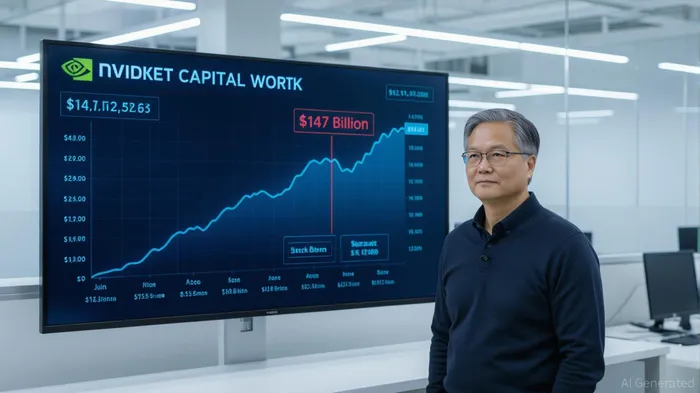
The extraordinary rise of NvidiaNVDA-- to a $4 trillion market capitalization—making it the world's most valuable publicly traded company—has sparked a compelling paradox: despite this astronomical valuation, its founder and CEO, Jensen Huang, remains only the 10th-richest person globally, with a net worth of $147 billion[1]. This discrepancy is not merely a curiosity but a window into the evolving dynamics of corporate capital structure and CEO compensation in high-growth technology firms.
The Capital Structure of Growth: Dilution as a Strategic Tool
Nvidia's success is inextricably linked to its role as the architect of the artificial intelligence revolution. Its GPUs power the training of large language models and machine learning systems, creating a demand that has driven its stock up by over 3,300% in five years[1]. Yet, this meteoric rise has been accompanied by a deliberate and systematic dilution of ownership stakes, particularly for its founder. Huang's ownership of less than 4% of the company—a figure that has dwindled over decades of employee stock compensation and share sales—reflects a broader trend in tech: the prioritization of employee incentives over founder retention of control[1].
This strategy is not unique to Nvidia. High-growth firms increasingly use equity-based compensation to align employee interests with long-term value creation. For example, 80% of Nvidia's full-time employees are now “paper millionaires,” a direct result of its aggressive equity grants[1]. Such practices, while diluting founder stakes, foster a culture of shared success and innovation. However, they also highlight a critical tension: the trade-off between rewarding talent and preserving concentrated ownership.
CEO Compensation: Stock Performance Over Salary
Jensen Huang's compensation package, estimated at $113.4 billion in 2025[3], is not a traditional salary but a function of his stock holdings. Unlike peers in other industries, Huang's wealth is almost entirely tied to Nvidia's market performance. This aligns with a broader shift in tech leadership compensation, where executives forgo cash-heavy packages in favor of equity-linked rewards. For instance, Amazon's board members receive annual RSU grants worth $290,000, while employees receive vesting stock awards[6]. Such structures ensure that CEO and employee interests are synchronized with shareholder value.
Yet, this model raises questions about the sustainability of such wealth concentration. While Huang's net worth has grown exponentially with Nvidia's stock, it remains modest compared to peers like Elon Musk or Bernard Arnault, who have leveraged debt or diversified holdings to amplify their fortunes[1]. The absence of a large cash component in Huang's compensation underscores a key feature of tech leadership: the reliance on capital gains rather than operational income to build wealth.
The Broader Implications for Tech Firms
Nvidia's case illustrates a broader trend in corporate governance: the normalization of dilution as a growth strategy. In 2025, 6% more companies adopted equity compensation compared to previous years[5], reflecting its efficacy in retaining talent and funding expansion. However, this approach is not without risks. For early-stage startups, excessive dilution can erode founder control, while for public companies, it may signal overreliance on share issuance to fund operations[2].
Nvidia's balance sheet, with $8.6 billion in cash and $34.6 billion in marketable securities[4], provides a buffer against these risks. Its ability to fund innovation without heavy debt issuance ensures that dilution remains a strategic tool rather than a necessity. This financial flexibility is critical for maintaining investor confidence, particularly in sectors like AI, where R&D expenditures are capital-intensive.
Conclusion: A Model for the Future?
Nvidia's trajectory offers a blueprint for high-growth tech firms navigating the intersection of capital structure, compensation, and innovation. By prioritizing employee equity and aligning CEO incentives with long-term value creation, it has fostered a culture of shared success. However, the relatively modest personal wealth of its founder, despite the company's stratospheric valuation, serves as a reminder of the trade-offs inherent in such strategies. As the tech sector continues to evolve, the balance between dilution, compensation, and founder retention will remain a defining challenge—and opportunity—for firms seeking to replicate Nvidia's success.





Comentarios
Aún no hay comentarios