
Nuclear Energy's Strategic Role in Powering AI Infrastructure Growth
The exponential expansion of artificial intelligence (AI) is reshaping global energy demand, creating a critical juncture for institutional investors and policymakers. By 2035, data centers-driven by AI training and inference operations-are projected to consume up to 1,700 terawatt-hours (TWh) of electricity annually, rivaling the energy use of entire nations like India. This surge is not merely a technical challenge but a strategic imperative for energy systems worldwide. As AI models grow in complexity, their power requirements outstrip the capacity of conventional grids, particularly in regions where renewable energy sources face intermittency issues. Here, nuclear energy-especially small modular reactors (SMRs)-emerges as a pivotal solution, offering a combination of reliability, scalability, and low carbon emissions.
The Energy Demands of AI: A New Paradigm
AI's energy footprint is no longer a marginal concern. Training a single large model, such as GPT-4, can consume 30 megawatts of power, while inference operations account for up to 90% of a model's lifecycle energy use. In the United States, data centers already account for 3.5% of total electricity consumption, a figure expected to rise to 12% by 2030. This trajectory strains local grids, as seen in Loudoun County, Virginia, where data centers consumed 21% of regional power in 2023. The problem is compounded by the fact that AI workloads require continuous, high-capacity electricity-unlike many industrial processes that can tolerate periodic interruptions.
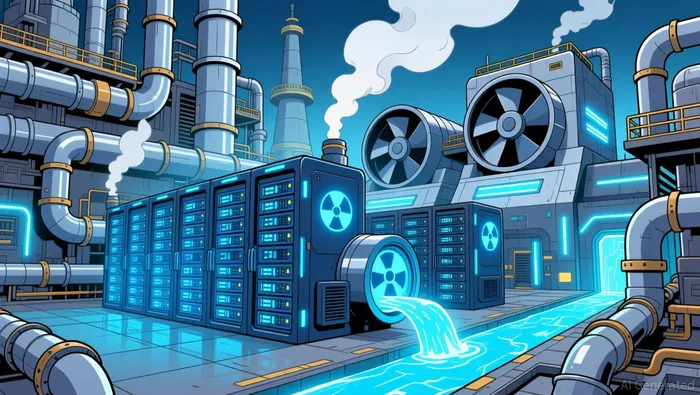
Renewables, while essential for decarbonization, struggle to meet this demand due to their inherent variability. Solar and wind power, for instance, cannot guarantee 24/7 supply without costly storage solutions. Nuclear energy, by contrast, provides baseload power with minimal carbon emissions, making it uniquely suited to underpin AI's energy needs. This is not a theoretical argument: tech giants like Meta, Google, and Amazon are already pivoting toward nuclear partnerships to secure long-term energy stability.
SMRs: A Tailored Solution for AI Infrastructure
Small modular reactors (SMRs) are gaining traction as the ideal nuclear technology for AI infrastructure. Unlike traditional reactors, SMRs are designed for modularity, scalability, and enhanced safety. Their compact size allows them to be deployed incrementally, aligning with the phased expansion of data centers. For example, Meta has committed to funding up to 6.6 gigawatts (GW) of new nuclear capacity by 2035, including SMRs from companies like TerraPower and Oklo. These reactors can be co-located with data centers, reducing transmission losses and enabling direct integration of power and cooling systems.
The advantages of SMRs extend beyond technical compatibility. Their passive safety systems and smaller footprints make them more adaptable to diverse geographic locations, including industrial zones where data centers are often clustered. Moreover, advanced designs-such as sodium fast reactors and microreactors-offer dual benefits of electricity generation and industrial heat, further enhancing their value proposition.
Investment in SMR developers is accelerating, driven by both private and public capital. The U.S. Department of Energy (DOE) has allocated $3.1 billion in its FY2026 budget specifically for SMR deployment, while tech firms are forming strategic partnerships with nuclear utilities. Google, for instance, has backed seven SMRs from Kairos Power, and Amazon is advancing an SMR project in Washington. These initiatives reflect a growing consensus that SMRs are not just a niche technology but a cornerstone of the AI energy ecosystem.
Regulatory Momentum and Institutional Adoption
The convergence of nuclear energy and AI is being propelled by regulatory reforms. In 2025, the Trump administration issued four executive orders to streamline nuclear licensing and accelerate reactor testing. The DOE also updated its National Environmental Policy Act (NEPA) guidelines to expedite advanced reactor projects. These measures address historical bottlenecks, such as lengthy approval timelines, which had deterred investment in nuclear infrastructure.
Institutional energy buyers are capitalizing on this momentum. Long-term power purchase agreements (PPAs) with nuclear utilities are becoming a standard practice. Meta's agreements with Vistra and TerraPower, for example, lock in cost stability over 20–30 years, shielding AI operations from volatile energy markets. Such arrangements also align with corporate sustainability goals, as nuclear power generates minimal carbon emissions compared to fossil fuels.
Strategic Investment Opportunities
For institutional investors, the nuclear-AI nexus presents compelling opportunities. SMR developers, such as TerraPower, Oklo, and Kairos Power, are positioned to benefit from both technological innovation and regulatory tailwinds. These firms are not only securing corporate partnerships but also attracting government funding, as seen in the $5 billion allocated to nuclear programs in the FY2026 appropriations bill.
Nuclear utilities, meanwhile, are evolving into critical infrastructure providers for the digital economy. Companies like Vistra and Exelon are extending the lifespans of existing reactors while investing in next-generation technologies. Their role in supplying reliable, low-carbon power to AI data centers is likely to grow, supported by long-term PPAs and public-private collaborations.
Conclusion: A Symbiosis of Atoms and Algorithms
The energy demands of AI are redefining the global power landscape. As data centers become the new industrial giants of the 21st century, their reliance on uninterrupted, low-carbon electricity will only intensify. Nuclear energy-particularly SMRs-offers a strategic solution to this challenge, bridging the gap between AI's insatiable power needs and the limitations of existing energy systems.
For investors, the implications are clear: the integration of nuclear energy into AI infrastructure is not a speculative bet but a necessary evolution. The regulatory, technological, and institutional momentum behind this transition is robust, creating a fertile ground for long-term returns. In the race to power the AI revolution, nuclear energy is no longer a peripheral option-it is the backbone of the digital future.





Comentarios
Aún no hay comentarios