
Norway's North Sea Renaissance: Unlocking High-Return Hydrocarbon Opportunities in a Low-Carbon Era
The North Sea, long a cornerstone of European energy security, is experiencing a renaissance in 2025. Aker BPBP-- and EquinorEQNR--, two of Norway's most prominent energy firms, have demonstrated how hydrocarbon exploration and low-carbon innovation can coexist to unlock value in a rapidly evolving energy landscape. Their 2025 achievements-marked by significant reserve additions, cost efficiencies, and strategic decarbonization-offer compelling insights into the future of energy investment.
Aker BP: Innovation and Infrastructure-Driven Growth
Aker BP's 2025 exploration campaign in the North Sea has been nothing short of transformative. The Omega Alfa discovery in the Norwegian North Sea added an estimated 96–134 million barrels of oil equivalent (mmboe) to its resource base, while the Lofn and Langemann gas and condensate find in the Sleipner area contributed 30–110 mmboe. These discoveries, combined with the Kjøttkake find, added over 100 million barrels net to reserves, ensuring production remains above 500,000 barrels per day into the 2030s.
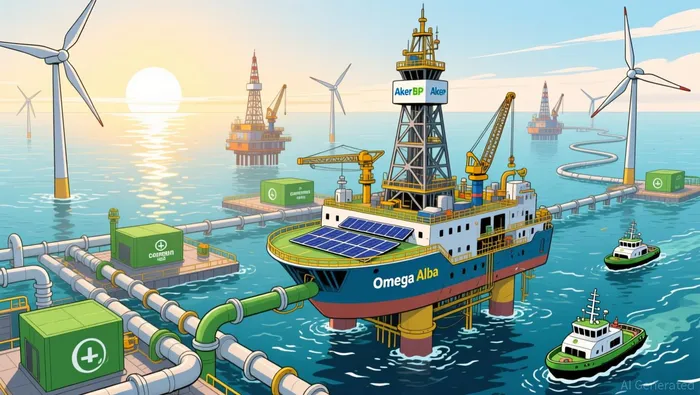 Crucially, Aker BP's strategy emphasizes leveraging existing infrastructure to minimize emissions. By tying new fields to established platforms, the company reduces both capital expenditures and carbon footprints. For instance, the Yggdrasil project, which contributed to Norway's highest monthly oil production since 2010, exemplifies this approach. Financially, Aker BP's Q3 2025 results underscore its resilience: production costs of $7.6 per boe and a resilient dividend of $0.63 per share highlight its ability to balance growth with shareholder returns.
Equinor: Bridging Hydrocarbons and Carbon Neutrality
Equinor's 2025 strategy is defined by a dual focus on hydrocarbon exploration and low-carbon innovation. In the North Sea, the company's Verdande subsea field, tied to the Norne FPSO, added 36 million barrels of oil and extended Norne's production beyond 2030. Meanwhile, the F-South discovery near the Troll field-estimated at 0.6–6.9 million barrels of oil equivalent and the Ringand find (2–12 million barrels of oil equivalent) demonstrate Equinor's ability to identify smaller, infrastructure-adjacent opportunities.
Electrification further underscores Equinor's decarbonization efforts. The Hywind Tampen floating wind farm now powers platforms like Gullfaks and Snorre, reducing emissions by up to 45%. While the company paused two electrification projects due to high costs, its commitment to near-zero emissions by 2050 remains intact.
Strategic Valuation in a Low-Carbon Era
The strategic valuation of Aker BP and Equinor hinges on their ability to align hydrocarbon growth with decarbonization. Aker BP's reserve additions and cost discipline position it as a high-return asset in a sector where exploration success is rare. Its focus on low-emission development-such as tying new fields to existing infrastructure-ensures it remains competitive in a carbon-constrained world.
Equinor, meanwhile, is redefining the energy transition. By integrating CCS and electrification into its North Sea operations, it transforms hydrocarbon projects into low-carbon assets. The Fram Sør project, which connects new resources to the shore-powered Troll C infrastructure, exemplifies this synergy. Equinor's ambition to expand CO₂ storage capacity by 2035 according to its sustainability plan also aligns with Norway's climate goals, enhancing its regulatory and reputational resilience.
Conclusion: A Blueprint for Energy Investment
The North Sea's renaissance in 2025 is not merely a revival of hydrocarbon exploration but a demonstration of how traditional energy firms can adapt to a low-carbon future. Aker BP and Equinor have shown that strategic valuation in this era requires a dual focus: maximizing hydrocarbon returns while investing in technologies that reduce emissions. For investors, these companies represent a rare combination of near-term profitability and long-term sustainability-a blueprint for energy investment in the 2020s and beyond.





Comentarios
Aún no hay comentarios