
Northwest Bancshares (NWBI) Q2 2025 Earnings: Navigating Growth and Regional Resilience Amid Mixed Results
Northwest Bancshares (NASDAQ: NWBI) reported its Q2 2025 earnings on July 29, 2025, delivering a mixed performance that underscores both the challenges and strategic opportunities facing regional banks. While the company beat EPS estimates, a significant revenue shortfall raised questions about near-term growth. However, the broader narrative of disciplined risk management, merger-driven scale, and a focus on resilient commercial lending suggests the bank is positioning itself for long-term stability. Below, we analyze the results, assess sustainability, and evaluate the resilience of this community-focused financial institution.
Earnings Snapshot: A Beat on EPS, Miss on Revenue
Northwest reported an EPS of $0.27, exceeding the consensus estimate of $0.23, driven by strong net interest income and cost discipline. However, revenue fell short of expectations, coming in at $97.99 million versus a projected $149 million. This miss reflects a sharp decline from Q1's $156.17 million, though management attributed the drop to seasonal fluctuations and strategic shifts toward higher-margin commercial lending. 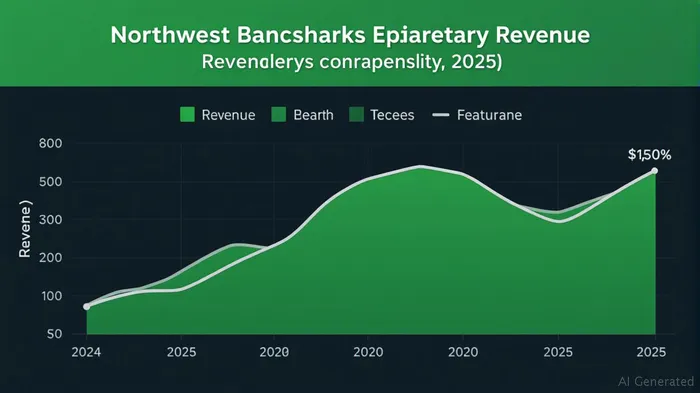
The stock dipped 0.19% on the earnings day but remains within historical post-earnings rebound patterns. Analysts, however, remain cautiously optimistic: full-year 2025 EPS estimates have risen to $1.25, reflecting confidence in the second-half recovery.
Growth Sustainability: A Focus on Commercial Lending and M&A
Northwest's Q2 results highlight two key growth engines: specialized commercial lending and the pending merger with Penns Woods Bancorp, which closed in late July 2025.
- Commercial Lending Dominance:
- Average C&I loans grew 6.2% quarter-over-quarter, driven by niche verticals like healthcare, franchise finance, and sports lending. These sectors offer higher margins and lower default risk than traditional CRE or residential loans.
Management emphasized a strategic pivot away from volatile CRE markets, reducing exposure to office and retail real estate. This discipline has kept non-performing loans (NPLs) at a five-quarter low of 53 basis points, with net charge-offs at 8 basis points—near historic lows.
Merger Synergies:
- The $450 million Penns WoodsPWOD-- acquisition adds $2.1 billion in assets, propelling Northwest into the top 100 U.S. banks by asset size. The merger expands its footprint in Pennsylvania, a key growth market, while boosting liquidity and deposit base diversification.
- Post-merger, the combined entity's efficiency ratio improved to 57.7%, reflecting cost synergies and streamlined operations.
Regional Resilience: A Community Banking Edge
Northwest's model hinges on community banking, which insulates it from national macroeconomic volatility. Key factors include:
- Deposit Stability:
- Average deposits grew 1.7% year-over-year, with a focus on low-cost consumer deposits (1.59% cost of funds). Management's shift of high-cost CDs into money market accounts has reduced liability pressures.
Institutional ownership at 69% signals long-term investor confidence in the bank's regional strategy.
Geographic Diversification:
With 132 branches across Pennsylvania, New York, Ohio, and Indiana, Northwest avoids overexposure to any single market. The merger further strengthens its presence in Pennsylvania's small- to mid-sized cities, where demand for personalized banking remains robust.
Credit Quality and Risk Mitigation:
- Loan portfolios are intentionally diversified, with 8% exposure to tariff-affected sectors (manufacturing/transportation). Management's “derisking actions” in late 2024—such as selling non-core CRE loans—have fortified balance sheets.
Risks and Challenges
Despite its strengths, Northwest faces hurdles:
- Revenue Volatility: The Q2 miss suggests reliance on seasonal or one-time factors, raising concerns about consistent top-line growth. Analysts will monitor Q3 results closely.
- Merger Integration: While synergies are expected, execution risks remain. A smooth transition is critical to maintaining customer trust and cross-selling opportunities.
- Interest Rate Cycles: While a flat or declining Fed rate path could ease deposit costs, competitive lending pressures may compress margins.
Investment Thesis: Caution Meets Opportunity
Northwest Bancshares presents a high-reward, moderate-risk investment. Key considerations:
- Buy Signal:
The stock's 12.96 forward P/E and 6.75% dividend yield offer value relative to its growth trajectory. The merger's scale and the focus on resilient commercial lending justify a long-term hold.
Hold Signal:
Near-term volatility around revenue consistency and merger execution may deter short-term traders. Investors should wait for Q3 results to confirm stabilization.
Avoid Signal:
- Aggressive traders may shy away until the bank demonstrates sustained revenue growth.
Conclusion: Banking on Resilience
Northwest Bancshares' Q2 results are a reminder that regional banks thrive not on short-term earnings beats but on strategic discipline and local relevance. While the revenue miss is a concern, the bank's focus on specialized lending, merger synergies, and deposit stability positions it to weather economic headwinds. For investors seeking exposure to a well-managed community bank with a growing footprint, NWBINWBI-- merits consideration—especially at current valuations. Monitor Q3 results for confirmation of its growth narrative.





Comentarios
Aún no hay comentarios