
Nissan's Autonomous Drive: A Strategic Gamble to Disrupt the Automotive Value Chain and Restore Shareholder Value
The automotive industry stands at the precipice of a technological revolution. Autonomous driving, once a distant dream, is now a $200 billion market projected to balloon to $2 trillion by 2030, driven by AI, sensor advancements, and shifting consumer demand [4]. In this high-stakes arena, Nissan has embarked on a bold strategy to reposition itself as a leader in self-driving technology. Yet, this move must be evaluated not only for its technical ambition but also for its potential to disrupt the automotive value chain and unlock shareholder value amid a backdrop of financial fragility.
A Strategic Shift: From Survival to Innovation
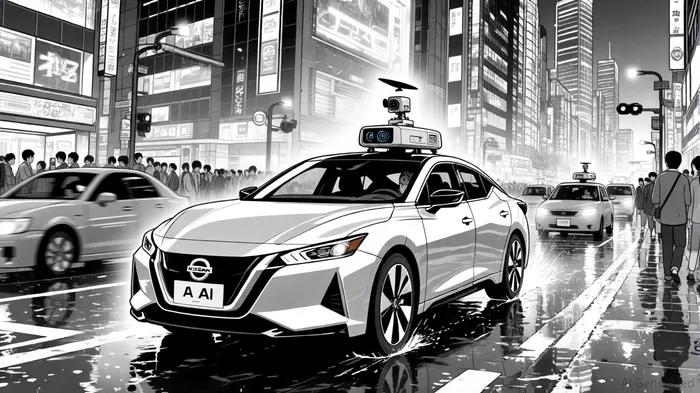
Nissan's recent demonstration of its Ariya sedan—equipped with 11 cameras, five radars, and LiDAR—marks a pivotal step in its quest to commercialize Level 2 autonomous driving by 2027 [1]. This technology, developed in collaboration with British AI startup Wayve, leverages real-time machine learning to navigate complex urban environments, a leap beyond previous systems limited to highways [3]. The partnership with Wayve is emblematic of a broader industry trend: automakers outsourcing AI expertise to startups, thereby accelerating development cycles and reducing capital intensity [5].
This shift has profound implications for the automotive value chain. Traditional automakers, long reliant on in-house R&D and hardware-centric models, are now ceding ground to software-driven ecosystems. By integrating Wayve's Embodied AI into its ProPilot system, Nissan is not merely upgrading its technology but redefining its role as a platform for AI-driven mobility services [6]. Such partnerships could democratize access to autonomous tech, compressing the time-to-market for competitors and reshaping supplier relationships.
Financial Realities and the Path to Turnaround
Despite these innovations, Nissan's financial health remains precarious. The company reported a 78% drop in third-quarter operating profit for FY2025, forcing it to slash its annual forecast by 20% [7]. Broader challenges include U.S. tariffs, a lack of hybrid models in North America, and fierce competition in China's EV market [5]. To stabilize its operations, Nissan has announced 11,000 job cuts, plant closures, and a cost-cutting initiative targeting 400 billion yen in savings by 2026 [2].
However, these measures are only the first step. The true test lies in Nissan's ability to monetize its autonomous driving ambitions. The projected $2 trillion market by 2030 offers a tantalizing opportunity, but capturing even a fraction of this requires scaling partnerships and securing regulatory approvals. For instance, Wayve's collaboration with Uber to deploy self-driving vehicles on its global ride-hailing network could provide Nissan with a ready-made distribution channel, bypassing the need for direct consumer adoption [5]. Such synergies could transform autonomous tech from a cost center into a revenue generator.
Shareholder Value: Balancing Risks and Rewards
The question for investors is whether Nissan's strategic pivot can offset its current financial woes. On one hand, the company's focus on solid-state batteries, hybrid models, and AI-driven mobility services aligns with long-term industry trends [2]. On the other, the path to profitability is fraught with risks. Autonomous driving remains unproven at scale, and regulatory hurdles—particularly in safety-critical urban environments—could delay commercialization.
Yet, Nissan's approach reflects a calculated bet on disruption. By leveraging Wayve's hardware-agnostic AI, it avoids the capital-intensive trap of building proprietary sensor systems. This flexibility could enable faster iterations and lower costs, critical in a market where first-mover advantage is less important than adaptability [3]. Moreover, the potential for data monetization—via real-time urban navigation insights or mobility-as-a-service models—adds another layer of value.
Conclusion: A High-Stakes Reimagining
Nissan's foray into autonomous driving is as much a survival strategy as it is a visionary leap. While the company's financial struggles cannot be ignored, its partnerships with Wayve and Uber, coupled with a focus on scalable AI solutions, position it to capitalize on the next phase of the automotive revolution. For shareholders, the key will be monitoring how effectively Nissan balances short-term cost discipline with long-term innovation. If successful, the company could emerge not just as a participant in the autonomous future but as a pivotal player in reshaping the industry's value chain.







Comentarios
Aún no hay comentarios