
NIH Leadership Shifts and the Biotech Renaissance: Identifying Undervalued Opportunities in a New Era of Medical Innovation
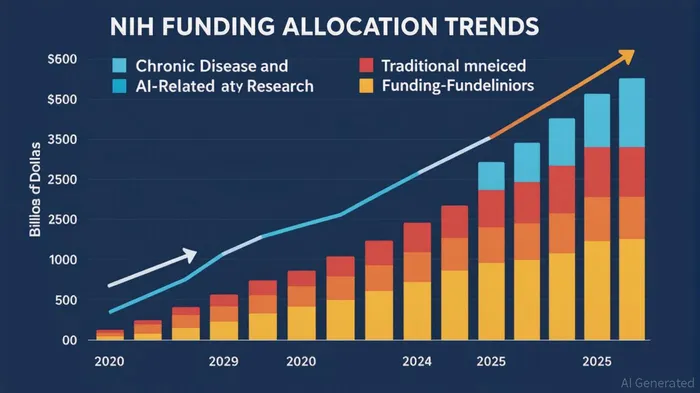
The National Institutes of Health (NIH) is undergoing a profound transformation, driven by leadership transitions and a recalibration of research priorities. Nina Schor's tenure as Deputy Director for Intramural Research, marked by her advocacy for investigator-initiated science and human-centric research, has given way to a new era under Director Jay Bhattacharya. This shift signals a strategic pivot toward “gold-standard science,” emphasizing chronic disease, artificial intelligence (AI), and alternative testing models[1]. For investors, the implications are clear: biotech firms aligned with these priorities may soon see a surge in NIH funding, while those clinging to outdated paradigms risk obsolescence.
The Schor Legacy and the New NIH Agenda
Nina Schor's leadership at the NIH was defined by a commitment to fostering innovation and diversity in scientific research. As Acting Scientific Director of the National Institute of Neurological Disorders and Stroke (NINDS) and later as IRP Director, she championed initiatives like the Ultra-Rare GENe-targeted Therapies (URGenT) Network, which sought to accelerate treatments for rare diseases[4]. However, her departure—though not explicitly detailed in recent sources—coincides with a broader reorientation under Bhattacharya, who has prioritized politically aligned agendas such as chronic disease research and domestic-focused innovation[3].
The new NIH strategy, as outlined in the “Gold-Standard Science” executive order, explicitly de-emphasizes animal-based research in favor of human-centric models. This includes organ-on-a-chip systems, computational simulations, and AI-driven platforms[1]. The agency has also established the Office of Research Innovation, Validation, and Application (ORIVA) to coordinate these efforts, signaling a systemic shift toward technologies that promise greater translatability to human health outcomes[2].
The Biotech Landscape: Undervalued Innovators in the Crosshairs of NIH Priorities
The NIH's 2025 priorities create a fertile ground for biotech firms specializing in chronic disease, AI, and alternative testing. Yet many of these companies remain undervalued, offering compelling investment opportunities.
Chronic Disease and Human-Based Models
The NIH's focus on chronic diseases—such as diabetes, Alzheimer's, and cardiovascular conditions—has spurred demand for human-based research tools. Companies like CN Bio and Emulate, which develop organ-on-a-chip technologies, are at the forefront of this shift. These platforms enable precise modeling of human physiology, reducing reliance on animal trials and accelerating drug development[3]. Despite their strategic alignment with NIH priorities, both firms trade at price-to-sales (P/S) ratios below industry averages, suggesting undervaluation[5].AI-Driven Drug Discovery
AI is reshaping biotech, and NIH funding is increasingly directed toward AI platforms that optimize clinical trials and repurpose existing drugs. Insilico Medicine, for instance, has advanced its AI-discovered drug, INS018_055, into Phase II trials for idiopathic pulmonary fibrosis[6]. Similarly, Recursion Pharmaceuticals leverages AI and high-throughput screening to identify novel compounds, with its recent acquisition of Exscientia's platform further solidifying its competitive edge[6]. Yet, despite these milestones, both firms trade at P/S ratios of 4–6x, significantly below the 10–15x range typical for high-growth biotechs[5].Alternative Testing and Regulatory Validation
The NIH's push for alternative testing models has also spurred growth in firms like Schrödinger, Inc., which uses generative AI to simulate molecular interactions. With a P/S ratio of 4–6x and revenue of $200 million, SchrödingerSDGR-- appears undervalued relative to its technological potential[5]. Meanwhile, Cradle Bio—a leader in AI-powered protein engineering—has secured partnerships with Novo NordiskNVO-- and Ginkgo BioworksDNA--, yet remains overlooked by mainstream investors[6].
Risks and Considerations
While the NIH's new priorities present opportunities, investors must remain cautious. Budget constraints, such as proposed 40% funding cuts, could delay progress in foundational research[5]. Additionally, the transition to human-based models is not without challenges; multi-organ interactions remain complex to simulate, and regulatory validation of AI-driven tools is still evolving[3].
Conclusion: A Strategic Inflection Point
The NIH's leadership transition and strategic realignment represent a pivotal moment for biotech. Firms that align with chronic disease research, AI, and human-based models are poised to benefit from a surge in funding and policy support. For investors, the key lies in identifying undervalued innovators—those with robust pipelines, strategic partnerships, and technologies that directly address NIH's 2025 priorities. As the biotech sector navigates this inflection point, patience and precision will be rewarded.





Comentarios
Aún no hay comentarios