
Neuronetics Inc: A New Chapter in Mental Health Innovation and Investment Potential
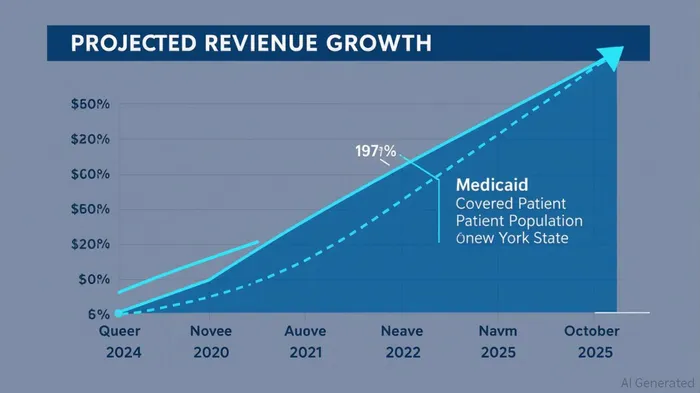
The recent decision by New York State Medicaid to cover Transcranial Magnetic Stimulation (TMS) therapy for major depressive disorder (MDD) marks a pivotal moment for NeuroneticsSTIM-- Inc., the developer of NeuroStar Advanced Therapy. This policy, effective October 1, 2025, for fee-for-service members and November 1 for Medicaid Managed Care Plans, extends access to nearly 5.4 million individuals in the state [1]. For a company already navigating a transformative phase, this expansion represents both a validation of its clinical value and a catalyst for financial growth.
Market Access: A Strategic Inflection Point
New York's inclusion of TMS in Medicaid benefits addresses a critical gap in mental health care. Prior to this, Medicaid coverage for TMS varied widely across states, often requiring diagnoses of treatment-resistant depression [2]. By removing such barriers, New York's policy aligns with the broader recognition of TMS as an evidence-based treatment, with response rates of 83% and remission rates of 62% for MDD [1]. For Neuronetics, this means immediate access to a population that previously could not afford its services.
The scale of this expansion is staggering. Nearly 1 million fee-for-service Medicaid members and 4.4 million in managed care organizations now qualify for TMS therapy [1]. Given that Neuronetics operates over 95 clinics nationwide via its Greenbrook acquisition [4], the company is uniquely positioned to scale utilization without significant capital expenditure. This operational leverage—turning newly eligible patients into revenue—could accelerate its path to cash flow breakeven, a goal it aims to achieve by Q3 2025 [4].
Financial Implications: Revenue and Valuation Dynamics
Neuronetics' Q2 2025 results already hint at its growth potential. Revenue reached $38.1 million, with Greenbrook contributing $23.0 million [1]. The company's 2025 guidance of $149–155 million in total revenue reflects a 36% year-over-year increase [4]. However, profitability remains elusive, with a projected 2025 loss per share of $0.57 [4]. The key question for investors is whether Medicaid expansion can bridge this gap.
The New York policy could add tens of millions in incremental revenue. Assuming even 10% of newly eligible patients seek TMS therapy—a conservative estimate given the treatment's efficacy—Neuronetics could see an additional $50–70 million annually. This would not only bolster top-line growth but also improve margins, as Medicaid reimbursements typically exceed private insurance rates. Analysts have already raised price targets, with an average of $7.00 implying a 152% upside from current levels [3].
Valuation multiples, however, remain stretched. At an EV/Revenue of 3.9x and a negative EV/EBITDA of -8.3x [4], the stock trades at a premium to peers. Yet this reflects high expectations for future cash flow. If Medicaid expansion accelerates revenue growth and reduces losses, the company could transition from a speculative play to a more defensible investment.
Broader Strategic Tailwinds
Beyond New York, Neuronetics is capitalizing on other trends. Its recent expansion of adolescent TMS coverage with CignaCI-- and HumanaHUM-- [1] taps into a $10 billion mental health market. Meanwhile, the integration of SPRAVATO®—a ketamine-based therapy—into its clinics diversifies its offerings and enhances patient retention [4]. These initiatives, combined with Medicaid expansion, create a compounding effect that analysts may soon price in.
Conclusion: A High-Stakes Bet with Clear Catalysts
Investors in Neuronetics face a classic growth dilemma: high risk, high reward. The company's dependence on regulatory and reimbursement decisions introduces volatility, but the New York Medicaid expansion provides a concrete, near-term catalyst. If Neuronetics can convert this policy into sustained utilization, it may finally achieve the profitability that has eluded it for years. For now, the stock remains a speculative bet, but one underpinned by tangible progress in both clinical adoption and operational execution.





Comentarios
Aún no hay comentarios