
Netflix's Ten-for-One Stock Split: A Behavioral Finance Perspective on Accessibility and Valuation Attractiveness
Behavioral Finance and Retail Investor Accessibility
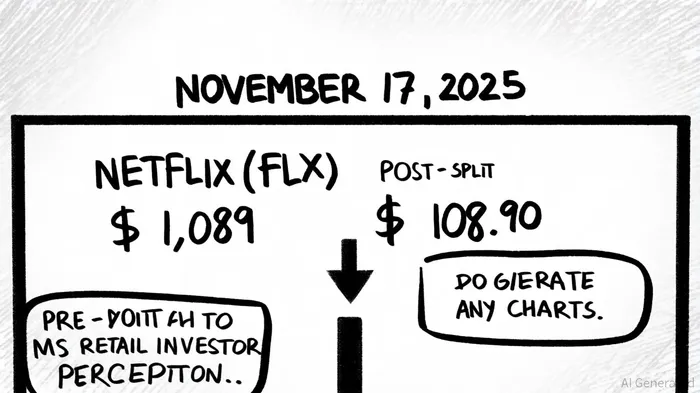
Stock splits have long been recognized for their psychological impact on investor behavior. By reducing the nominal price per share, splits make equities appear more affordable, even though the underlying value remains unchanged. This "anchoring effect" can significantly influence retail investors, who often perceive lower-priced stocks as more accessible or less risky, as explained in a stock split explainer. For example, Tesla's 2020 5-for-1 split, which dropped its share price from $1,300 to $400, led to a surge in retail participation, particularly among younger, lower-income investors, as described in stock splits explained.
Academic studies from 2020 to 2025 reinforce this behavioral dynamic. Research on global markets found that the impact of stock splits can enhance liquidity and attract smaller investors, though their impact on valuation is often muted. A 2022 abnormal stock return study of the Indonesian Stock Exchange revealed no significant abnormal returns before or after splits, suggesting that while splits may alter investor psychology, they do not necessarily drive long-term price changes. For Netflix, the split's primary benefit lies in its ability to democratize access to a stock that had become prohibitively expensive for many individual investors.
Valuation Attractiveness and Market Sentiment
While splits can boost short-term sentiment, their impact on valuation attractiveness depends on a company's fundamentals. Netflix's forward price-to-earnings (P/E) ratio of 45.96, compared to peers like Comcast's 6.89, underscores that valuation multiples remain a critical determinant of investor interest, as Netflix announced its ten-for-one split. Academic research highlights that splits are most effective when accompanied by strong earnings growth or innovation. For instance, ServiceNow's 5-for-1 split in 2023 coincided with a blowout earnings report and raised guidance, driving a significant post-announcement rally.
However, splits alone cannot mask weak fundamentals. A 2023 study of global stock exchanges found that while splits may improve liquidity, they do not inherently alter a company's valuation attractiveness. This aligns with Netflix's own statement that the split will not impact its business fundamentals or earnings outlook. The company's focus on innovation and user experience-key drivers of its long-term value-remains paramount.
The Heterogeneous Impact of Splits
Retail investor behavior further complicates the valuation equation. Younger, less experienced investors often exhibit herding behavior, amplifying short-term volatility, as shown in retail trader sophistication. For Netflix, this could mean increased trading volume post-split, but also heightened sensitivity to market noise. Conversely, institutional investors, who prioritize fundamentals over price tags, may remain indifferent to the split. This duality reflects the broader tension between behavioral biases and rational valuation in modern markets.
Conclusion
Netflix's 10-for-1 stock split is a calculated move to enhance retail accessibility and signal confidence in its future. While behavioral finance principles suggest the split may boost investor sentiment and liquidity, its long-term success hinges on the company's ability to deliver on its growth narrative. For investors, the split serves as a reminder that price per share is a psychological construct, not a proxy for value. As always, fundamentals-earnings, innovation, and market position-remain the true arbiters of valuation attractiveness.





Comentarios
Aún no hay comentarios