
Navigating Thailand's Tariff Crossroads: A Strategic Playbook for Equity Investors
As Thailand races against the August 1 deadline to avert a 36% U.S. tariff hike on its exports, the stakes for its export-driven economy—accounting for nearly 70% of GDP—could not be higher. The proposed zero-tariff agreement with the U.S., alongside structural reforms to slash its $46 billion trade surplus with America, presents a dual-edged scenario: a potential GDP contraction of up to 2% if negotiations fail, or a repositioning of Thai equities as undervalued plays on U.S.-Thailand trade normalization. For investors, this is a moment to parse risk and reward in sectors most exposed to the deal's outcome.
The Tariff Crossroads: Stakes and Strategies
Thailand's proposal to eliminate tariffs on 90% of U.S. goods—including agricultural products, natural gas, and aircraft—aims to address Washington's ire over its trade surplus. The second revised offer, submitted days before this article, aligns with the Regional Comprehensive Economic Partnership (RCEP) framework, ensuring commitments to other trading partners remain intact. Yet, the U.S. demands a 70% surplus reduction by 2030 and a balanced trade by 2032, a tall order for an economy where U.S. exports account for 18% of total shipments.
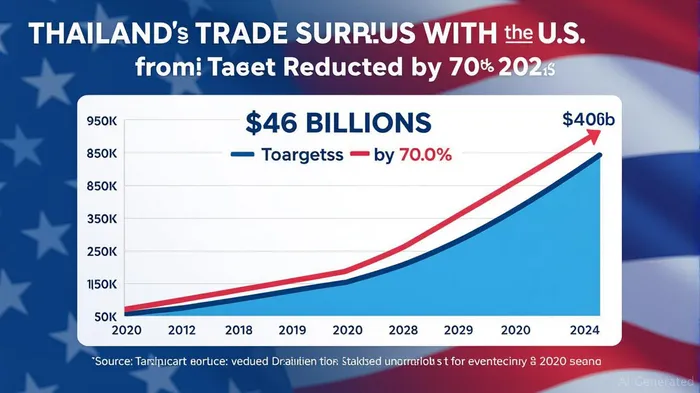
The near-term catalyst is clear: a deal by August 1 could stabilize export sectors and avert a GDP hit. Failure risks a 1-2% contraction, with electronics, food processing, and rubber industries bearing the brunt. To cushion the blow, Thailand has allocated 200 billion baht ($6.1 billion) in soft loans to businesses, while the Thai National Shippers' Council urges firms to diversify markets and reduce costs.
Sector-Specific Implications
Automotive: Left-Hand Drive Vehicles and Structural Adjustments
Thailand's automotive industry—its third-largest export sector—stands to benefit if the zero-tariff deal reduces costs for U.S. components. The removal of duties on left-hand drive vehicles (a key U.S. export) could also attract American automakers to Thailand's assembly lines. However, the sector's exposure to retaliatory tariffs on Thai-made cars (e.g., pickup trucks) poses a countervailing risk.
Investors should target companies with dual exposure: those reliant on U.S. parts (e.g., Tier 1 suppliers) and those exporting to the U.S. The valuation multiples of Thai automotive firms, trading at ~12x 2025E EPS versus the SET50's 14x, offer a margin of safety if a deal materializes.
Energy: Natural Gas Imports and Geopolitical Leverage
Thailand's pledge to boost U.S. natural gas purchases—part of its surplus reduction strategy—creates opportunities in energy infrastructure. State-owned PTT Public Company (PTT), Thailand's largest energy firm, is expanding LNG import terminals to meet rising demand. A successful deal could accelerate this shift, reducing reliance on regional gas suppliers and strengthening energy security.
PTT's stock, trading at 6.5x 2024E P/E, reflects limited upside unless gas demand surges. However, the geopolitical angle—Thailand balancing U.S. energy ties with China—adds complexity.
Technology: Component Reliance and Global Supply Chains
U.S.-reliant tech firms in Thailand, such as electronics manufacturers using American semiconductors, could see cost advantages under zero tariffs. This sector's proximity to U.S. suppliers and its role in global tech supply chains positions it as a beneficiary of trade normalization.
Companies like Hana Microelectronics (HANA), trading at 8.2x 2024E P/E versus Taiwan's TSMCTSM-- at 13x, offer a discount if U.S. trade barriers fall.
Valuation and Catalysts: Timing the Deal's Resolution
With three weeks remaining, the Thai government's optimism contrasts with the U.S. stance of no extensions. Investors should monitor two key metrics:
1. Negotiation updates: A public statement by August 1 or a delay clause could trigger volatility.
2. Sector-specific data: Thai exports to the U.S. (e.g., electronics shipments) and U.S. goods imports into Thailand (e.g., LNG volumes) will signal confidence in the deal's terms.
The SET Index, down 5% year-to-date amid geopolitical jitters, trades at 14x 2024E P/E—a 10% discount to its five-year average. A successful deal could narrow this gap, while failure risks a further 5-10% correction.
Risks and Considerations
- Geopolitical overhang: Transshipment of Chinese goods via Thailand—a separate U.S. concern—could derail negotiations.
- Competitor dynamics: Thailand's tariff offer (36%) is higher than Malaysia's (25%) or Vietnam's (20%). A deal must ensure competitiveness without triggering further U.S. demands.
- Structural execution: Reducing the trade surplus requires sustained U.S. import growth, which may strain domestic industries.
Investment Recommendations
Selective long positions in Thai equities:
- Automotive: Overweight stocks with U.S. component exposure (e.g., AUTO, TISCO) if a deal is reached.
- Energy: Hold PTT for its LNG terminal plays but avoid until geopolitical clarity emerges.
- Tech: Accumulate discounted electronics firms (e.g., HANA) as U.S. supply chain risks ease.
Avoid: U.S.-exposed export sectors (e.g., rubber, rice) unless tariffs are reduced to 20% or lower.
Conclusion
Thailand's tariff deal with the U.S. is a high-stakes test of its export economy's resilience. For investors, the August 1 deadline is a binary event: a resolution could unlock undervalued opportunities in automotive, energy, and tech, while failure risks a broader market reset. The path forward hinges on structural reforms and geopolitical calculus—a test of nerve and valuation discipline for equity players.
As the clock ticks, the question remains: Will Thailand's gambit stabilize its trade future, or will it fall into the crossfire of U.S.-China tensions? The answer lies in the next three weeks—and in the portfolios of those willing to bet on Thai equities' resilience.







Comentarios
Aún no hay comentarios