
Navigating Holiday-Driven Liquidity Shifts: A Strategic Guide for Q1 2026 Market Entries
The opening months of 2026 will present unique challenges for investors navigating the interplay between market liquidity and seasonal holiday schedules. As the U.S. equity and bond markets brace for closures and early shutdowns around key dates-including New Year's Day, Good Friday, and Independence Day-the implications for trading volumes, volatility, and asset correlations demand careful strategic planning. Drawing on the 2026 holiday calendar and historical patterns, this analysis outlines actionable steps to mitigate liquidity risk and capitalize on tactical entry opportunities, particularly around the post-holiday reopening on January 2, 2026.
The 2026 Holiday Calendar: A Blueprint for Liquidity Constraints
The NYSE Group has confirmed that U.S. bond markets will close on January 1, 2026, in observance of New Year's Day, with trading resuming on January 2 according to NYSE calendar. Notably, bond markets will close early at 2:00 p.m. Eastern Time on December 31, 2025, while equity markets remain open during standard hours as per FINRA. This divergence in closure times creates a critical asymmetry: fixed-income trading will experience reduced liquidity in the final days of 2025, even as equities remain active. Such imbalances often amplify cross-asset volatility, as investors adjust portfolios ahead of the holiday lull.
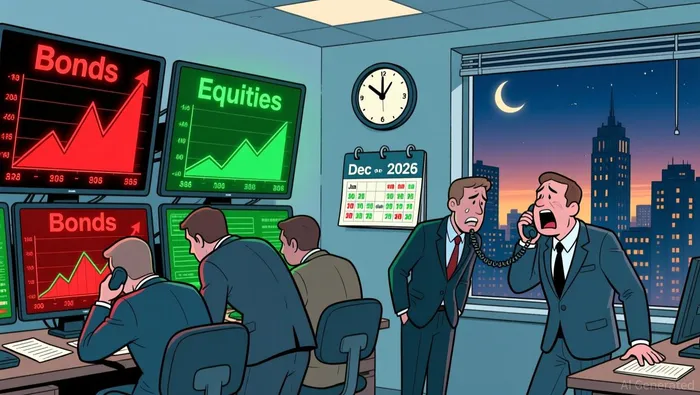
The full-year calendar also includes early closures on April 3 (Good Friday), July 3 (Independence Day), and November 27 (Thanksgiving) per NYSE calendar. These dates, combined with the post-holiday reopening on January 2, will likely see pronounced liquidity shifts, particularly in bond markets, where trading volumes typically decline by 20% in December.
Historical Patterns: Volatility, Liquidity, and Correlation Shifts
Historical data underscores the systemic impact of holiday-driven liquidity constraints. From late November through early January, global equity volumes often fall to 45–70% of normal levels, with similar reductions in derivatives and credit markets. During this period, trading costs rise, spreads widen, and execution speeds slow, creating a fertile ground for volatility spikes. For instance, the S&P 500 has historically exhibited abnormal strength in the week before New Year's Day, peaking two days after the holiday, followed by a fade.
Equity-bond correlations, meanwhile, have shown a marked shift in recent years. Traditionally, equities and bonds exhibited a negative correlation, with bonds acting as a hedge during equity downturns. However, the post-COVID inflationary environment has altered this dynamic. As markets refocus on inflation during post-holiday periods, rising interest rates and a lower equity risk premium have pushed stock-bond correlations into positive territory. This shift is particularly relevant for 2026, as investors grapple with lingering inflationary pressures and central bank policy uncertainty.
Macroeconomic Influences and Tactical Implications
The interplay between liquidity constraints and macroeconomic factors further complicates the post-holiday landscape. Reduced trading volumes during holiday periods amplify the impact of macroeconomic news. For example, if inflation data or fiscal policy announcements emerge during the December 31–January 2 window, their effects on asset prices could be magnified due to limited liquidity.
Investors must also consider the role of investor behavior. The "January effect"-a historical tendency for small-cap stocks to outperform-may interact with bond market dynamics as portfolios are rebalanced. However, with bond liquidity constrained, such strategies could face execution risks. Similarly, the early closure of bond markets on December 31 may lead to delayed price discovery, creating mispricings that persist into January.
Strategic Recommendations for January 2, 2026
To navigate these challenges, investors should adopt a multi-pronged approach:
- Liquidity Risk Mitigation:
- Avoid large, discretionary orders around December 31 and January 2, given the heightened risk of slippage. Instead, use limit orders to manage execution costs.
Prioritize liquid assets (e.g., large-cap equities, short-duration bonds) during the post-holiday period, as trading volumes normalize, as illiquid instruments may face prolonged price dislocations.
Volatility Arbitrage Opportunities:
The post-holiday reopening on January 2 may see a surge in volatility as investors unwind holiday positions. Consider volatility-linked strategies, such as options straddles or inverse VIX products, to capitalize on this dynamic.
Correlation-Driven Hedging:
Given the positive equity-bond correlation in inflationary environments, traditional hedging with long-duration bonds may be less effective. Instead, explore short-duration bonds or inflation-linked securities to manage risk according to SSGA research.
Timing of Entries:
- The first week of January often sees a normalization of liquidity. Consider delaying tactical entries until mid-January, when trading volumes and correlations stabilize.
Conclusion
The Q1 2026 market environment will be shaped by a confluence of holiday-driven liquidity shifts, macroeconomic pressures, and evolving asset correlations. By understanding the 2026 holiday calendar and historical patterns, investors can proactively manage risk and identify opportunities. The post-holiday reopening on January 2, 2026, will require disciplined execution and a nuanced grasp of market dynamics-a challenge that, when navigated effectively, could yield significant rewards.







Comentarios
Aún no hay comentarios