
Natural Gas Price Stability and Strategic Energy Sector Positioning in 2025–2026
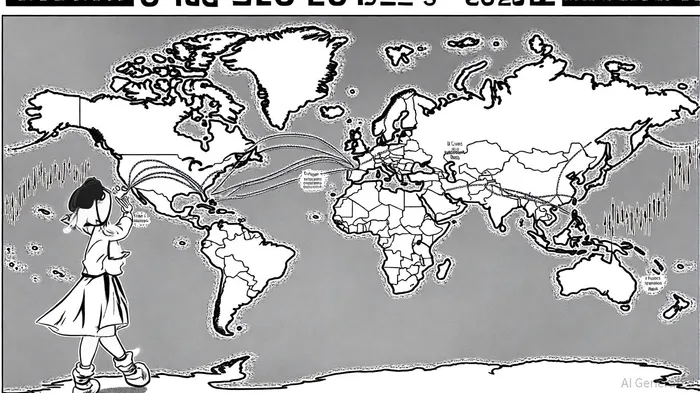
The natural gas market in late 2025 and early 2026 is poised for a period of heightened volatility and strategic repositioning. As supply-demand fundamentals tighten and geopolitical risks persist, investors must navigate a landscape where LNG infrastructure, regional production hubs, and risk mitigation strategies will define long-term success.
Supply-Demand Dynamics and Price Projections
According to the U.S. Energy Information Administration (EIA), the Henry Hub spot price is projected to average $3.00 per million British thermal units (MMBtu) in Q3 2025, with a winter peak of $4.60/MMBtu expected in January 2026. By 2026, prices are forecasted to nearly double from 2024 levels, reaching $4.30/MMBtu on average. This surge is driven by robust LNG exports, which are set to increase by 36% (4.3 billion cubic feet per day) from 2024 to 2026, far outpacing domestic consumption growth.
Global demand, however, has shown signs of fragility. In the first half of 2025, Asian markets-particularly China and India-recorded declines in gas demand due to price sensitivity and economic slowdowns, according to the IEA. Meanwhile, European demand rebounded in June 2025 amid pipeline disruptions and rising power sector needs, per an Accio analysis. These divergent trends underscore the importance of regional diversification in investment strategies.
Geopolitical Risks and Policy Shifts
Geopolitical tensions, including conflicts in the Middle East and the Red Sea, have added layers of uncertainty to the market, as highlighted by an Accio analysis. Compounding this, the U.S. imposed a 10% tariff on Canadian gas in March 2025, reducing imports and tightening supply in the Midwest and Northeast. Such policy shifts highlight the need for hedging strategies to mitigate cross-border trade risks.
The International Energy Agency (IEA) notes that global LNG supply growth will accelerate in 2026, driven by new projects in the U.S., Canada, and Qatar. These developments are expected to bolster gas demand in key import markets like Asia, but they also expose investors to the volatility of geopolitical realignments, such as the redirection of LNG cargoes from Asia to Europe following Russian supply disruptions.
Strategic Investment Opportunities
1. LNG Infrastructure Expansion
North America's natural gas industry, valued at $435.26 billion in 2024, is projected to reach $622.63 billion by 2030, driven by LNG export capacity growth, as noted by PwC. Major projects like the Plaquemines LNG terminal in Louisiana and Corpus Christi Stage 3 in Texas are reinforcing the U.S. as a leading LNG supplier. Additionally, floating storage and regasification units (FSRUs) are enabling access to natural gas in non-pipeline-connected regions, such as Western Europe and Latin America.
2. Regional Production Hubs
U.S. production is forecasted to average 117.1 billion cubic feet per day (Bcf/d) in 2025 and 116.8 Bcf/d in 2026. While growth in the Permian Basin slows, the Appalachia and Haynesville regions are expected to offset declines with increased output. Infrastructure projects like the Black Fin Pipeline (3.5 Bcf/d capacity) and Louisiana Gateway Pipeline (1.8 Bcf/d capacity) are critical to supporting this transition.
3. Risk Mitigation and Flexibility
As spot market activity rises, LNG contracts are shifting toward greater flexibility and optionality. Investors must prioritize hedging strategies to manage exposure to price swings and geopolitical shocks. For example, BP's integration of carbon capture technology in its Indonesian LNG facility demonstrates how decarbonization can align with risk reduction, a point discussed in the IEA analysis.
Conclusion
The natural gas market in 2025–2026 presents a complex interplay of opportunities and risks. While prices are set to rise due to tightening fundamentals and geopolitical pressures, strategic investments in LNG infrastructure, regional production hubs, and flexible risk management frameworks can position investors to capitalize on this volatility. As the EIA and IEA emphasize, the key to long-term success lies in aligning with the accelerating global LNG transition while hedging against the unpredictable currents of geopolitics.





Comentarios
Aún no hay comentarios