
Natural Gas Market Volatility: A Strategic Entry Point Amid Weather, Supply, and Export Dynamics
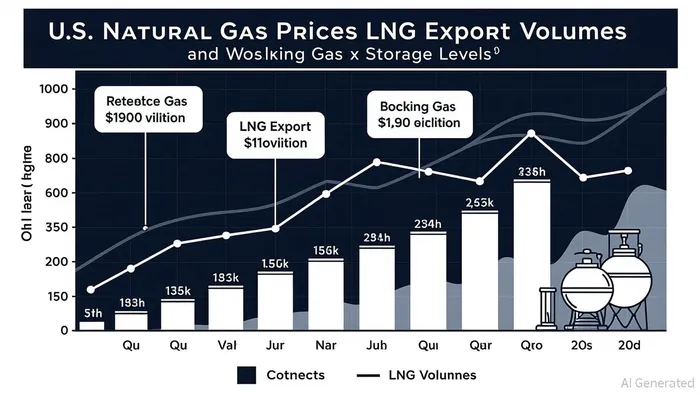
The natural gas market in 2025 has become a theater of volatility, shaped by the collision of weather anomalies, surging LNG export trends, and shifting storage fundamentals. For investors, this turbulence is not merely a risk but a potential opportunity. The confluence of these factors has created a landscape where strategic entry points emerge for those who can navigate the complexities of a globalized energy system.
Weather as a Catalyst for Price Swings
Weather patterns have proven to be a dominant force in 2025. A mild winter in the U.S. initially suppressed demand, while a February cold snap triggered short-term price spikes, underscoring the market’s sensitivity to seasonal shifts [3]. In China, warmer-than-expected February temperatures reduced heating demand, but March saw a rebound as peak-shaving efforts and tightened supply pushed prices upward [3]. These fluctuations highlight the inherent unpredictability of weather-driven demand, which remains a critical variable for investors.
Meanwhile, Europe’s storage levels, at 58.2% of capacity as of June 28, 2025, remain below historical averages, despite subdued demand [2]. This vulnerability is compounded by geopolitical uncertainties, such as the impending expiry of the Russia-Ukraine gas transit deal, which could disrupt flows and amplify price swings [4]. For investors, the lesson is clear: weather and geopolitical risks are not just background noise—they are central to pricing dynamics.
LNG Exports: A Double-Edged Sword
The U.S. has emerged as the linchpin of global LNG supply, accounting for 85% of incremental capacity in 2025 through projects like Plaquemines LNG and Corpus Christi Stage 3 [1]. With exports projected to reach 15.5 bcf/d, the U.S. has insulated itself from some of the volatility seen in Europe, where LNG imports surged by over 50% year-on-year in Q3 2025 [2]. However, this growth is not without challenges. Cheniere Energy’s maintenance schedules for new LNG trains in Q1 2025 temporarily constrained supply, illustrating how infrastructure bottlenecks can disrupt even the most bullish forecasts [2].
Canada’s LNG Canada Phase 1 project, launched in late June 2025, offers a compelling counterpoint. By enabling direct shipments to Asia, it reduces reliance on U.S. infrastructure and diversifies market access, potentially stabilizing prices in the long term [1]. For investors, the key is to differentiate between short-term hiccups and long-term structural shifts in LNG supply chains.
Storage Fundamentals: A Buffer or a Liability?
Storage levels have acted as both a stabilizer and a source of instability. In the U.S., working gas inventories remain in the top 20% of the five-year range, tempering near-term prices [1]. However, this surplus could quickly reverse if extreme weather events or industrial demand surges deplete reserves. Conversely, Europe’s lower storage fill rate—despite strong LNG imports—leaves the continent exposed to sudden supply shocks [2].
The disciplined capital spending by U.S. shale producers, who have held back production through drilled, uncompleted wells (DUCs) and deferred turn-in-lines (DTILs), has been a critical factor in normalizing storage levels [3]. This strategic restraint has pushed front-month gas prices from multi-year lows to over $4.00/MMBtu in January 2025 [3], demonstrating how production discipline can influence market fundamentals.
Strategic Entry Points for Investors
The current environment presents a paradox: while volatility is high, so too are the opportunities for those who can align with structural trends. The U.S. shale sector, with its robust production and disciplined capital allocation, offers a compelling case for long-term investment. Similarly, Canadian projects like LNG Canada Phase 1 provide exposure to diversified markets and infrastructure-driven growth.
For Europe, the focus must shift to hedging against supply risks through diversified LNG imports and accelerated renewable integration. The EU’s renewable additions have already offset some power-sector demand, but the continent’s reliance on LNG will remain a key determinant of price stability [4].
Conclusion
Natural gas markets in 2025 are a mosaic of risks and rewards. Weather anomalies, LNG export dynamics, and storage fundamentals are not isolated forces but interconnected variables that demand a nuanced investment approach. For those willing to navigate the volatility, the rewards could be substantial—provided they act with a clear understanding of the underlying structural shifts.
Source:
[1] TXOGA Quarterly Perspective – 2025 Q3 [https://www.txoga.org/2025-q3-perspective/]
[2] Executive summary – Gas Market Report, Q2-2025 [https://www.iea.org/reports/gas-market-report-q2-2025/executive-summary]
[3] Natural Gas Price Trend and Indexes Database 2025 [https://www.openpr.com/news/4037755/natural-gas-price-trend-and-indexes-database-2025-track]
[4] Natural Gas [https://www.iea.org/energy-system/fossil-fuels/natural-gas]





Comentarios
Aún no hay comentarios