
Midday Market Movements and Sector Rotation: Strategic Positioning in High-Momentum Stocks
The interplay between midday market movements and sector rotation in 2025 reveals a complex landscape where strategic positioning in high-momentum stocks can yield outsized returns-or expose vulnerabilities. OracleORCL--, FerrariRACE--, Delta, and Albemarle exemplify this dynamic, each navigating distinct sector trends while responding to macroeconomic forces. Their trajectories underscore the importance of aligning investment theses with both fundamental and technical signals.
Oracle: Cloud Dominance and Valuation Risks
Oracle's stock has surged 87% year-to-date, driven by a 45% year-over-year increase in annualized recurring revenue (ARR) to $14 billion and a 359% jump in Remaining Performance Obligations (RPOs) to $455 billion, according to a Fool.com analysis. This growth, fueled by cloud infrastructure expansion and embedded AI capabilities, has propelled the company to a $805.51 billion market capitalization. However, its forward P/E ratio of 55.67×-more than double its ten-year average-raises questions about sustainability. Analysts project cloud infrastructure revenue to reach $144 billion by 2029, but such optimism hinges on Oracle's ability to maintain execution momentum. Technically, the stock trades near its 52-week high of $253.07, with a 14-day RSI of 65 and a bullish MACD of 12.21, suggesting overbought conditions, per StockAnalysis statistics.
Ferrari: Luxury Resilience and Strategic Innovation
Ferrari's 2024 full-year net profit rose 21% to €1.526 billion, driven by a premium product mix and personalized offerings, as reported by CNBC. Its adjusted EBITDA of €2.555 billion reflects a 12.1% year-over-year increase, with 2025 revenue projections exceeding €7 billion. Technically, the stock's mixed signals-a 14-day RSI of 53.875 and a MACD of -0.020-contrast with its strong buy consensus from six indicators. Ferrari's strategic pivot to electric vehicles, with a planned launch in Q4 2025, positions it to counter broader luxury automotive sector headwinds. A €300 million share repurchase in early 2025 further signals confidence in capital allocation (CNBC coverage).
Delta: Premium Revenue and Cyclical Challenges
Delta Air Lines' Q3 2025 results highlight a 6% year-over-year revenue increase to $16.67 billion, driven by 9% growth in premium and corporate travel. Adjusted EPS of $1.71 exceeded expectations, with ancillary revenue surging 59%. However, the airline faces persistent challenges in its economy-class segment, where demand remains weak despite a 13% rise in loyalty travel awards. Delta's operating margin of 11.2% and $1.8 billion in operating cash flow underscore its resilience, but its reliance on premium pricing and sustainability initiatives-such as sustainable aviation fuels-will be critical in navigating sector rotation tied to business cycle dynamics, per a Morningstar analysis.
Albemarle: Energy Storage Volatility and Cost-Cutting Gambit
As detailed in a Nasdaq article, Albemarle's Q3 2024 performance was marred by a 41.4% revenue decline to $1.35 billion, driven by a 54.8% drop in Energy Storage segment sales. A net loss of $1.1 billion and a 52-week price decline of 0.8% reflect the sector's struggles amid low lithium prices. The company's cost-reduction strategy-targeting a 50% cut in 2025 capital expenditures and overhead reductions-aims to offset these pressures, according to Morningstar. Analysts remain cautious, with a $86.27 price target (12.7% below current levels) and a "Hold" consensus based on StockAnalysis data. Albemarle's intrinsic value of $225 per share suggests long-term potential, but near-term volatility, as indicated by its beta of 1.66, demands careful risk management.
Sector Rotation and Strategic Implications
The 2025 market environment reveals a shift toward technology and luxury sectors, with Oracle and Ferrari benefiting from innovation-driven demand. Conversely, airlines and energy storage face cyclical and commodity-linked challenges. Delta's premium-focused strategy aligns with industrial sector strength, while Albemarle's cost-cutting efforts mirror broader materials sector adjustments. Investors must weigh these dynamics against technical indicators and valuation metrics to identify mispricings.
Conclusion
Strategic positioning in high-momentum stocks requires a nuanced understanding of sector-specific drivers and macroeconomic context. Oracle's cloud ambitions and Ferrari's luxury resilience offer compelling growth narratives, while Delta's premium strategy and Albemarle's cost discipline highlight the importance of adaptability. As midday market movements reflect these trends, investors must balance optimism with caution, ensuring that valuation metrics and technical signals align with long-term strategic goals.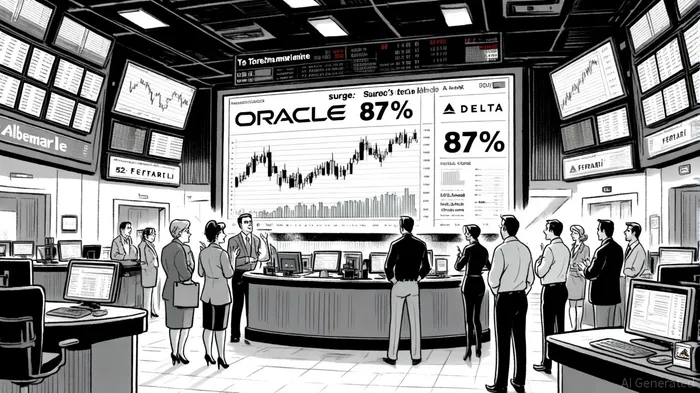





Comentarios
Aún no hay comentarios