
MEG Energy's Strategic Position Amid Cenovus's Sweetened Offer and Toronto Market Optimism
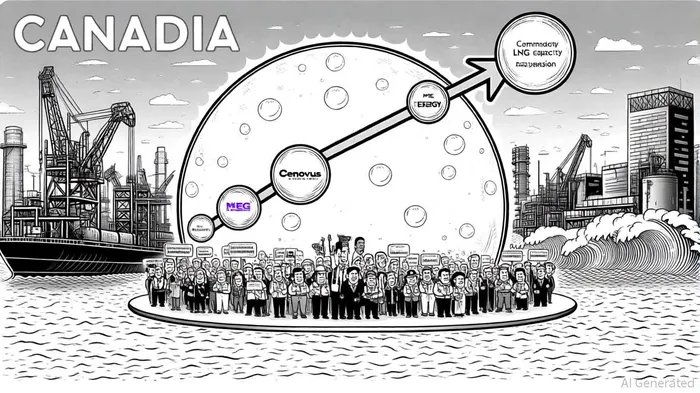
The Canadian energy sector is at a pivotal juncture, shaped by a confluence of strategic consolidation, commodity price dynamics, and divergent market sentiment. At the heart of this transformation lies MEG Energy's impending acquisition by Cenovus EnergyCVE--, a sweetened $8.6 billion offer that underscores the sector's evolving priorities. This deal, coupled with broader trends in the Toronto market, presents a compelling case for risk-rebalance opportunities in energy equities.
Strategic Rationale for Cenovus's Sweetened Offer
Cenovus's revised bid for MEG Energy-raising the valuation from $7.9 billion to $8.6 billion-reflects a strategic pivot toward securing high-quality oil sands assets and enhancing operational scale. The offer allows MEG shareholders to choose between $29.50 in cash or 1.240 Cenovus shares per MEG share, with a cap of 50% cash participation, according to MoneySense. This flexibility aims to maximize shareholder value while aligning with Cenovus's long-term growth objectives. The MEG board's endorsement highlights improved transaction economics and the potential for synergies in the combined entity's resource base and operational efficiency, according to MoneySense.
The deal's approval hinges on a shareholder vote on October 22, requiring a two-thirds majority. If successful, it will mark a significant step in the sector's consolidation phase, where larger players seek to optimize costs and scale amid regulatory and market headwinds. Historically, MEG Energy's shareholder meetings have shown mixed outcomes: while the stock has demonstrated mild outperformance (≈ +1.3% cumulative) in the first 15 days post-meeting, it has underperformed the benchmark by -6% to -6.3% after 26 days, with win rates declining from ~60% to ~31% over a 30-day window, per a historical analysis of MEG Energy shareholder meeting performance (2022–2025).
Sector Consolidation and Commodity Tailwinds
The Canadian energy sector is witnessing a surge in consolidation, driven by both strategic and regulatory imperatives. According to a FinancialContent article citing an ATB Capital Markets Fall 2025 survey, 88% of exploration and production (E&P) companies plan to increase production over the next 12 months, with gas-weighted producers targeting 6-7% growth. This optimism is fueled by the expansion of LNG export capacity, particularly with LNG Canada's Phase 1 nearing full operational capacity by mid-2026 and pending final investment decisions for Phase 2 and Ksi Lisims projects, according to the FinancialContent article.
However, institutional investors remain cautious. Only 38% expect WTI crude to average above $75 per barrel over a three-to-five-year horizon, while 45% anticipate Henry Hub gas prices to exceed $3.50 per thousand cubic feet, per the FinancialContent article. This divergence between producer optimism and investor skepticism creates a fertile ground for risk-rebalance opportunities. Energy equities, currently undervalued in the eyes of many investors, may offer attractive entry points if commodity price expectations align with production growth.
Toronto Market Sentiment and Resilience
Despite headwinds-including U.S. tariffs, a weakened Canadian dollar, and election-related uncertainty-Canadian energy stocks have demonstrated remarkable resilience. The XEG.to ETF reached 10-year highs in Q3 2025, according to Boereport. This performance was driven by strong downstream margins, record U.S. LNG exports, and AI-driven economic optimism. Energy Fuels Inc., for instance, surged 171.5% in the quarter, buoyed by rising uranium prices and U.S. policy shifts favoring domestic nuclear energy, as noted in MoneySense.
The sector's strength is further supported by its exposure to global demand trends. Refiners like Valero Energy and Marathon Petroleum capitalized on high export demand, while midstream and upstream players benefited from infrastructure bottlenecks and resource scarcity, as highlighted in the FinancialContent article. As the Fed's rate-cut cycle looms, investors are increasingly positioning for a rebound in energy demand, particularly in refining and LNG.
Risk-Rebalance Opportunities
The interplay of sector consolidation, commodity tailwinds, and market sentiment creates a unique window for risk-rebalancing in Canadian energy equities. For investors, the Cenovus-MEG deal exemplifies how strategic acquisitions can enhance scale and resilience in a fragmented sector. Gas-weighted E&Ps, such as Tourmaline Oil Corp. and ARC Resources Ltd., are well-positioned to capitalize on LNG-driven growth, while oil-weighted producers face infrastructure constraints that may limit their upside, according to the FinancialContent article.
Moreover, the divergence between producer optimism and investor caution suggests potential mispricing. If commodity prices stabilize or rise in line with production forecasts, energy equities could outperform broader markets. The key lies in identifying firms with robust balance sheets, exposure to high-growth segments (e.g., LNG, SMRs), and strong shareholder return policies. Historical data on MEG Energy's shareholder meetings also underscores the importance of timing: while short-term gains are possible, long-term underperformance after 26 days highlights the need for a disciplined, fundamentals-driven approach.
Conclusion
MEG Energy's strategic position, amplified by Cenovus's sweetened offer, encapsulates the broader dynamics reshaping the Canadian energy sector. As consolidation accelerates and commodity tailwinds materialize, investors must navigate the tension between producer optimism and investor caution. For those willing to rebalance risk, the sector offers a compelling mix of growth potential and resilience, particularly in firms aligned with LNG expansion and clean energy transitions. The coming months will test the sector's ability to deliver on its promises, but the current landscape suggests that the rewards for strategic positioning could outweigh the risks.





Comentarios
Aún no hay comentarios