
McKesson's (MCK) Outperformance Amid Market Volatility: Operational Resilience and Long-Term Growth Drivers in Healthcare Distribution
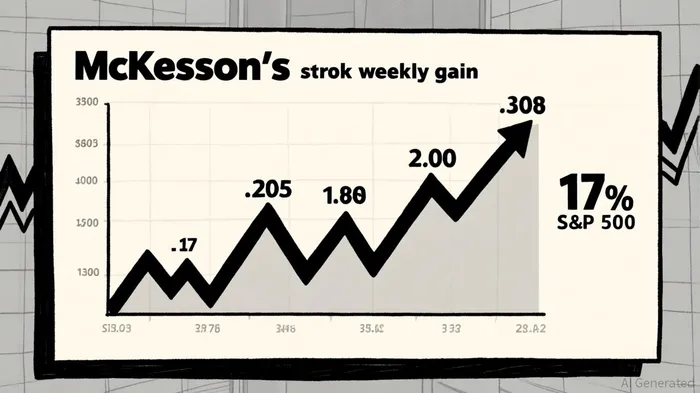
In an era of persistent market volatility, McKesson CorporationMCK-- (MCK) has emerged as a standout performer, with its shares rising 17% in the past week alone, outpacing the S&P 500 [2]. This resilience is not accidental but rooted in a strategic repositioning of the company's operations, supply chain innovations, and a clear focus on high-margin healthcare segments. As the healthcare distribution landscape evolves, McKesson's ability to adapt and innovate offers a compelling case for long-term investors.
Operational Resilience: The Foundation of Stability
McKesson's recent financial results underscore its operational strength. For Q3 2025, the company reported consolidated revenues of $95.3 billion, an 18% year-over-year increase, driven by robust growth in its U.S. Pharmaceutical segment [1]. This segment, which accounts for the bulk of McKesson's revenue, benefited from higher prescription volumes and the expansion of its oncology platform. Adjusted earnings per diluted share (EPS) rose by 4% to $8.03, reflecting disciplined cost management and a reduced share count [1].
The company's resilience is further bolstered by its strategic divestitures and acquisitions. The sale of its Canadian retail businesses (Rexall and Well.ca) in late 2024 allowed McKessonMCK-- to focus on core distribution and specialty services, while the acquisition of an 80% stake in PRISM Vision Holdings expanded its footprint in ophthalmology and retina management [1]. These moves align with a broader strategy to prioritize high-margin, high-growth areas such as oncology and biopharma services.
Strategic Restructuring: Focusing on High-Margin Segments
McKesson's reorganization into four reportable segments—North American Pharmaceutical, Oncology and Multispecialty, Prescription Technology Solutions, and Medical-Surgical Solutions—has enhanced transparency and operational efficiency [2]. The OncologyTOI-- and Multispecialty segment, in particular, has become a growth engine, leveraging integrated solutions for cancer care and specialty providers. This segment's revenue grew 19% in Q3 2025, driven by increased demand for specialty drugs and advanced care models [1].
The Prescription Technology Solutions segment also demonstrated strength, with a 14% revenue increase, fueled by third-party logistics and technology services [1]. Meanwhile, the Medical-Surgical Solutions segment, slated for a spin-off, faces short-term challenges, such as a 3% revenue decline in Q3 due to reduced vaccine demand. However, its long-term potential lies in streamlining supply chains for medical equipment and leveraging McKesson's extensive distribution network [2].
Supply Chain Resilience: A Competitive Edge
McKesson's supply chain strategies are a cornerstone of its competitive advantage. The company has invested heavily in AI-powered automation, aiming to achieve 99.95% order accuracy and reduce labor costs by 20% in 35 distribution centers [3]. These technologies are critical in managing the complexities of distributing biologics and specialty drugs, which require precise temperature controls and real-time tracking.
Moreover, McKesson's contingency planning for disruptions—such as natural disasters—has proven effective. The company maintains backup generators, satellite communication systems, and strategic inventory buffers to ensure uninterrupted supply flows [1]. Its Critical Care Drug Task Force, a cross-functional team of pharmacists and supply chain experts, proactively monitors and mitigates drug shortages, a persistent challenge in healthcare [3].
Long-Term Growth Drivers: Innovation and Diversification
Looking ahead, McKesson's strategic priorities are poised to drive sustained growth. The company has raised its fiscal 2025 adjusted EPS guidance to $32.55–$32.95, reflecting confidence in its operational trajectory [1]. Analysts project an 8.0% annualized revenue growth over the next three years, outpacing the broader healthcare industry's 6.7% forecast [2].
Key initiatives include expanding biopharma services, deploying AI across operations, and strengthening customer relationships through enhanced service delivery programs [2]. The acquisition of PRISM Vision Holdings exemplifies McKesson's commitment to diversifying into niche markets with strong growth potential. Additionally, the company's international segment saw a 6% revenue increase in Q3, driven by pharmaceutical distribution in Canada [1].
Challenges and Risks
Despite its strengths, McKesson faces headwinds. The Q3 free cash flow turned negative at $2.6 billion, attributed to timing shifts in cash flow and capital expenditures [3]. However, the company's cost optimization initiatives, targeting $100 million in savings, aim to address this. Regulatory scrutiny in healthcare distribution and potential supplier concentration risks also warrant caution.
Conclusion: A Model for Resilient Growth
McKesson's outperformance in volatile markets is a testament to its operational discipline, strategic agility, and innovation. By focusing on high-margin segments, enhancing supply chain resilience, and leveraging technology, the company is well-positioned to navigate macroeconomic uncertainties. For investors, McKesson represents a rare combination of defensive qualities and growth potential—a rare but valuable asset in today's turbulent market.





Comentarios
Aún no hay comentarios