
Market Resilience in Turbulent Times: The Interplay of Policy, Earnings, and Investor Psychology
Monetary Policy: A Double-Edged Sword
Central banks have played a pivotal role in shaping market outcomes. The Federal Reserve's pivot from restrictive to accommodative policy in late 2023, as outlined in its December 2023 FOMC statement, directly reduced the drag of high interest rates on equity valuations, according to an ECB analysis. By lowering borrowing costs, the Fed not only supported corporate balance sheets but also compressed equity risk premia to multi-year lows, particularly in the technology sector. This compression reflects a shift in investor risk appetite, where the perceived safety of high-growth tech stocks outweighed macroeconomic uncertainties.
However, monetary policy's influence is not uniform. In 2025, U.S. tariff policies introduced sectoral asymmetries. For example, the automotive industry faced a $35 billion cost burden from tariffs, according to a Reuters report, while tech firms like the "Magnificent Seven" (Alphabet, Amazon, Apple, etc.) continued to outperform, with their stock prices rising 75% in 2023 and 45% in 2024, a divergence noted in ECB commentary. This divergence highlights how monetary easing can selectively bolster sectors insulated from trade-related headwinds, amplifying earnings momentum in innovation-driven industries.
Earnings Momentum: The Tech Sector's Engine
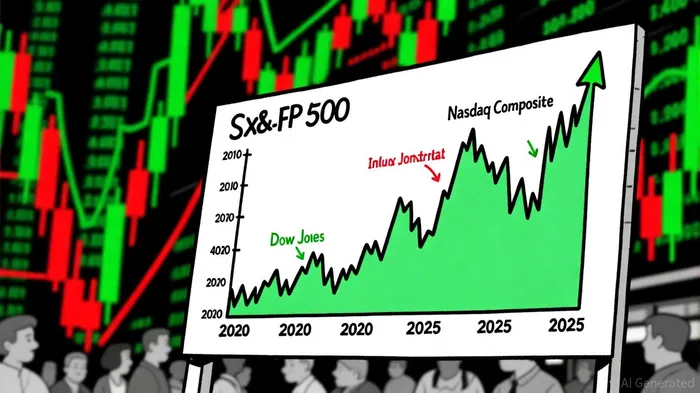
Earnings momentum has been a cornerstone of market resilience, particularly in the technology sector. Analysts project double-digit S&P 500 earnings growth for 2025 and 2026, a trend highlighted in ECB analysis, fueled by AI-driven productivity gains and structural shifts in corporate spending. The "Magnificent Seven" exemplify this trend, with their valuations increasingly decoupled from traditional metrics like interest rates. For instance, despite rising borrowing costs in 2024, these firms maintained historically low equity risk premia, reflecting investor confidence in their long-term growth prospects as described in the ECB commentary.
Yet, this momentum is not without fragility. The automotive sector's struggles under 2025 tariffs-such as Ford's $1 billion tariff-related headwinds-demonstrate how external shocks can disrupt earnings trajectories, according to a Seeking Alpha report. Here, the interplay between monetary policy and sector-specific dynamics becomes critical. While the Fed's rate cuts in late 2025 provided some relief to consumer spending, automakers faced compounding challenges from supply chain disruptions and regulatory shifts.
Investor Psychology: Risk-On Sentiment and Behavioral Biases
Investor psychology has amplified market resilience through self-reinforcing feedback loops. During crises, such as the 2020 pandemic or the 2025 tariff announcements, retail investor behavior often diverges from institutional rationality. For example, Google search volume (GSV) for "coronavirus" in early 2020 spiked sharply, correlating with panic selling and a 30% market drop, according to an Investing.com report. Conversely, in 2025, the same behavioral patterns led to rapid repricing of tariffs' impacts, with the S&P 500 falling 11% in two days following the April 2025 tariff announcement, as documented in a San Francisco Fed analysis.
However, risk-on sentiment has also been shaped by central bank interventions. The Fed's 2023 policy pivot and subsequent 25-basis-point rate cuts in Q3 2025 restored confidence in risk assets, particularly in sectors like financials and industrials, a dynamic referenced in the MCB transcript. This underscores a key insight: investor psychology is not purely exogenous but is molded by policy signals. When central banks act decisively, they can recalibrate risk premiums and stabilize sentiment, even amid negative news.
Structural Resilience: Policy and Sectoral Adaptation
Emerging economies offer instructive examples of structural resilience. Countries that adopted micro- and macro-prudential reforms-such as maintaining flexible exchange rates and accumulating foreign reserves-recovered more robustly from shocks, according to a ScienceDirect study. For instance, China's People's Bank of China (PBOC) emphasized "scientific and prudent" monetary policy to stabilize its currency and support growth amid U.S. tariff pressures, as Investing.com reported. Similarly, Japan's Bank of Japan (BOJ) maintained an accommodative stance despite global uncertainties, as noted in an NHK report.
These strategies highlight how structural reforms and policy flexibility can insulate markets from external shocks. In contrast, rigid policy frameworks-such as the Bank of Italy's struggle with a red balance sheet in 2024-exacerbate vulnerabilities, according to a First Online report. The lesson is clear: resilience is not innate but engineered through proactive governance.
Conclusion: A Fragile Equilibrium
The interplay of monetary policy, earnings momentum, and investor psychology has created a fragile equilibrium in today's markets. While the Fed's interventions and tech sector dominance have bolstered resilience, vulnerabilities persist. Tariff-driven distortions, sectoral imbalances, and behavioral biases all threaten to disrupt this balance. For investors, the key lies in distinguishing between structural resilience and transient optimism. As the 2025 case studies demonstrate, markets can rebound-but only if the underlying drivers remain intact.






Comentarios
Aún no hay comentarios