
Market Implications of Political Interference in Fed Policy: A Case for Defensive Rebalancing
The escalating tension between President Donald Trump and Federal Reserve Chair Jerome Powell has thrust the fragility of central bank independence into sharp relief. Rumors of Trump's potential dismissal of Powell—rooted in disputes over interest rate policy and a controversial $2.5 billion Fed headquarters renovation—have exposed systemic risks to financial stability. 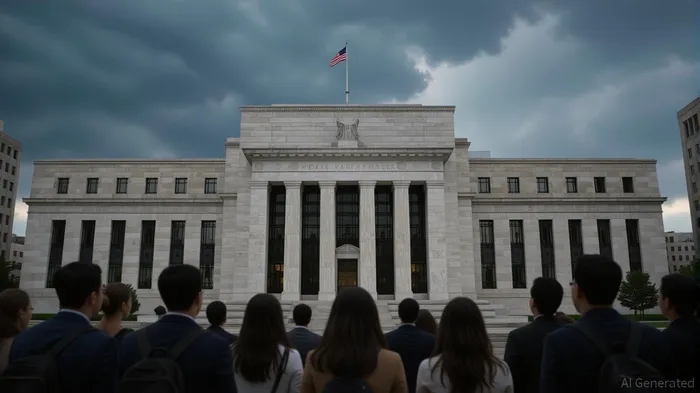 As markets grapple with the erosion of the Fed's autonomy, investors must prepare for volatility across asset classes and sector divergence.
Central Bank Independence Under Siege
The Fed's quasi-independent status, enshrined by decades of legal precedent, faces unprecedented political pressure. Should Trump succeed in ousting Powell—a move courts might challenge—markets could interpret it as a rupture in the Fed's mandate to prioritize economic stability over political whims. Historical parallels, such as Nixon's 1970s manipulation of the Fed and Turkey's 2018 inflation crisis under central bank interference, warn of dire consequences. . Current pricing reflects little concern, but this complacency may prove misplaced. A Supreme Court ruling in May 2025 reaffirmed the Fed's legal independence, yet public rhetoric and bureaucratic tactics—like the National Capital Planning Commission's politicized objections to the Fed's renovation—signal a coordinated assault on institutional norms.
Policy Uncertainty and Asset Class Risks
The immediate fallout of a Powell dismissal could trigger a “financial fire drill.” Deutsche BankDB-- analysts warn that such an event would likely collapse the U.S. dollar, with the trade-weighted index plunging 3-4%, and bond markets enduring a sell-off reminiscent of the 2013 “taper tantrum.” . Equity markets, meanwhile, would face sector bifurcation:
- Financials: Could benefit from short-term volatility and higher interest rate expectations if markets price in a Fed chair more amenable to Trump's demands.
- Consumer Staples: Remain vulnerable to tariff-driven inflation, with staples giants like Procter & Gamble (PG) and Coca-ColaKO-- (KO) under pressure as prices rise.
Hedging Strategies for a Volatile Landscape
Investors must act preemptively to mitigate downside risks while preserving upside potential:
1. Short-Term Treasury Puts: Use inverse Treasury ETFs (e.g., TLT) to profit from rising yields amid Fed credibility erosion.
2. Reduce Rate-Sensitive Sectors: Rotate out of real estate (XLK), utilities (XLU), and high-yield bonds (JNK), which are sensitive to inflation and policy uncertainty.
3. Overweight Defensive Equities: Focus on consumer staples (XLP), healthcare (XLV), and dividend-paying industrials (XLI), which offer stability in turbulent macro environments.
Historical Precedents and Immediate Action
The 1970s provide a cautionary tale: Nixon's pressure on Arthur Burns to keep rates low fueled stagflation, with inflation spiking to 13%. Today, the risks are amplified by record U.S. debt and global financial linkages. With the Fed's credibility now a political football, investors must rebalance portfolios to prioritize safety.
. History suggests that defensive positioning now could shield portfolios from the asymmetric risks of politicized monetary policy.
In conclusion, the erosion of Fed independence is not just a legal battle but a systemic threat to market stability. Investors should treat this as an underpriced tail risk and act swiftly to rebalance toward defensive assets. The stakes could not be higher: the Fed's autonomy is the bedrock of global financial order.







Comentarios
Aún no hay comentarios