
MARA Holdings: A Masterclass in Capital Efficiency and Scalability in Bitcoin Mining
The BitcoinBTC-- mining sector, long criticized for its energy intensity and capital demands, has emerged as a fertile ground for innovation. Among its most compelling stories is that of MARA HoldingsMARA--, a company that has redefined the economics of digital assetDAAQ-- production. By combining operational discipline with strategic foresight, MARAMARA-- has achieved a rare trifecta: explosive revenue growth, cost compression, and scalable infrastructure. This analysis explores how the firm's twin pillars—capital efficiency and operational scalability—position it as a leader in a sector poised for transformation.
Capital Efficiency: Mining at the Margins
MARA's Q2 2025 financials reveal a company operating at peak efficiency. Revenues surged 64% to $238.5 million, while net income skyrocketed 505% to $808.2 million, driven by a 1,093% increase in Adjusted EBITDA to $1.2 billion [1]. These figures are not merely the result of Bitcoin's price action but reflect disciplined cost management. The company's energy cost per BTC mined at owned sites fell to $33,735, with a per-kWh cost of just $0.04—a 24% improvement year-over-year [1]. Such metrics underscore MARA's ability to extract value from its infrastructure, a critical advantage in an industry where energy costs often dictate margins.
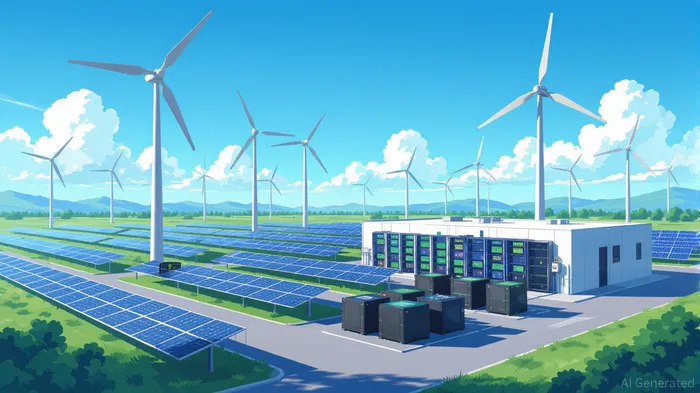
This efficiency stems from a strategic shift to owning 70% of its mining sites, reducing reliance on third-party operators and enabling tighter control over energy procurement [2]. By integrating renewable energy sources—such as its Texas wind farm—MARA not only lowers costs but also mitigates exposure to volatile grid prices. As stated in its shareholder letter, the firm's immersion cooling technology and proprietary energy management systems further amplify these gains, reducing hardware degradation and extending the lifespan of mining equipment [3].
Operational Scalability: The Twin-Turbo Model
Scalability in Bitcoin mining is not merely about adding more rigs; it requires harmonizing infrastructure, energy, and market dynamics. MARA's “twin-turbo” strategy—combining mining with strategic Bitcoin purchases—exemplifies this approach. In Q2 2025, the company mined 2,358 BTC while increasing its total holdings by 170% to 49,951 BTC [1]. This dual approach allows MARA to capitalize on arbitrage opportunities: when market prices exceed its marginal production cost, it mines; when prices dip, it buys. Such flexibility is rare in the sector and provides a buffer against price volatility.
Operational scalability is further evidenced by MARA's hashrate expansion. Its energized hashrate grew 82% year-over-year to 57.4 EH/s, with a new Texas data center nearing completion [2]. This growth is not speculative but underpinned by a 1.7 gigawatt nameplate capacity across 15 data centers spanning four continents [1]. By strategically locating operations near renewable energy sources, MARA addresses two challenges at once: reducing grid congestion and solving the intermittency problem of renewables. As noted in its blog, Bitcoin mining acts as a “demand response” mechanism, consuming excess energy that would otherwise be curtailed [3].
Strategic Investments: Beyond Bitcoin
MARA's ambitions extend beyond mining. Its acquisition of a 64% stake in Exaion, a subsidiary of EDF, and a significant investment in TwoPrime, a digital asset manager, signal a pivot toward AI infrastructure and European markets [2][4]. These moves are not diversions but logical extensions of its core competencies. Exaion's expertise in energy infrastructure complements MARA's renewable focus, while TwoPrime offers a pathway to monetize Bitcoin holdings through institutional-grade services. Such strategic layering—mining, energy, and financial services—creates a flywheel effect, where each component amplifies the others.
Risks and Realities
No analysis is complete without acknowledging risks. MARA's rapid expansion depends on stable energy prices and regulatory clarity, both of which are volatile. Additionally, its Bitcoin holdings, while a source of strength, expose it to price swings. However, the company's cost structure—already among the lowest in the sector—provides a margin of safety. At $33,735 per BTC, its breakeven is significantly below current prices, offering downside protection [1].
Conclusion: A Model for the Future
MARA Holdings has transcended the traditional role of a Bitcoin miner. It is now a digital energy company, leveraging Bitcoin as both a product and a tool for optimizing renewable infrastructure. Its capital efficiency—evidenced by compressed costs and surging margins—and its operational scalability, driven by a twin-turbo model and global infrastructure, position it as a bellwether for the sector. As the industry matures, MARA's ability to balance technological innovation with financial prudence will likely determine its long-term dominance.





Comentarios
Aún no hay comentarios